
Impairment related work expenses let you subtract what you spend out of pocket, because of your disability, to be able to work from the earnings the Social Security Administration counts against you. The Social Security Administration deducts allowable IRWEs when it figures Substantial Gainful Activity for SSDI and countable income for SSI. To qualify, you must pay the cost yourself, without reimbursement, and be ready to prove it.
TL;DR:
- Impairment-related work expenses must be paid out of pocket and directly linked to your ability to work, covering items such as assistive technology, service animals, and transportation.
- Expenses reimbursed by insurance, employers, or covering routine living costs, like rent or groceries, are never deductible for SSA calculations.
- Proper documentation includes receipts, provider letters, and evidence linking expenses to your work, with detailed records improving approval chances.
- Only costs incurred after November 30, 1980, and certain large or proration-appropriate purchases qualify under SSA timing and reasonable cost rules.
- A specialized disability attorney can improve chances of approval or successful appeal by ensuring documentation aligns with SSA standards and highlighting complex deduction rules.
Table of Contents
- What Counts as an IRWE: Clear Examples and Quick Rules
- How IRWEs Change SSDI (SGA) and SSI Calculations
- Timing, Allocation, and Reasonable Limits Under the SSA Rules
- Documentation: The Proof SSA Actually Accepts
- Reporting IRWEs to SSA and Knowing When to Get Help
- A Worked Example and a Checklist You Can Reuse Every Month
- What SSA Reviewers Actually Flag, and Where Legal Help Changes the Outcome
- Getting Help Documenting IRWEs and Appealing Denials
- Sources
What Counts as an IRWE: Clear Examples and Quick Rules
The Social Security Administration draws a fairly generous line around what qualifies, as long as the expense connects directly to your ability to work and your impairment. The Choose Work fact sheet on impairment-related work expenses lists categories that come up again and again in real claims:
- Medical devices and durable equipment: wheelchairs, hearing aids, braces, or a specialized keyboard.
- Assistive technology and job-specific software, including screen readers or speech-to-text programs.
- Service animals, including food and veterinary costs tied to the animal's work function.
- Attendant care that helps you get ready for work or navigate the workplace itself.
- Transportation, when your impairment makes standard public transit unusable.
What usually gets rejected is just as important to know. General living costs, such as rent or regular groceries, never qualify. Anything reimbursed by insurance, Medicaid, or an employer is off the table, and equipment your employer already supplies is not yours to deduct. The base cost of a personal vehicle also doesn't count, though modifications made for your impairment often do.
One rule surprises a lot of claimants: an item doesn't have to stay at the office to qualify. A wheelchair you use at home and at work still counts as an IRWE, as the SSA Red Book confirms, as long as you can show it's necessary for your job duties.
How IRWEs Change SSDI (SGA) and SSI Calculations
SSA runs your earnings through a specific sequence before it decides what actually counts against you. For SSI, it starts with a $20 general income exclusion, then a $65 earned income exclusion, then your IRWE deduction, and only then does it count half of what remains.
The Red Book's own example makes this concrete: gross earnings of $1,025, minus the $20 general exclusion, minus $65 work exclusion, minus a $250 IRWE, leaves $690. Half of that, $345, becomes the countable income SSA actually uses to set your SSI payment.
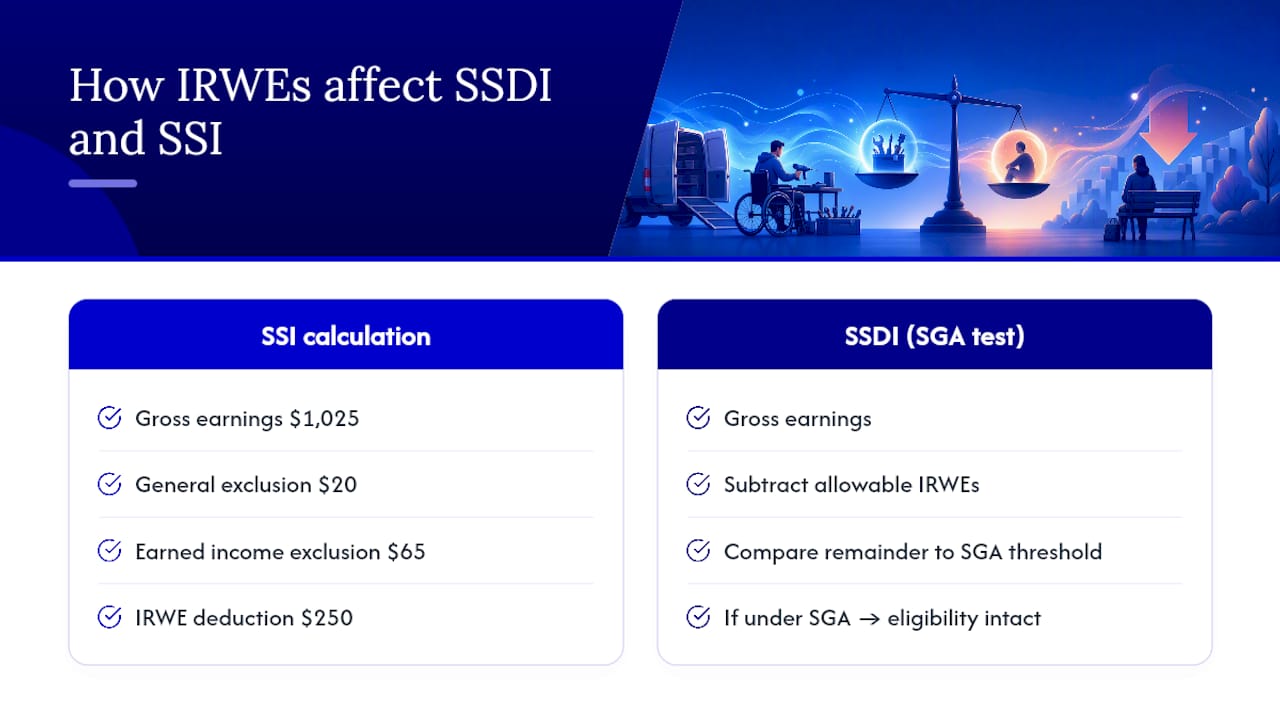
For SSDI, the math works differently but the effect is similar. SSA subtracts your allowable IRWEs from your gross earnings before comparing what's left against the Substantial Gainful Activity threshold. If your unadjusted earnings sit above the SGA limit but your IRWE deductions pull you back under it, you can keep your SSDI eligibility intact. Understanding where the current SGA figure stands, and how the two-test eligibility structure works, matters just as much as knowing your deductions, because a well-documented IRWE claim is often the difference between staying on benefits and getting flagged for termination.
Timing, Allocation, and Reasonable Limits Under the SSA Rules
POMS DI 10520.030 and 20 C.F.R. §404.1576 lay out timing rules that trip up a lot of first-time claimants. A few principles carry the most weight:
- Only payments made after November 30, 1980, are eligible for the deduction in the first place.
- Services, like attendant care or counseling, are deductible in the month you actually receive them while working.
- A one-time durable item purchased up to 11 months before you started work may still qualify if it was necessary to prepare you for that job.
- You can prorate a large one-time purchase over 12 months, or deduct the full amount in a single month, depending on which pattern better reflects your work and income situation.
- SSA judges "reasonable" cost against Medicare Part B prevailing charges where those exist, or against your local community's standard pricing when they don't.
If what you paid runs above the Medicare rate, SSA may still allow the full amount, but only if you document why the higher charge was justified in your area. Skipping that step is one of the fastest ways a legitimate expense gets trimmed down or denied.
Documentation: The Proof SSA Actually Accepts
Approval hinges on paperwork, not good intentions. The Red Book specifies that payment must be in cash, check, or credit card, never an in-kind trade, and that SSA wants to see:
- Original receipts or paid invoices showing the date, amount, and item or service.
- Cancelled checks or credit card statements matching those receipts.
- Signed statements from you when a receipt alone doesn't explain the work connection.
- Provider letters confirming medical necessity, especially for attendant care or specialized equipment.
Transportation claims need extra support. A statement from a physician or vocational counselor explaining why public transit isn't usable, paired with mileage logs, carries far more weight than a mileage estimate alone. Vehicle modifications and service animal costs benefit from itemized shop invoices and veterinary records that separate work-related care from routine costs.
Pro Tip: Keep a simple monthly ledger, one line per expense, scanned and filed by month in a labeled folder. Reviewers move faster on claims where every dollar has a receipt attached to it, and you'll want at least a few years of records on hand if SSA ever revisits your case.
Reporting IRWEs to SSA and Knowing When to Get Help
- Report your IRWEs at the same time you report any work activity, either through your local SSA office or your assigned representative.
- Submit copies, never originals, of every receipt and provider letter, and keep your own duplicate set.
- If SSA denies or reduces a deduction, you have the right to appeal, and the clock on that deadline starts the day you receive the denial notice.
- When a denial involves a complex allocation decision, like prorating a wheelchair purchase across a full year, or when an appeal is already underway, a disability attorney experienced with overpayment and appeal disputes can help build the evidentiary record SSA actually expects to see.
A Worked Example and a Checklist You Can Reuse Every Month
Picture a claimant earning $1,200 gross in a month, with $300 in documented IRWEs for attendant care and transportation. Start with the $1,025 baseline math from the Red Book's own example: after the $20 general exclusion and $65 work exclusion, you're at $940. Subtract the $300 IRWE and you land at $640. Half of that, $320, is what SSI counts against the payment. That $300 deduction alone cut the countable figure by $150.
Run every expense through this checklist before you file:
| Field | What to record |
|---|---|
| Expense name | Item or service description |
| Date paid | Exact payment date |
| Amount | Dollar figure paid out of pocket |
| Proof type | Receipt, cancelled check, provider letter |
| Medical verification | Physician or counselor statement, if applicable |
| Reimbursed status | Confirm no insurance or employer coverage |
For a single large purchase, weigh proration against a one-month deduction. Proration smooths the benefit effect across a year; a single-month deduction produces a sharper, immediate drop in countable earnings, which sometimes matters more if you're right at the SGA line that month.
What SSA Reviewers Actually Flag, and Where Legal Help Changes the Outcome
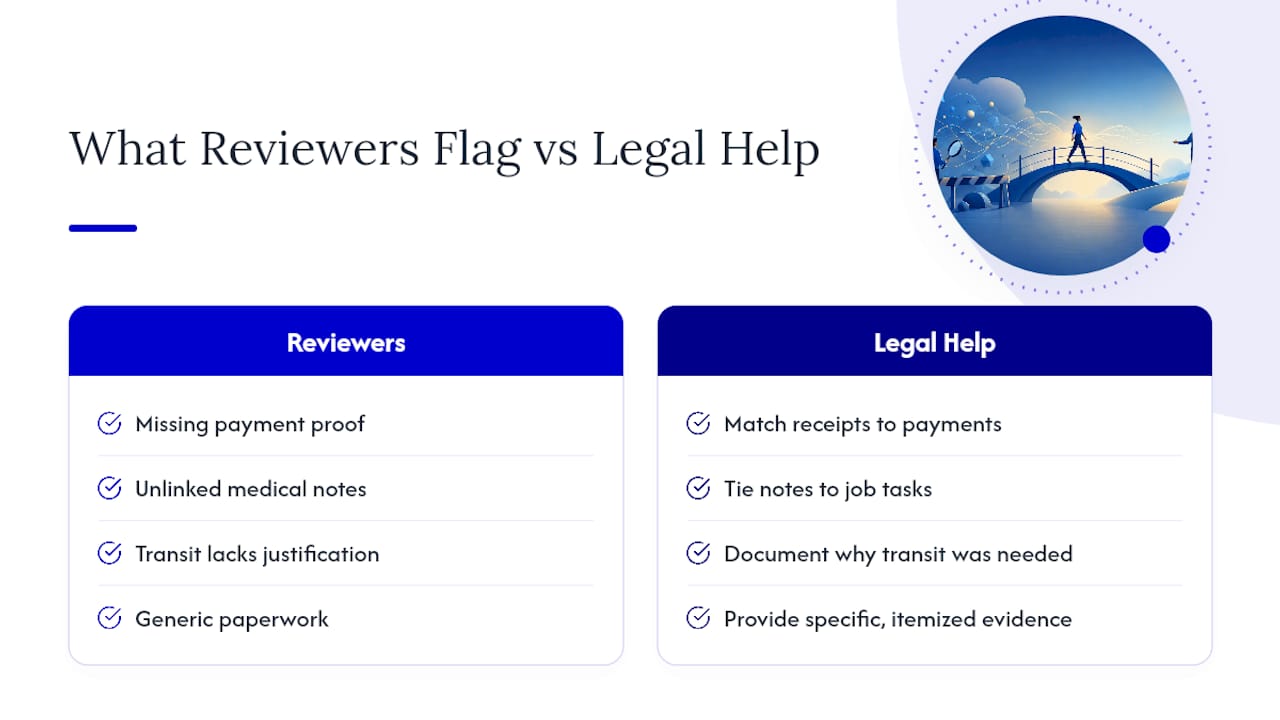
The pattern behind most denials isn't complicated: missing proof of payment, vague medical notes that don't tie the expense to a job task, and transportation claims with no documentation showing why public transit wasn't an option. Reviewers are not being difficult. They're following a standard that rewards specificity and punishes generic paperwork.
Where legal counsel earns its value is in the details claimants tend to overlook: matching each receipt to a medical justification, choosing proration versus single-month deduction with the actual benefit math run both ways, and representing you if a denial turns into an appeal. If your case is heading toward a hearing, resources like the SSA work history report guide fill in the documentation side; an attorney fills in the argument. If your dispute stems from an employer refusing accommodations in the first place, a firm focused on workplace disability discrimination may be the more relevant contact before SSA even enters the picture.
— Gerard
Getting Help Documenting IRWEs and Appealing Denials
Building an IRWE claim that survives SSA review takes more than a folder of receipts. It takes someone who knows exactly which documents a reviewer weighs heaviest and how to frame a proration decision so it holds up. You can connect with disability attorneys who handle this kind of evidence work daily, rather than interpreting POMS language on your own.
A short intake conversation is usually enough for an attorney to flag weak spots in your documentation before SSA ever sees them, whether that means a missing medical verification letter or a transportation claim that needs a stronger record. If you're facing a denial, an upcoming appeal, or a complicated allocation decision on a big-ticket item, start that conversation now at SSDILawyer and get a case reviewed before your next reporting deadline.
This article is general information, not a substitute for advice from a qualified financial advisor. Consult a qualified financial professional about your own circumstances before acting on anything here.
Sources
- Fact sheet - Impairment-Related Work Expenses (Choose Work / SSA)
- SSDI and SSI employment supports (SSA Red Book)
- POMS: DI 10520.030 - Determining when IRWE are deductible and how they are distributed