
Yes. If you receive SSDI, the Trial Work Period lets you test working while keeping your full disability check, no reduction, no early termination, for up to nine service months. In 2026, a service month is triggered when you earn at least the monthly earnings threshold or log more than 80 hours in self-employment. This rule applies only to Social Security Disability Insurance, not Supplemental Security Income, which has its own, separate work rules.
Here's the short version before the details:
- You get a defined number of TWP months, and they do not need to be back to back.
- Any month over the $1,210 threshold (or 80+ self-employment hours) counts, even a single high-earning month.
- Full SSDI payments continue during all nine months, regardless of how much you actually earn.
TWP trigger: monthly gross earnings exceeding the stated threshold or 80+ hours of self-employment work. The rest of this guide walks through how months are counted, what happens once you use all nine, and how to report your work to Social Security without creating problems for yourself later.
Key Takeaways
The Trial Work Period lets SSDI recipients earn without limit for nine nonconsecutive service months, but the real financial risk begins afterward, during the 36-month Extended Period of Eligibility.
| Point | Details |
|---|---|
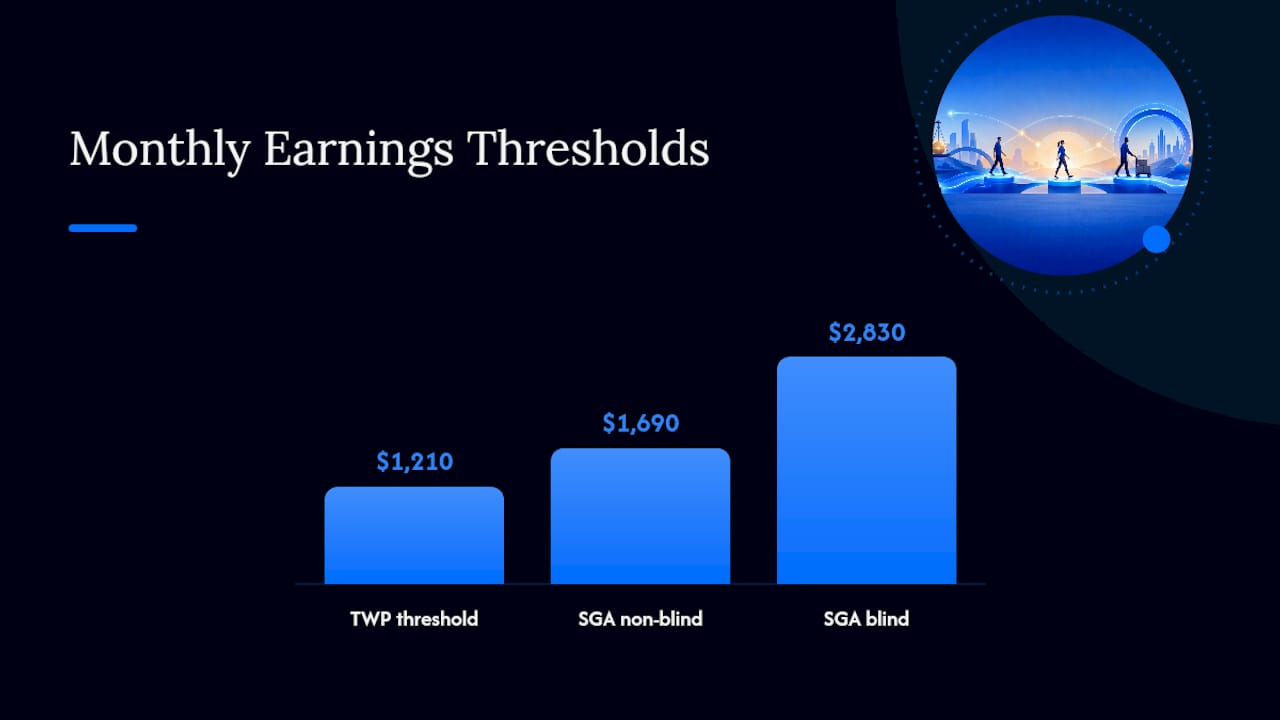
| 2026 TWP trigger | $1,210 in gross monthly earnings, or 80+ hours of self-employment work, counts as one service month. |
| Nine months, no rush | TWP months don't need to be consecutive and are tracked within a multi-year rolling window. |
| SGA takes over after TWP | Once TWP ends, benefits depend on staying below $1,690/month (non-blind) or $2,830 (blind) in 2026. |
| Medicare keeps going | Part A coverage continues for at least 93 months after TWP, even if cash benefits stop. |
| Reinstatement without reapplying | Expedited Reinstatement lets you restart benefits within five years if your condition worsens. |
This article is general information, not a substitute for advice from a qualified financial advisor. Consult a qualified financial professional about your own circumstances before acting on anything here.
Table of Contents
- How the SSDI Trial Work Period Works
- What Counts as a TWP Month vs. a Month of Substantial Gainful Activity
- What Happens After Your Nine TWP Months Are Used Up
- Tracking Your TWP Months and Reporting Work to SSA
- Work Incentives That Pair Well With the Trial Work Period
- When a Disability Attorney Should Get Involved
- Why the Trial Work Period Gets Misunderstood More Than It Should
- Sources
How the SSDI Trial Work Period Works
The clock starts the month you become entitled to SSDI benefits or the month you file your claim, whichever comes later. It does not start the moment you get a job. Someone approved for benefits in January 2026 who does not start working until August has not burned any TWP time in the meantime.
The service months are cumulative, not consecutive, tracked within a multi-year rolling window, so scattered months of higher earnings still add up despite gaps. Only one Trial Work Period is permitted per period of disability entitlement, a rule spelled out in Code of Federal Regulations § 404.1592. Once you've used your nine months for a given claim, you don't get a fresh set unless you go through a new period of entitlement entirely.
Here's a simplified example of how nonconsecutive counting plays out:
- March 2026: You earn $1,400 at a part-time job. That's TWP month one.
- April through July: You're laid off and earn nothing. No TWP months used.
- August 2026: You return to work and earn $1,600. That's TWP month two.
Two months down, seven to go, even though five months separate them.
Pro Tip: Keep a personal log of every month you earn over the threshold, separate from employer reports, as discrepancies can occur in monthly counting.

What Counts as a TWP Month vs. a Month of Substantial Gainful Activity
The Trial Work Period and Substantial Gainful Activity (SGA) are two different earnings tests, and confusing them is one of the most common mistakes SSDI recipients make. TWP measures whether a month counts toward your nine-month allowance. SGA measures whether you're earning too much to receive benefits after your TWP is finished.
| Test | 2026 Threshold | When It Applies |
|---|---|---|
| Trial Work Period | monthly gross earnings above the earnings threshold or sufficient self-employment hours | During your nine TWP months, SSDI only |
| SGA, non-blind | $1,690/month | After TWP ends, during the Extended Period of Eligibility |
| SGA, blind | $2,830/month | After TWP ends, for legally blind beneficiaries |
For self-employed beneficiaries, SSA counts hours worked in the business, not just net profit, so surpassing 80 hours in a month triggers a service month even if the business barely turned a profit. Gross earnings, not take-home pay, are what SSA uses for the wage-based trigger.
One frequent misconception: impairment-related work expenses (IRWEs), things like specialized transportation or adaptive equipment you pay for out of pocket to work, cannot be subtracted from your earnings to dodge a TWP month. They matter later, when SSA calculates SGA during the Extended Period of Eligibility, but not during the TWP itself. SSA reviews the $1,210 figure periodically and adjusts it for wage growth, a process explained on the Choose Work TWP fact sheet.
What Happens After Your Nine TWP Months Are Used Up
Once you've used all nine service months, you don't lose benefits automatically. You enter a 36-month Extended Period of Eligibility (EPE), during which SSA pays benefits only for months your earnings fall below the SGA threshold.
- The first month your earnings exceed SGA during the EPE is your "cessation month." You still get paid for that month plus the following two months, a built-in grace period.
- After the grace period, benefits are suspended (not terminated) for any month you're over SGA, and they resume automatically for any month you drop below it, no new application required.
- Medicare Part A coverage continues for at least 93 months after your TWP ends, even if your cash benefits stop, though you're still responsible for Part B premiums, per SSA's Working While Disabled publication.
- If your condition worsens and you stop working within five years of your benefits terminating, Expedited Reinstatement lets you restart benefits without filing a brand-new disability claim.
The Red Book calls the EPE a "re-entitlement" period for a reason. It's built so a bad month, or a bad year, doesn't force you to reapply from scratch. That structural safety net is arguably more valuable to most beneficiaries than the TWP itself, yet it gets far less attention.
Tracking Your TWP Months and Reporting Work to SSA
You can check how many TWP months you've used by logging into your my Social Security account or by calling SSA directly. Verifying your count matters because SSA's records occasionally lag behind actual pay periods, especially for self-employed beneficiaries.
- Save every pay stub, employer earnings statement, and, if self-employed, time logs showing hours worked and income received.
- Report new work activity to SSA as soon as you start, rather than waiting for a scheduled review. Late reporting is one of the leading causes of overpayment notices.
- Cross-check your own monthly earnings against the $1,210 threshold before assuming a month does or doesn't count.
- Contact SSA immediately if your TWP count looks wrong, and consider legal help if a correction request stalls or gets denied.
Pro Tip: Self-employed beneficiaries should track hours weekly, not just monthly totals. SSA's 80-hour rule is easy to misjudge in a fluctuating schedule, and a week you forgot to log can be the difference between staying under the threshold and triggering a service month.
Work Incentives That Pair Well With the Trial Work Period
Ticket to Work connects SSDI beneficiaries with free employment support, including career counseling, job placement, and skills training, and enrollment through an approved Employment Network can run alongside your TWP months without affecting your count.
- Vocational rehabilitation agencies, often state-run, offer trial job placements and coaching for beneficiaries easing back into work.
- IRWEs can lower your countable earnings once you're in the EPE and being measured against SGA, even though they don't help during the TWP itself.
- A benefits calculator can help you project how earnings changes affect your overall income picture while you're testing work.
- Combine Ticket to Work services with careful earnings tracking so support and reporting stay in sync from day one.
When a Disability Attorney Should Get Involved
Most routine reporting is a phone call or a my Social Security login, not a legal matter. But certain situations call for outside help:
- SSA's TWP month count doesn't match your own records and a correction request goes nowhere.
- You receive a formal termination notice after returning to work and believe it was calculated incorrectly.
- You've gotten an overpayment notice tied to work activity during the TWP or EPE.
- Your self-employment income is complex enough that SSA is questioning your reported hours or earnings.
In these cases, an attorney can review your SSA earnings record, file corrections, request Expedited Reinstatement, or handle an appeal on your behalf. Ssdilawyer connects beneficiaries with attorneys experienced in exactly these disputes. For general questions on how attorney track records get evaluated, see this guide on vetting disability attorneys.
Why the Trial Work Period Gets Misunderstood More Than It Should
Most explainers treat the TWP as a simple countdown: nine months, then you're done. That framing undersells how forgiving the rule actually is. Nonconsecutive counting means a beneficiary can test a job, fail, try again eight months later, and still have plenty of TWP months left. The real risk isn't the TWP itself, it's what comes after, when the SGA threshold starts governing whether a check arrives at all.
Conventional advice tends to fixate on the $1,210 trigger and skip the Extended Period of Eligibility almost entirely. That's backwards. The EPE is where most disputes and overpayment notices actually happen, because beneficiaries assume benefits stop the instant they cross SGA, when in reality a three-month grace period and automatic reinstatement rules are built in.
If you take one thing from this guide, let it be this: track your earnings monthly, in writing, starting the day you take any paid work. Don't wait for SSA's records to tell you where you stand. By the time a mismatch surfaces, you're often already dealing with a correction request instead of a simple conversation.
— Gerard