An SSDI lawyer approval rate is defined as the percentage of Social Security Disability Insurance claims an attorney wins at each stage of the process, most meaningfully at the Administrative Law Judge (ALJ) hearing level. Knowing how to check this rate before hiring a lawyer gives you a concrete measure of their track record. The Social Security Administration (SSA) publishes official ALJ Disposition Data quarterly on ssa.gov, and third-party directories compile that data into searchable tools. This article walks you through exactly how to find, read, and use that data to make an informed decision about legal representation in 2026.
How to check SSDI lawyer approval rates and why they matter
An SSDI lawyer approval rate reflects how often a claimant wins benefits with that attorney's help. The rate is most meaningful at the ALJ hearing stage, where the gap between represented and unrepresented claimants is widest.
The SSDI claim process runs through three main stages before reaching a federal court:
- Initial application: approval rates average roughly 36%, making initial denials the norm rather than the exception.
- Reconsideration: approval rates drop to roughly 2%–13%, the lowest point in the process.
- ALJ hearing: approval rates climb to 45%–62%, making this the best opportunity for most claimants.
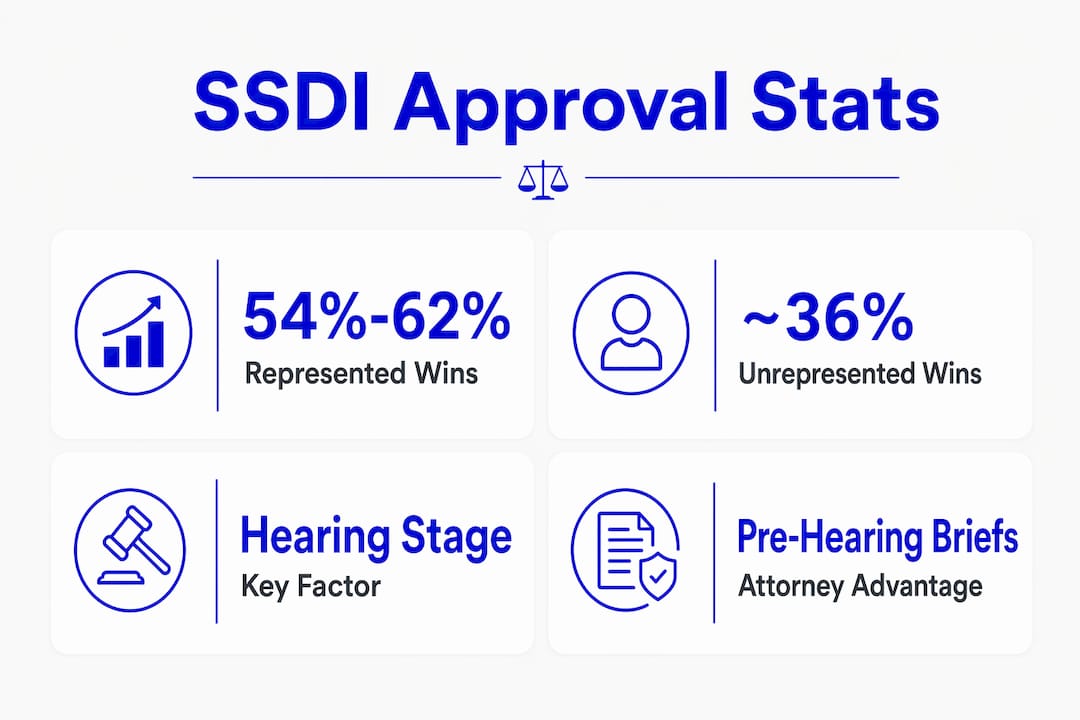
The hearing stage is where attorney representation produces the clearest statistical advantage. Represented claimants at ALJ hearings win at rates of 54%–62%, while unrepresented claimants win at only 34%–45%. That gap of roughly 20 percentage points is not a coincidence. Attorneys prepare medical evidence, submit legal briefs, and cross-examine vocational experts, all of which directly affect the outcome.
Approval rate transparency gives you real leverage. When you can compare attorneys by their documented success at the hearing level, you stop choosing based on advertising and start choosing based on results.

Pro Tip: Ask any attorney you interview specifically about their ALJ hearing approval rate, not just their general win rate. The hearing stage is where the data matters most.
Where to find official SSDI lawyer approval rates
The SSA publishes its ALJ Disposition Data quarterly on ssa.gov. This is the authoritative source for judge-level approval statistics. The data lists every ALJ by name, hearing office, and the number of fully favorable, partially favorable, and unfavorable decisions they issued in a given period.
Follow these steps to access the data directly:
- Go to ssa.gov and search for "ALJ Disposition Data" in the site search bar.
- Navigate to the Office of Hearings Operations (OHO) section, which hosts the quarterly data files.
- Download the most recent Excel or CSV file for the fiscal year you want to review.
- Open the file and locate the columns for "Fully Favorable," "Partially Favorable," and "Unfavorable" decisions.
- Add the three decision types together to get total dispositions for each judge.
- Divide the "Fully Favorable" count by total dispositions to calculate that judge's fully favorable rate.
- Cross-reference the judge's hearing office with the location where your hearing will be held.
The SSA data does not list attorney names directly. It lists judges. To connect an attorney's approval rate to a judge, you need to know which judges that attorney regularly appears before, which is information you can ask the attorney directly.
One important limitation: the raw SSA files contain thousands of rows and require basic spreadsheet skills to sort and filter. If you are not comfortable with Excel, third-party tools handle this step for you.
| Decision type | What it means | Impact on claimant |
|---|---|---|
| Fully favorable | Full award from original onset date | Maximum back pay and benefits |
| Partially favorable | Award with a later onset date | Reduced back pay |
| Unfavorable | Claim denied | No benefits at this stage |
Using third-party tools to check SSDI attorney success rates
Third-party websites aggregate SSA's ALJ Disposition Data into searchable directories, removing the need to process raw spreadsheets. These tools let you search by judge name, hearing office, or state and see approval rates displayed as percentages.
Key benefits of using these directories include:
- Faster lookup: Search by judge name and get instant approval rate summaries.
- Visual comparisons: Many tools display approval rates as charts, making it easier to spot outliers.
- Historical data: Some directories track approval rates across multiple fiscal years, showing whether a judge's rate is trending up or down.
- Office-level summaries: You can compare entire hearing offices, not just individual judges.
The most important caveat is accuracy. Third-party tools are only as current as the SSA data they pull from. Always check when the tool last updated its data. If a site shows FY2023 data and the SSA has released FY2025 data, the numbers may be outdated.
Pro Tip: Cross-check any third-party approval rate against the raw SSA file for the same judge. If the numbers differ by more than a few percentage points, rely on the SSA file.
When checking an attorney's track record, ask which judges they appear before most often and then look up those judges in the SSA data or a third-party directory. An attorney who regularly appears before judges with high fully favorable rates has a structural advantage, regardless of their own skill level.
How to interpret approval rate data when choosing an SSDI attorney
Approval rates are a useful starting point, but they require careful interpretation. The national average ALJ approval rate was approximately 58%–59% in FY2025, but individual judges range from below 9% to over 93%. That range is enormous. It means the judge assigned to your case can matter as much as the attorney you hire.
"Judges' total dispositions can be misleading. Focus on fully favorable decisions to assess true claimant benefit potential. A judge with a high overall approval rate but a low fully favorable rate may be granting benefits with reduced back pay far more often than the headline number suggests."
Fully favorable decisions award benefits from the original onset date, which maximizes retroactive pay. Partially favorable decisions award benefits but often push the onset date forward, cutting back pay significantly. When you evaluate a judge or attorney, look at the fully favorable rate specifically, not just the combined approval number.
Common mistakes claimants make when reading approval statistics:
- Treating overall approval rate as the only metric. A high approval rate with mostly partial decisions may mean less money in your pocket.
- Ignoring regional variation. Approval rates vary by state and hearing office. A 58% national average tells you little about your specific office.
- Overlooking attorney experience and case preparation. Approval rates are one factor; an attorney's ability to organize medical evidence and manage onset dates matters equally.
- Selecting an attorney based on a single year of data. One strong year can reflect a favorable caseload, not consistent skill.
The best approach combines quantitative data with qualitative assessment. Review the attorney's hearing approval rate, ask about their experience with your type of disability, and evaluate how clearly they communicate your options.
How legal representation changes SSDI approval outcomes
The statistical case for hiring an attorney at the ALJ hearing stage is clear. Represented claimants win at 54%–62% compared to 34%–45% for those without representation. That 20-percentage-point gap translates directly into thousands of dollars in benefits for claimants who would otherwise be denied.
| Stage | Unrepresented approval rate | Represented approval rate |
|---|---|---|
| Initial application | ~36% | Marginal improvement |
| Reconsideration | 2%–13% | Marginal improvement |
| ALJ hearing | 34%–45% | 54%–62% |
Attorneys produce this advantage through specific procedural actions. They submit pre-hearing briefs that frame the medical evidence within SSA's legal standards. They cross-examine vocational experts who testify about job availability, often the deciding factor in borderline cases. They also manage onset dates carefully, which directly affects how much back pay a claimant receives.
The SSDI approval process functions like a funnel, with most claims denied at the initial stage and a significant portion approved only after appeals. This means an initial denial is not a signal to stop. It is a signal to get legal help before the ALJ hearing.
Many experienced SSDI attorneys focus their resources on the hearing stage specifically because the procedural tools available there, including cross-examination and legal briefs, produce the highest return on preparation time.
Pro Tip: If you have already been denied at the initial or reconsideration stage, do not wait to find an attorney. The ALJ hearing is your strongest opportunity, and preparation time matters.
Key Takeaways
Checking an SSDI lawyer's approval rate requires accessing official SSA ALJ Disposition Data, interpreting fully favorable decision percentages, and combining that data with attorney-specific qualitative factors.
| Point | Details |
|---|---|
| Official data source | The SSA publishes quarterly ALJ Disposition Data on ssa.gov with judge-level decision counts. |
| Hearing stage advantage | Represented claimants win at 54%–62% at ALJ hearings versus 34%–45% without an attorney. |
| Fully favorable rate matters | Focus on fully favorable decisions, not overall approval rates, to assess true benefit potential. |
| Judge variability is wide | Individual ALJ approval rates range from below 9% to over 93%, making judge-specific research critical. |
| Data alone is not enough | Combine approval rate data with attorney experience, case preparation quality, and communication style. |
What I've learned from years of watching claimants choose attorneys
The most common mistake I see is claimants treating approval rate as a pass/fail score. A lawyer with a 65% approval rate is not automatically better than one with a 55% rate. The caseload composition matters. An attorney who takes difficult cases with complex medical histories will show a lower rate than one who screens aggressively for easy wins. That context is almost never visible in the raw numbers.
The second mistake is ignoring judge variability entirely. I have seen claimants spend months researching attorneys while never once looking up the approval rate of the judge assigned to their case. That judge's rate can swing the outcome more than any attorney choice. Check the judge first, then evaluate the attorney.
The data is genuinely useful. The SSA's quarterly ALJ Disposition Data is one of the most transparent public records in federal administrative law. Use it. But use it as one input, not the final answer. Ask the attorney how they prepare medical evidence, how they handle vocational expert testimony, and how often they appear before your assigned judge. Those conversations reveal more than any spreadsheet.
Persistence through the appeals process is also undervalued. The SSDI approval funnel rewards claimants who reach the ALJ hearing with proper representation. An initial denial is not a verdict. It is the beginning of a process that statistically favors those who keep going with the right legal help.
— Gerard
Ssdilawyer connects you with vetted SSDI attorneys
Ssdilawyer was built specifically to help SSDI claimants find experienced disability attorneys without paying anything upfront. Every attorney in the network works on contingency, meaning you pay only if you win.
The platform connects you with attorneys who have documented experience at the ALJ hearing level, where representation produces the strongest statistical advantage. Ssdilawyer also provides resources to help you understand the SSDI claims process before your first attorney conversation. If you have been denied or are preparing for a hearing, the right legal match is the most direct path to approval.
FAQ
What does an SSDI lawyer approval rate measure?
An SSDI lawyer approval rate measures the percentage of claims an attorney wins, most meaningfully at the ALJ hearing level where represented claimants win at 54%–62% compared to 34%–45% without representation.
Where can I find official SSDI judge approval rates?
The SSA publishes quarterly ALJ Disposition Data on ssa.gov, listing fully favorable, partially favorable, and unfavorable decisions by judge name and hearing office.
What is the difference between fully and partially favorable decisions?
A fully favorable decision awards benefits from the original onset date, maximizing back pay. A partially favorable decision awards benefits but often with a later onset date, which reduces the retroactive payment amount.
How do I use approval rate data to choose an SSDI attorney?
Look up the judges your attorney regularly appears before using SSA data or a third-party directory, then combine that information with the attorney's experience, case preparation approach, and communication quality.
Is a high approval rate the most important factor when hiring an SSDI attorney?
Approval rate is one important factor, but attorney experience, quality of medical evidence preparation, and familiarity with your assigned judge all contribute equally to claim outcomes.