
An inheritance does not reduce or eliminate your Social Security Disability Insurance benefits. SSDI is an earned benefit tied to your work history and payroll tax contributions, not your bank balance, so the Social Security Administration (SSA) does not care whether you received $500 or $500,000 from a relative's estate. The only wrinkles show up if you also collect workers' compensation or another public disability benefit, or if the money helps you return to work above the substantial gainful activity (SGA) limit.
If either of those situations applies to you, here is what to do right now:
- Document the inheritance. Save the estate paperwork, the executor's letter, and your bank deposit records in case questions come up later.
- Contact SSA only if you also receive workers' comp or another public disability benefit. SSDI-only recipients generally have nothing to report.
Key Takeaways
SSDI ignores private inheritances entirely because it is an earned benefit based on work credits, while SSI can lose eligibility over the same inheritance because it enforces a strict resource limit.
| Point | Details |
|---|---|
| SSDI has no asset test | An inheritance of any size leaves your SSDI monthly payment unchanged. |
| Public disability offsets are the real risk | Workers' comp or other public disability income, not the inheritance, can trigger an 80% offset. |
| SGA, not the inheritance, ends SSDI | Only earned income above the substantial gainful activity limit can stop SSDI eligibility. |
| Report public disability changes immediately | Lump sums and new workers' comp awards need prompt reporting to avoid an overpayment. |
| Concurrent SSI cases need a trust strategy | A Special Needs Trust or pooled trust can protect SSI eligibility after an inheritance. |
Table of Contents
- Why SSI and Inheritance Rules Don't Apply to SSDI Recipients
- Exceptions: Workers' Comp, Lump Sums, and Returning to Work
- Reporting an Inheritance and Related Disability Payments to SSA
- What Happens if SSA Claims You Were Overpaid
- When to Call an SSDI Attorney (and How Ssdilawyer Helps)
- How Inheritance Affects SSI vs. SSDI: The Key Difference
- How an Inheritance Changes SSI Payments and Eligibility
- SSI Resource Limits and Where an Inheritance Fits
- Protecting an Inheritance With Trusts When SSI Is Involved
- How to Report an Inheritance to SSA Without Losing Benefits
- Timing: How Fast an Inheritance Can Affect SSI Payments
- The Gap Between SSDI Fear and SSDI Reality
- Sources
Why SSI and Inheritance Rules Don't Apply to SSDI Recipients
SSDI works like an insurance policy you paid into through payroll taxes. Your eligibility and monthly payment depend on your work credits and your average lifetime earnings before your disability began, calculated through your Average Indexed Monthly Earnings. Nothing about that formula references what you own or what shows up in your checking account after a relative passes away.
That is the core distinction that trips people up when they search for guidance on SSI and inheritance and assume the same rules apply to SSDI. An inheritance is unearned income (money you did not work for), and SSA's SSDI rules simply do not count unearned income or assets against your benefit. This is fundamentally different from how the SSI program treats assets, which does impose strict resource limits.
Here is a simple example. Say you receive $1,400 a month in SSDI. Your aunt leaves you $40,000 in her will, deposited into your checking account in March. Your April SSDI payment is still $1,400. It stays $1,400 the following month, and the month after that, regardless of how long the inheritance sits in your account or what you spend it on.
Pro Tip: Don't confuse "unearned income doesn't count for SSDI" with "no income counts." Earned income from a job still matters if it pushes you over the SGA threshold, which is a separate issue covered below.
Advocacy groups and legal explainers consistently back this up: because SSDI has no asset test, an inheritance will not affect your monthly payment or your continued eligibility.
Exceptions: Workers' Comp, Lump Sums, and Returning to Work
The inheritance itself is never the problem. The problems, when they happen, come from three other directions that sometimes get triggered around the same time as an inheritance.
- Public disability offsets. If you also receive workers' compensation or another public disability benefit (not SSDI itself), SSA applies what is known as the 80% rule. Your combined benefits generally cannot exceed 80% of your average current earnings before you became disabled. If workers' comp plus SSDI pushes you over that cap, SSA reduces the SSDI portion, not because of your inheritance, but because of the combined public benefit total. The SSA's own guidance walks through this offset with worked examples.
- Lump-sum public disability awards. A workers' comp settlement paid as a lump sum can be prorated over time for offset purposes, which can trigger a recalculation of your SSDI check. SSA needs to know about this immediately, not after the money arrives.
- Returning to work. If an inheritance gives you the financial cushion to attempt work, and your earnings exceed the SGA limit, that earned income (not the inheritance) can end your SSDI eligibility. Personal injury and settlement guidance draws this same line: unearned lump sums don't threaten SSDI, but earned wages above SGA do.
Watch for these red-flag moments:
- You start receiving or expect a workers' comp settlement in the same year as an inheritance.
- SSA sends a notice referencing "other disability payments" or asks you to verify income sources.
- You are considering part-time or full-time work using inheritance funds as a bridge.
- You receive a letter mentioning benefit recalculation or an overpayment review.
Reporting an Inheritance and Related Disability Payments to SSA
If you receive SSDI only, with no workers' comp, no public disability benefit, and no SSI, you generally do not need to report a private inheritance to SSA at all. That single fact resolves most of the anxiety behind searches about SSI and inheritance rules bleeding over into SSDI cases.
Where reporting matters is workers' comp and other public disability income. If you're in that situation, take these steps:
- Gather your estate distribution documents, bank statements showing the deposit, and any workers' comp award letters or notices.
- Call SSA directly or visit your local field office to report changes in workers' comp or public disability payments, especially lump sums.
- Ask for written confirmation any time SSA tells you an offset or recalculation is coming.
Pro Tip: Keep every piece of SSA correspondence in one folder, physical or digital. If a dispute arises later, a clean paper trail is often the difference between a quick fix and a drawn-out appeal.
What Happens if SSA Claims You Were Overpaid
An overpayment notice after a public disability offset or lump-sum recalculation is not a dead end. You generally have three paths forward, and they are not mutually exclusive.
- File an appeal if you believe the overpayment determination is wrong. You typically have 60 days from the notice date to request reconsideration.
- Request a waiver of recovery if the overpayment wasn't your fault and repaying it would cause financial hardship. Waiver requests benefit from documentation like a month-by-month expense ledger, proof of medical or burial costs, and records showing the money is already spent on necessities.
- Negotiate a repayment plan if you owe the money but can't pay it in one lump sum. SSA will generally work with a reasonable monthly amount based on your finances.
Complex offset disputes, large lump-sum recoupments, and anything headed toward a formal hearing, are where a lawyer's involvement changes outcomes. An attorney knows how to frame hardship arguments and which SSA forms actually move a case forward.
When to Call an SSDI Attorney (and How Ssdilawyer Helps)
Certain situations call for legal help rather than a solo attempt to sort things out with SSA.
An experienced SSDI attorney handles appeals, represents you at hearings, and negotiates waivers on your behalf. They'll typically ask for your award letters, SSA notices, pay stubs or workers' comp documentation, and a summary of your monthly expenses.
Claimants often try to handle offset disputes or overpayment waivers alone, only to discover the paperwork and deadlines are far less forgiving than they expected. Getting a second opinion early, before a deadline passes, tends to produce a better outcome than scrambling after a denial.
Ssdilawyer connects you with experienced disability attorneys who handle exactly these situations, from initial applications through denials, appeals, and hearings. If you're staring down an SSA notice you don't understand, get matched with a disability attorney through Ssdilawyer before a response deadline slips by.
How Inheritance Affects SSI vs. SSDI: The Key Difference
The rules diverge sharply once you cross from SSDI into SSI territory, and confusing the two is the single most common mistake claimants make. SSDI is an earned benefit, funded by the payroll taxes you and your employers paid over your working years. SSI, by contrast, is a needs-based program funded by general tax revenue, designed for people with limited income and resources regardless of work history.
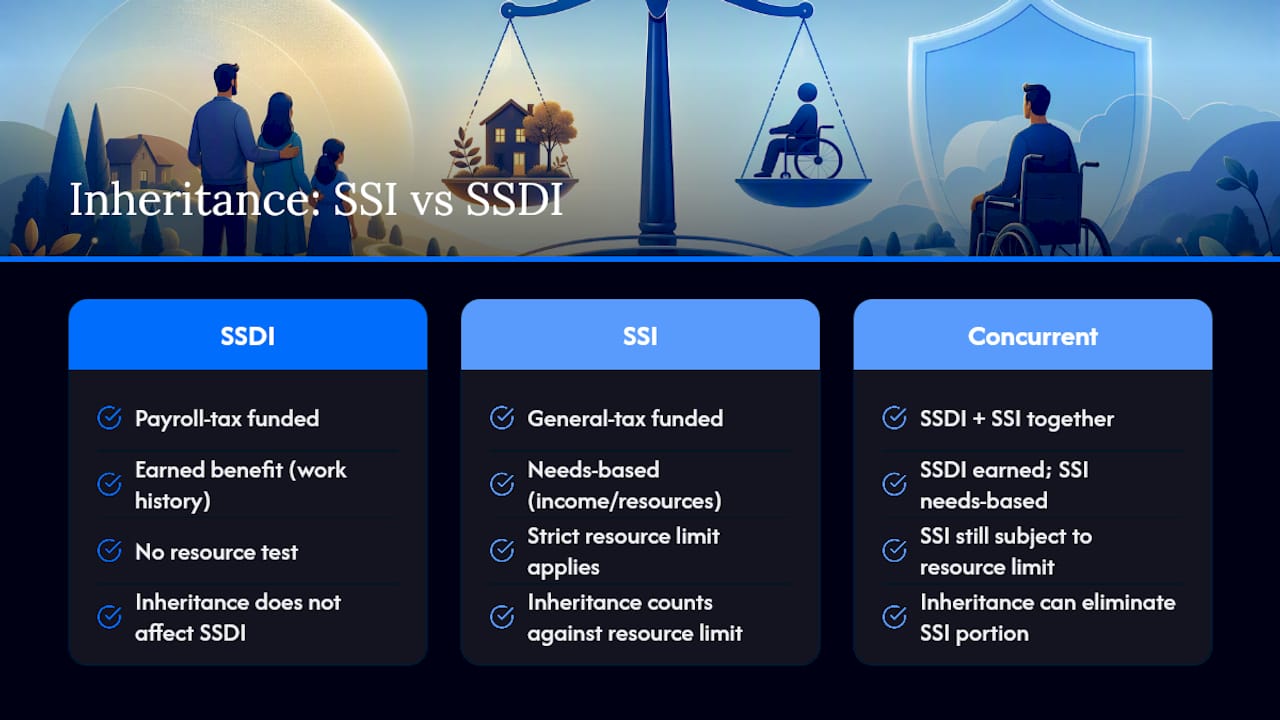
Because SSI is needs-based, it comes with a strict resource limit, and an inheritance counts directly against that limit. SSDI carries no such test. If you receive SSDI only, an inheritance changes nothing about your monthly check or your continued eligibility.
The complication arises for concurrent beneficiaries, people who receive both SSDI and SSI at the same time, usually because their SSDI amount is low enough to qualify for a partial SSI supplement. For that group, an inheritance can eliminate the SSI portion of their benefits even though the SSDI portion stays completely intact. Advocacy organizations point out that this dual-program confusion is exactly why so many people searching for guidance on inheritance and disability benefits end up alarmed over nothing, or blindsided by a change they didn't see coming. If you're not sure which category you fall into, reviewing the differences between SSDI and SSI is the fastest way to find out before you make any decisions about the inheritance itself.
How an Inheritance Changes SSI Payments and Eligibility
For someone receiving SSI, either alone or alongside SSDI, an inheritance can reduce or eliminate the SSI payment starting the month after it's received, depending on the amount and how quickly it pushes total countable resources over the limit. SSI treats an inheritance as unearned income in the month it's received, and if any portion remains unspent by the first moment of the following month, that remainder counts as a resource going forward.
That distinction between "income" and "resource" matters. In the month of receipt, the inheritance can reduce that month's SSI payment dollar for dollar as income. From the next month onward, whatever is left counts toward the resource limit, and if that limit is exceeded, SSI stops entirely until the resource is spent down below the threshold again.
This is why a modest inheritance can do more damage to SSI than people expect. Even a relatively small windfall, if left sitting in an account, can push a claimant over the resource ceiling and suspend a benefit that took months to establish. None of this touches the SSDI portion of a concurrent beneficiary's payment. That part continues on schedule, calculated the same way it always has been, based on work history rather than assets.
SSI Resource Limits and Where an Inheritance Fits
SSI's resource limit is one of the strictest features of the program, and it applies to essentially everything you own with a few narrow exclusions, such as a primary home and one vehicle. An inherited lump sum, once deposited and unspent, gets added to whatever countable resources you already have.
Cash inheritances are the most straightforward case, since they land directly in a bank account as countable funds. Inherited property is trickier. A house or land you inherit but don't live in typically counts as a resource at its equity value, while a share in real estate that's difficult to sell can sometimes qualify for a temporary exclusion while you attempt to liquidate it. Retirement accounts, vehicles beyond the excluded one, and any other transferable asset inherited from an estate generally count the same way cash does.
The practical trap is timing. SSI resource limits are checked as of the first moment of each month, so a claimant who inherits funds and doesn't act before month's end can find their benefit suspended before they've had a real chance to plan. This is a different exposure than SSDI carries entirely, since SSDI has no comparable ceiling regardless of what a claimant owns or inherits. For concurrent beneficiaries in particular, understanding exactly where the resource line sits, and how close an inheritance pushes them to it, is the first step before deciding what to do with the money.
Protecting an Inheritance With Trusts When SSI Is Involved
Claimants who also receive SSI have real options for preserving benefits after an inheritance, and disclaiming the money outright is rarely the smartest one. Refusing an inheritance, or restructuring it after the fact to dodge SSI's resource count, can be treated by SSA as a transfer of resources for less than fair market value, which can trigger a penalty period of SSI ineligibility even longer than simply accepting the funds would have caused.

A better route is usually a properly drafted Special Needs Trust (sometimes called a Supplemental Needs Trust), which holds inherited funds for the beneficiary's supplemental needs, such as therapy, transportation, or home modifications, without those funds counting as a resource for SSI purposes. A pooled trust, managed by a nonprofit that combines the assets of many beneficiaries while keeping individual accounts separate, offers a similar shelter and can be a practical option for smaller inheritances where setting up an individual trust isn't cost effective.
Both tools require careful drafting to meet SSA's technical requirements, and mistakes in the trust language can undo the protection entirely. This is squarely the kind of work where legal guidance pays for itself, since the difference between a compliant trust and a flawed one is often the difference between keeping SSI intact and losing it retroactively.
How to Report an Inheritance to SSA Without Losing Benefits
Reporting requirements diverge sharply depending on whether you're SSDI-only or a concurrent SSDI/SSI beneficiary, and getting this sequence right protects you from an avoidable overpayment.
- SSDI-only recipients: no reporting obligation for a private inheritance exists, since SSDI ignores unearned income and assets entirely.
- Concurrent SSDI/SSI recipients: report the inheritance to SSA within 10 days after the end of the month in which you received it. Waiting longer risks an overpayment finding once SSA cross-checks bank records or receives third-party reporting.
- Documentation to gather before you call or visit SSA: the estate distribution letter or will excerpt, the date funds were received, the exact amount, and your bank statement showing the deposit.
- Follow-up: request written confirmation of how SSA classified the inheritance (income for the month received, resource going forward) and whether any trust arrangement was accepted as excluded.
Skipping the report doesn't make the resource disappear from SSA's eventual review. It just delays the overpayment notice and makes the repayment conversation harder later.
Timing: How Fast an Inheritance Can Affect SSI Payments
The timing window on SSI is tighter than most claimants expect. SSA evaluates income in the month received and resources as of the first instant of the following month, which means a claimant has, at most, roughly the remainder of the current calendar month to spend down, transfer to an excluded trust, or otherwise restructure inherited funds before they count against the resource limit.
An inheritance received on the 3rd of a month gives you close to four weeks. One received on the 28th gives you almost none. That asymmetry is exactly why immediate action matters more than the amount itself. A modest inheritance mishandled in a two-day window can trigger the same suspension as a much larger one handled correctly over several weeks.
SSDI recipients without SSI face no equivalent clock. Since SSDI ignores the inheritance altogether, there's no monthly resource snapshot working against you. That asymmetry is the clearest practical reason to know, immediately, which program (or which combination) governs your case before deciding how to handle inherited funds.
The Gap Between SSDI Fear and SSDI Reality
Most of the anxiety around inheritance and disability benefits comes from a mismatch: people search for their situation and land on advice written for SSI, then assume it applies to their SSDI claim. It usually doesn't. That confusion costs real time and, sometimes, real money spent on unnecessary trust arrangements or panicked calls to SSA that weren't needed in the first place.
The conventional advice tends to bury the lede. It walks through every possible complication before answering the one question that actually matters for an SSDI-only recipient: does the inheritance change your check? It doesn't, in the overwhelming majority of cases. Where the advice falls short is in distinguishing SSDI's genuine risk points, workers' comp offsets, lump-sum recalculations, and a return to work, from the SSI resource-limit problem that dominates most online searches.
If you take one thing from this guide, let it be this: figure out which program governs your benefit before you do anything else. That single fact determines whether you need a trust attorney, a phone call to SSA, or nothing at all.
This article is general information, not a substitute for advice from a qualified lawyer. Consult a qualified legal professional about your own circumstances before acting on anything here.
Sources
- How Workers’ Compensation and Other Disability Payments May Affect Your Benefits (SSA)