
Short answer: yes. Most SSDI recipients qualify for a Total and Permanent Disability (TPD) discharge on federal student loans, and many are identified automatically without filing anything. Your next move is simple: check Studentaid and your mail for a discharge notice, then pull your SSA notice of award or request a Benefits Planning Query (BPQY) to confirm your documentation lines up.
Three SSA pathways typically trigger eligibility:
- You received a compassionate allowance determination.
- Your medical onset date is five or more years old.
- Your next scheduled review falls at three years, or at five to seven years because medical improvement isn't expected.
Pro Tip: Don't wait for a letter that may never come. Log into your SSA online account today and check your next scheduled continuing disability review date. That single number tells you which discharge category you're likely in.
Key Takeaways
Most SSDI recipients qualify for TPD student loan discharge through documented SSA review categories, and gathering the right paperwork early determines how fast the process moves.
| Point | Details |
|---|---|
| Confirm your SSA category | Check whether you're a compassionate allowance case, MINE, or have an onset date five-plus years old. |
| Get your documentation ready | Request a BPQY or locate your SSA notice of award before filing anything. |
| Watch for automatic notices | The Department's SSA data match may discharge your loans without an application; you get 60 days to opt out. |
| Track the three-year monitoring window | Reinstated loans are possible if income changes trigger a post-discharge review. |
| Get legal help for defaults or denials | Ssdilawyer.co matches you with attorneys who handle contested onset dates and active garnishment cases. |
Where to Verify the Details Yourself
- TPD discharge application (PDF) and the Studentaid.
- The Department's automatic SSA data match notice and 34 CFR § 685.213 for the legal requirements.
- Save your SSA notice of award and request a BPQY now if you haven't already.
This article is general information, not a substitute for advice from a qualified lawyer. Consult a qualified legal professional about your own circumstances before acting on anything here.
Table of Contents
- Which SSDI Pathways Qualify You for Student Loan Discharge
- How to Apply: Documents and Filing Steps
- How Automatic SSA Matching and the Opt-Out Window Work
- What Happens After Discharge: Monitoring and Taxes
- Does a TPD Discharge Affect Your SSDI Benefits?
- When to Call a Disability Attorney
- Sources
Which SSDI Pathways Qualify You for Student Loan Discharge
Not every SSDI award triggers automatic discharge eligibility. The Department of Education relies on specific markers in your SSA file, not the mere fact that you receive benefits.
The four recognized categories are:
- Compassionate allowance recipients — SSA fast-tracked your claim because your condition is on its severe-impairment list.
- Medical Improvement Not Expected (MINE), with your next review scheduled five to seven years out.
- Onset date five or more years in the past, showing a long-standing disability.
- Next continuing disability review scheduled at the three-year mark, a middle-tier category SSA uses for conditions likely, but not certain, to persist.
Simply cashing SSDI checks does not automatically flag you. The Department of Education requires documentation tying your case to one of these categories, usually a BPQY or your SSA notice of award.
Pro Tip: Your award letter often lists your diagnosis code and next review date in small print near the bottom. If you can't find it, request a BPQY directly from your local SSA field office. It spells out your review schedule in plain language a loan servicer can process without guesswork.
How to Apply: Documents and Filing Steps
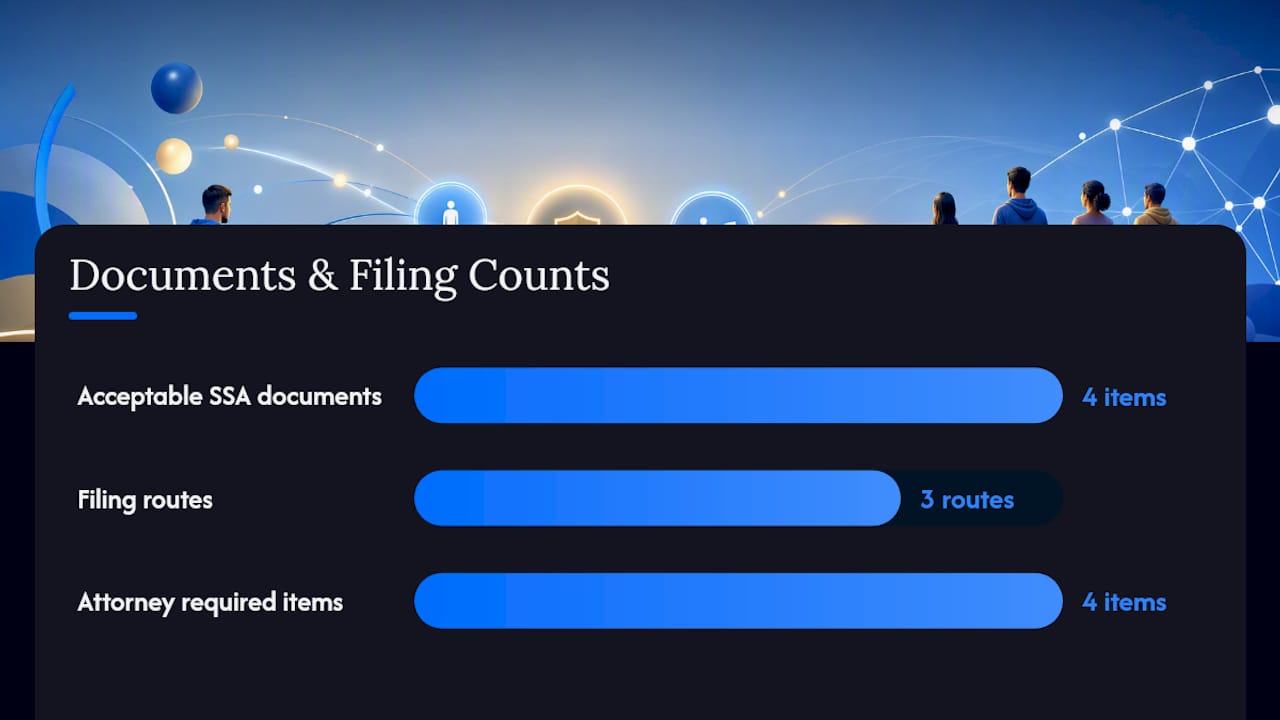
The TPD discharge application is a short PDF form available directly through the Federal Student Aid TPD hub. You can file it three ways, and the paperwork behind it matters more than the form itself.
Acceptable SSA documentation includes:
- A Benefits Planning Query (BPQY) showing your review category.
- Your SSA notice of award with onset date and next review date visible.
- Physician certification if your SSA records don't clearly show a qualifying schedule.
- A VA disability determination, for veterans rated 100% permanently and totally disabled.
To file, choose one of these routes:
- Submit online through your StudentAid.gov account.
- Print, sign, and mail the PDF application with your supporting SSA documents to the assigned claims processor.
- Have a disability attorney submit the package on your behalf, particularly if your onset date or review category is unclear.
If you're working with counsel, hand over four things immediately: your SSA award letter, a current BPQY, a one-page summary of your medical onset timeline, and copies of any prior SSDI denial or appeal decisions. Attorneys use these to confirm which of the SSDI benefits documents map to a qualifying TPD category before filing anything.
How Automatic SSA Matching and the Opt-Out Window Work
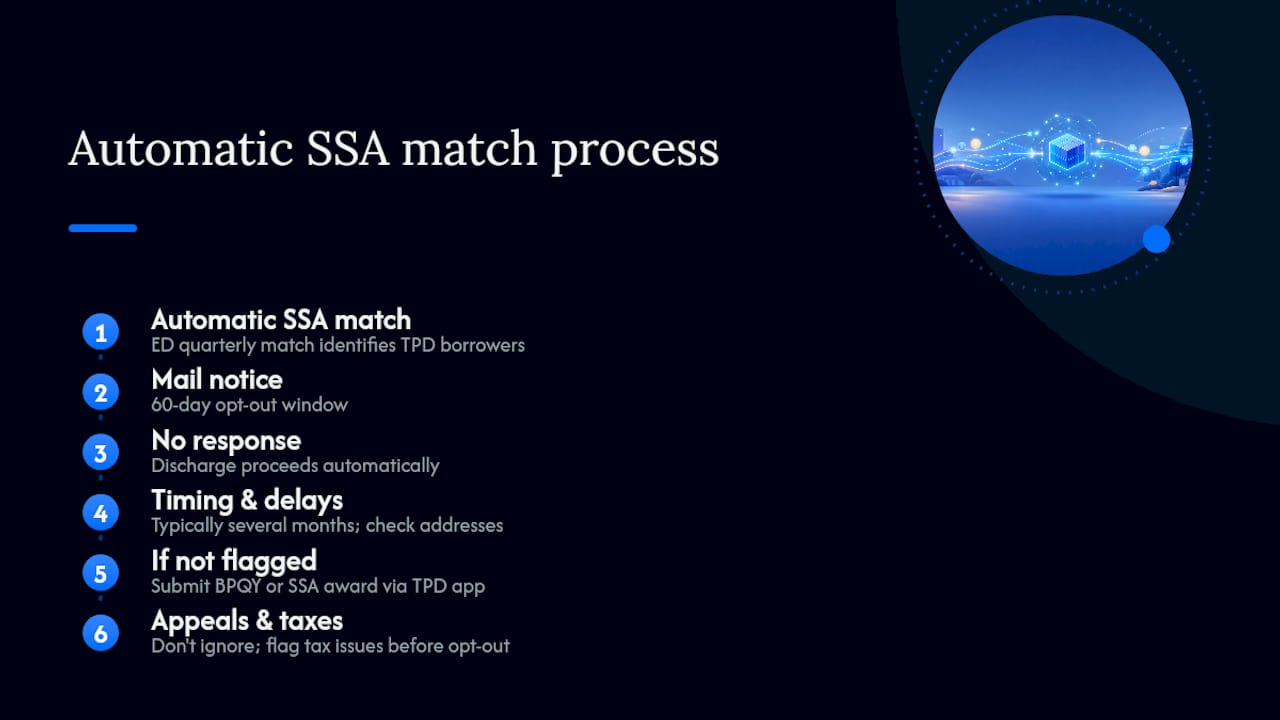
You may not need to file at all. Since September 2021, the Department of Education has run a quarterly data match with SSA that automatically identifies borrowers who meet TPD criteria and begins discharge without a separate application.
Once identified, you'll get a notice by mail explaining your eligibility and a 60-day window to opt out if you'd rather keep your loans (some borrowers do, for reasons tied to future borrowing plans). If you don't respond, the discharge proceeds automatically. Processing from identification to final discharge typically takes several months, and delays usually trace back to outdated mailing addresses or SSA records that haven't synced with a recent review update.
If you weren't automatically flagged but believe you qualify, don't assume the system missed you by accident — consider your options for student loan robocall recovery as part of your next steps. Submit a BPQY or SSA notice of award directly through the TPD application process rather than waiting for a letter that may never arrive.
If a notice arrives while you're still appealing an SSDI denial, don't ignore it. And if you're weighing state tax exposure on a discharge, flag that concern before your opt-out window closes, not after.
What Happens After Discharge: Monitoring and Taxes
Discharge isn't necessarily the finish line. Borrowers approved through SSA documentation or physician certification enter a three-year post-discharge monitoring period, during which the Department checks for signs your disability status changed, such as new earnings above the threshold. Fail that check, and your loans can be reinstated, meaning you owe payments again.
The Department has at times suspended parts of this monitoring requirement and floated rulemaking changes, so confirm the current status before assuming a monitoring letter is routine.
Federal tax law has excluded TPD discharges from taxable income for specific windows, but that exclusion doesn't automatically extend to every state. Some states still tax forgiven debt as income.
Three things to do now:
- Keep pay stubs and employment records for three years after discharge.
- Respond to every monitoring request promptly, even if it feels redundant.
- Ask a tax professional whether your state taxes discharged debt, since some consumer guides note this catches people off guard.
Does a TPD Discharge Affect Your SSDI Benefits?
No. The Social Security Administration confirms that a federal student loan discharge due to disability does not reduce or otherwise affect the SSDI or SSI benefits you receive.
- Your monthly SSDI payment stays exactly as calculated.
- If you have questions about how a discharge interacts with other benefit programs, SSA's field offices can clarify case-specific administrative follow-up.
When to Call a Disability Attorney
A lawyer earns their fee fastest when your paperwork is messy or your loans are already in default. Attorneys and matching services like Ssdilawyer typically handle:
- Requesting your BPQY and SSA award letter directly from SSA.
- Preparing and submitting the TPD application with the correct supporting documents.
- Assembling a medical evidence summary if your onset date is contested.
- Appealing a denied TPD discharge or a denied SSDI claim tied to it.
- Stopping administrative garnishment if your loans went into default before discharge.
Pro Tip: If your SSDI check has already been reduced by an offset for defaulted student loans, call an attorney immediately rather than filing the TPD application alone. Stopping an active garnishment usually requires faster, more specific action than the standard filing timeline allows.
A Common Pattern Worth Knowing
Most cases that stall come down to one missing document, usually the BPQY. Once a client pulls that single record, the rest of the application tends to move quickly. Ssdilawyer.co exists to connect people in that exact situation with attorneys who already know which SSA form unlocks their case.
Get Matched with a Disability Attorney Who Handles This
Ssdilawyer.co is the faster alternative to searching for a disability attorney cold: instead of vetting firms yourself, you submit one intake and get matched with attorneys experienced in SSDI claims and the paperwork that supports TPD discharge.
There's no upfront cost to submit an intake, and the process is built to move quickly once your documents are in hand. Have your SSA award letter, BPQY (if you have one), and any loan default statements ready before you start. Submitting them together speeds up how fast an attorney can review your case. Your information stays private and is only shared with attorneys reviewing your specific situation. If you're ready to move forward, Ssdilawyer today.
Sources
- Automatic Total and Permanent Disability Discharge through Social Security Administration Data Match (EA ID: GENERAL-21-49) | Knowledge Center
- If my federal student loan is discharged because I am disabled, will it affect my SSDI or SSI benefits? | Frequently Asked Questions | SSA
- 34 CFR § 685.213 - Discharge application process