
Yes. Congestive heart failure can qualify as a Social Security disability under two distinct legal paths: meeting the objective thresholds in SSA Blue Book Listing 4.02, or demonstrating through a residual functional capacity (RFC) assessment that you cannot sustain substantial gainful activity. A clinical diagnosis alone is not sufficient. SSA requires documented, objective medical evidence tied to specific cardiac measurements or documented hospitalization events.
Immediate next steps:
- Collect echocardiogram reports, discharge summaries, and cardiology notes from the past 12 months
- Ask your cardiologist to document functional limitations in writing, not just diagnoses
- Consider a free consultation with an SSDI attorney before filing or after a denial
Table of Contents
- How does the SSA define "disability" differently from a medical diagnosis?
- What are the exact Blue Book criteria for chronic heart failure?
- What if you don't meet Listing 4.02?
- How do you apply, and how long does the process take?
- How hard is it to get disability approved for CHF?
- How can a disability attorney help with a CHF claim?
- Key Takeaways
- Why documentation quality decides most CHF claims
- Ssdilawyer connects you with SSDI attorneys at no upfront cost
- Authoritative sources and where to read more
How does the SSA define "disability" differently from a medical diagnosis?
The SSA's legal standard and a cardiologist's clinical diagnosis are not the same thing. A physician diagnoses congestive heart failure based on symptoms, imaging, and lab values. SSA determines disability based on whether that condition prevents you from performing any substantial gainful activity (SGA) for at least 12 continuous months, or is expected to result in death.
"Disability under Social Security is based on your inability to work. We consider you disabled under Social Security rules if you cannot do work that you did before and we decide that you cannot adjust to other work because of your medical condition(s), and your disability has lasted or is expected to last for at least one year or to result in death." — Social Security Administration
That distinction matters practically. A person with a confirmed CHF diagnosis who still works full-time above the SGA earnings threshold does not meet SSA's legal standard, regardless of how serious their condition is medically. SSA evaluates three things: the medical severity of the impairment, the objective evidence supporting it, and the claimant's remaining capacity to work.
The National Heart, Lung, and Blood Institute (NHLBI) defines heart failure as a condition in which the heart cannot pump enough blood to meet the body's needs. That clinical framing is the starting point. SSA then asks: what do the numbers show, and what can this person still do?
What are the exact Blue Book criteria for chronic heart failure?
SSA's Blue Book Listing 4.02 covers chronic heart failure. It is divided into two categories: systolic failure and diastolic failure. To meet the listing, a claimant must satisfy one of the criteria under 4.02A (systolic) or 4.02B (diastolic), plus show that the condition persists despite prescribed treatment.
Systolic failure criteria (4.02A)
Under Listing 4.02A, SSA looks for at least one of the following:
| Criterion | Threshold |
|---|---|
| Left ventricular ejection fraction (EF) | 30% or less during a period of stability |
| left ventricular end diastolic dimensions that are increased beyond normal limits | |
| multiple acute CHF episodes within a 12-month period, each requiring extended acute care |
Diastolic failure criteria (4.02B)
For diastolic heart failure, SSA requires evidence of left ventricular diastolic dysfunction plus at least one of:
- left ventricular posterior wall plus septal thickness increased on imaging
- an enlarged left atrium evident on imaging
- Three or more acute CHF episodes in 12 months, each requiring 12+ hours of acute care
Exercise tolerance testing (ETT) and METs
When objective imaging alone does not clearly meet the listing, SSA may evaluate exercise capacity. If a claimant cannot complete an exercise tolerance test due to medical risk, that inability itself can satisfy certain criteria under 4.02B. SSA's medical consultants determine whether an ETT is safe to order. If the test is considered dangerous, SSA may find the listing met without it.
Key point: An ejection fraction of 30% or less is one of the clearest paths to meeting Listing 4.02. If your most recent echocardiogram shows this number, it belongs at the front of your claim file.
The documents that supply these numbers are echocardiogram reports (EF and LV dimensions), cardiac catheterization reports, discharge summaries from hospitalizations, and cardiologist treatment notes. POMS guidance DI 34005.104 reinforces that objective, current evidence is required and that absence of ongoing treatment weakens any chronic impairment claim.
What if you don't meet Listing 4.02?
Not meeting a Blue Book listing is not the end of a claim. SSA then evaluates your residual functional capacity (RFC), which is an assessment of the most you can still do despite your limitations. RFC considers exertional limits (sitting, standing, walking, lifting, carrying) and non-exertional limits (concentration, fatigue, need for rest breaks).
From there, SSA applies medical-vocational rules, sometimes called the "Grid Rules," which factor in age, education, and prior work history. A 58-year-old with a limited education and a history of heavy manual labor who can now only perform sedentary work has a substantially different outcome than a 40-year-old with a college degree and transferable office skills, even if both have the same RFC finding.
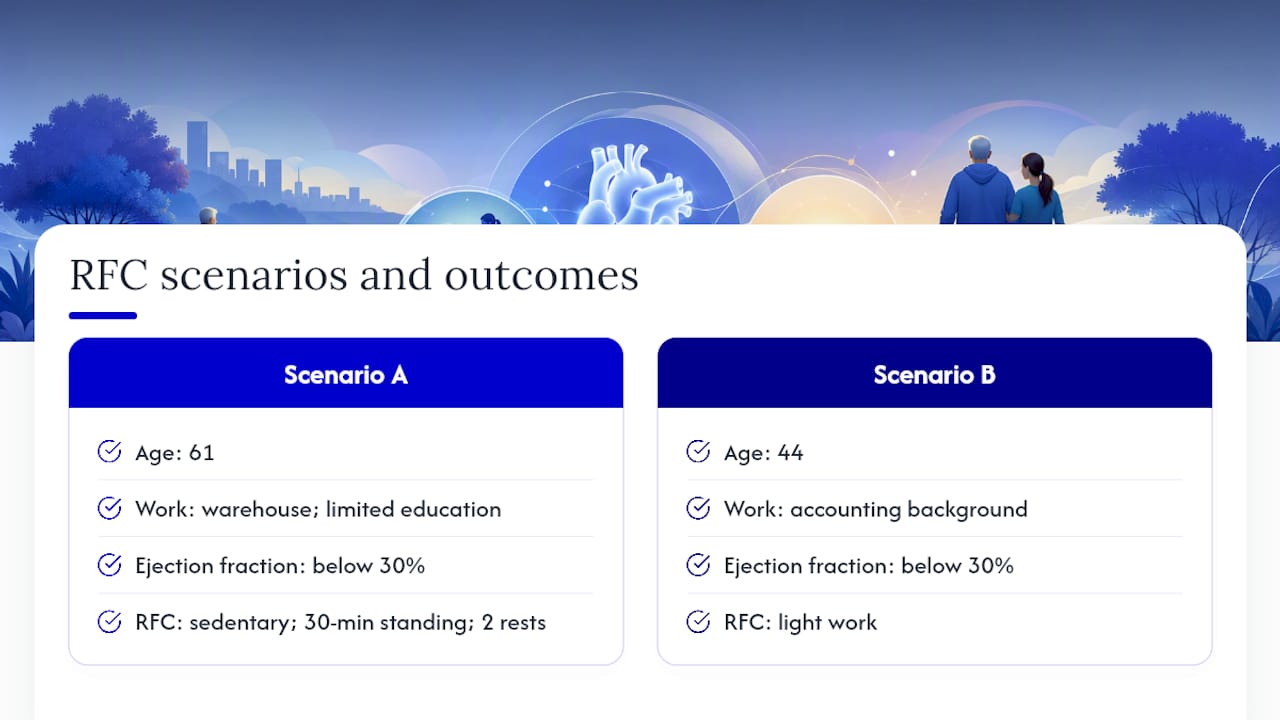
Two scenarios illustrate how this plays out:
Scenario A: A 61-year-old former warehouse worker with CHF has an an ejection fraction that does not meet the 30% threshold but can only stand for 30 minutes at a time and requires two rest periods per workday. SSA finds a sedentary RFC. Given age, limited education, and no transferable sedentary skills, the Grid Rules direct an allowance.
Scenario B: A 44-year-old with CHF and an ejection fraction that does not meet the threshold and an RFC for light work and a background in accounting. SSA finds jobs exist in the national economy she can perform. The claim is denied at the RFC step unless additional impairments or limitations are documented.
Examples of winning SSDI cases show that RFC-based allowances often hinge on the specificity of the treating physician's functional statement, not just the diagnosis.
How do you apply, and how long does the process take?
The application process has several stages, and the timeline at each stage varies considerably.
Step 1: Gather records before filing. Submit a complete file from the start. Claims with missing evidence are more likely to be denied at the initial level.
Step 2: Apply online or at an SSA office. Online applications are available at SSA.gov. For SSDI, you will need your work history and earnings records. For SSI, you will need financial documentation. Form SSA-16 may be required as part of the intake process.
Step 3: Initial determination. SSA sends the file to a state Disability Determination Services (DDS) office. Initial decisions typically take three to six months, though backlogs vary by state.
Step 4: Reconsideration (if denied). Most initial claims are denied. Reconsideration is the first appeal level. A different DDS reviewer examines the file. This stage takes roughly three to five months.
Step 5: ALJ hearing (if denied again). If reconsideration is denied, you can request a hearing before an Administrative Law Judge. Wait times for ALJ hearings have historically ranged from 12 to 24 months depending on the hearing office. This is the stage where legal representation has the most measurable impact.
Step 6: Appeals Council and federal court are available if the ALJ denies the claim, though these stages are less common.
Pro Tip: Track your claim status through your my Social Security online account at SSA.gov. If SSA orders a consultative exam (CE), attend it. Missing a CE appointment is one of the fastest ways to get a claim denied.
How hard is it to get disability approved for CHF?
A CHF diagnosis does not guarantee approval. SSA denies a significant portion of initial claims across all conditions, and CHF claims are not exempt from that pattern. The reasons claims fail are largely predictable and largely preventable.
Common denial reasons:
- EF and LV measurements are not in the record, or the most recent echo is more than 12 months old
- Hospitalization records are incomplete or do not document the duration of each acute care event
- Gaps in treatment history (missed cardiology appointments, lapses in medication) that suggest the condition is not as severe as claimed
- No treating physician functional statement connecting symptoms to specific work limitations
- Claimant is under 50 with transferable skills and an RFC that allows sedentary work
- Failure to document that the condition has lasted or is expected to last 12 months
The SSA POMS guidance for cardiovascular claims is explicit: absence of ongoing treatment makes proving a chronic impairment substantially harder. SSA relies on current, objective medical evidence. A claim built on records that are 18 months old and show no recent cardiology visits will face serious scrutiny.
Steps that reduce denial risk:
- Maintain consistent cardiology appointments and fill all prescriptions
- Request a written functional assessment from your cardiologist at least 60 days before filing
- Document every ER visit and hospitalization with complete discharge summaries
- If your EF is borderline (31–35%), ask your cardiologist whether a repeat echo is clinically indicated
- Consider when to hire a disability lawyer before the ALJ stage, not after
The ADA disability rights guide is a separate resource for claimants who need workplace accommodations or protection from discrimination while their SSDI claim is pending. ADA protections and SSDI eligibility operate under different legal standards and are not mutually exclusive.
How can a disability attorney help with a CHF claim?
Legal representation changes the procedural dynamics of an SSDI claim, particularly at the ALJ hearing level. What a disability lawyer does includes tasks that go well beyond filling out forms.
Concrete attorney services for CHF claims:
- Obtain and organize the complete medical record, including records claimants may not know exist
- Identify gaps in evidence (missing echo reports, undocumented hospitalizations) and work with treating physicians to fill them
- Draft persuasive treating source statements that map cardiac symptoms to specific functional limits
- File appeals within SSA's strict deadlines and prepare written pre-hearing briefs
- Represent the claimant at the ALJ hearing, cross-examine vocational experts, and challenge RFC findings
- Assess the realistic likelihood of approval based on the specific record and claimant profile
When to consider hiring counsel:
- After an initial denial, before filing reconsideration
- Before an ALJ hearing (this is the most critical stage)
- When the medical record is incomplete and you are unsure how to fill the gaps
- When your condition does not clearly meet Listing 4.02 and you need an RFC strategy
SSDI attorneys work on contingency. No upfront fee is required. If the claim is approved, the attorney's fee is capped by federal law at 25% of past-due benefits, not to exceed a set maximum. If the claim is not approved, no fee is owed. Preparing for a disability attorney consultation before your first meeting helps you use that time efficiently.
Ssdilawyer connects claimants with experienced SSDI attorneys through a free intake process. After submitting basic information about your condition and claim status, you are matched with an attorney who handles CHF and cardiovascular disability cases.
Key Takeaways
Congestive heart failure qualifies as a Social Security disability when objective medical evidence meets Blue Book Listing 4.02 criteria or when RFC and medical-vocational rules show the claimant cannot sustain any substantial gainful activity for 12 or more months.
| Point | Details |
|---|---|
| Two legal paths exist | Meet Listing 4.02 objective thresholds (EF ≤ 30%, or 3+ hospitalizations) or qualify via RFC and medical-vocational rules. |
| Objective records are required | Echocardiogram reports, BNP labs, discharge summaries, and a treating physician functional statement are the core of any CHF claim. |
| Diagnosis alone is not enough | SSA requires documented functional limitations and evidence of ongoing treatment, not just a confirmed CHF diagnosis. |
| Denials are common but appealable | Most initial claims are denied; the ALJ hearing stage is where representation has the greatest measurable impact on outcomes. |
| Ssdilawyer provides free attorney matching | Ssdilawyer connects CHF claimants with SSDI attorneys on a contingency basis, with no upfront cost to the claimant. |
Why documentation quality decides most CHF claims
Claims with clear EF measurements, documented hospitalization durations, and a cardiologist's written functional assessment tend to produce cleaner outcomes at every SSA review level. That is not a general observation. It is the direct implication of how Listing 4.02 is structured: the criteria are numerical, and SSA reviewers look for those numbers in the file.
What claimants consistently underestimate is the treating physician statement. A cardiologist who documents "moderate CHF, stable on medications" has technically described the condition. That statement does not tell SSA whether the patient can stand for six hours in a workday, carry 20 pounds, or sustain concentration through an eight-hour shift. Those are the questions SSA is actually asking. When the treating source answers them directly, in writing, the claim moves on firmer ground at reconsideration and at the ALJ hearing.
The gap between a denied claim and an approved one is often not the severity of the condition. It is the specificity of the documentation.
Ssdilawyer connects you with SSDI attorneys at no upfront cost
CHF claimants who have been denied, or who are preparing to file with an incomplete record, have a concrete option: get matched with an attorney before the next deadline passes.
Ssdilawyer's free intake process takes basic information about your condition, your claim status, and your work history, then matches you with an SSDI attorney who handles cardiovascular disability cases. The contingency model means the attorney collects a fee only if your claim is approved, capped by federal law. No approval, no fee.
After a match, the attorney reviews your existing records, identifies what is missing, and contacts your treating cardiologist to obtain the functional documentation SSA needs. For claimants approaching an ALJ hearing, that preparation window is often the difference between approval and a second denial.
During the application period, some claimants also explore financial options such as life settlement case studies to understand how other policyholders have managed income gaps during extended disability processes.
Start your free intake at Ssdilawyer to get matched with an attorney and move your claim forward.
This article provides general information about Social Security disability eligibility and is not legal advice. Eligibility rules, thresholds, and procedures can change. Confirm current requirements with the SSA directly or with a qualified SSDI attorney.
Authoritative sources and where to read more
- 4.00 - Cardiovascular - Adult | Disability | SSA
- SSA - POMS: DI 34005.104 - Cardiovascular System - 05/04/2026
- Social Security Disability | SSA
- Heart Failure | NHLBI
- Heart failure symptoms | NHLBI
- ADA disability rights guide | ADA
- Apply for disability | SSA
- Form SSA-16 | SSA