
Multiple sclerosis can qualify you for Social Security Disability Insurance when it stops you from earning above the Substantial Gainful Activity limit and meets, or medically equals, Blue Book Listing 11.09. Start by pulling your recent earnings and Social Security work-credit statement, since both determine whether you can even file. If your neurologist describes an aggressive, rapidly worsening course, ask about Compassionate Allowances, which can speed up review substantially.
TL;DR:
- Meeting Listing 11.09 requires objective evidence of significant motor loss, mental limitation, or severe fatigue demonstrated through timed tests or neurologic findings.
- Your application must include recent MRI reports, neuropsychological testing, gait assessments, and functional capacity statements from your healthcare provider.
- Most claims are denied if there is a lack of measurable functional limitations; thorough documentation and organized records are crucial for approval.
- Applying early and responding promptly to SSA requests, especially during appeals, increases your chances of approval and reduces processing time.
- For aggressive or malignant MS cases, documentation of rapid progression and clinical course can qualify you for faster review under Compassionate Allowances.
Table of Contents
- Do You Meet the Basic Multiple Sclerosis SSDI Requirements?
- How Does the SSA Evaluate MS Under Listing 11.09?
- What Records Do You Need Before You Apply?
- How Do You Actually File and How Long Does It Take?
- Why Do MS Claims Get Denied, and When Should You Call a Lawyer?
- Can Malignant MS Get Fast-Tracked Through Compassionate Allowances?
- What Financial and Medical Benefits Does SSDI Actually Provide?
- Does SSDI Work Alongside SSI or VA Benefits for MS?
- How Do You Keep Your SSDI Benefits Once You're Approved?
- Where Can You Find Support While You Apply?
- A Publisher's Perspective on Filing MS Claims
- Get Matched With an Attorney Who Knows MS Claims
- Where to Verify These MS SSDI Rules Yourself
- Sources
- FAQ
Do You Meet the Basic Multiple Sclerosis SSDI Requirements?
Before you gather a single medical record, run the numbers. The Social Security Administration will not approve an SSDI claim, no matter how severe your MS, if you're earning above the Substantial Gainful Activity threshold, which the SSA set at the Substantial Gainful Activity limit for non-blind applicants in 2024. Check your last few pay stubs against that figure before you invest weeks in paperwork.
You also need enough work credits, typically 20 credits earned in the last 10 years for most adults, though the exact rule shifts with age. Log into your ssa.gov account to confirm your credit count in minutes.
A few other checkpoints matter just as much:
- Your MS must be expected to limit you for at least 12 continuous months, not a single bad flare.
- The mandatory waiting period applies to payments, not to when you can apply, so file as soon as you're eligible.
- If your neurologist uses words like "malignant" or "fulminant" MS, ask whether your case fits Compassionate Allowances for expedited handling.
- Diagnosis alone never guarantees approval. The SSA cares about what you can no longer physically or mentally do.
How Does the SSA Evaluate MS Under Listing 11.09?
The SSA doesn't grade your MS diagnosis. It grades your function against Listing 11.09, which offers three separate paths to qualify, and you only need to satisfy one.
Path A covers disorganization of motor function in two extremities, meaning a significant loss of coordination, balance, or muscle control that disrupts standing, walking, or fine hand movements. A claimant who drags one leg, needs a walker for stability, or can't button a shirt due to hand tremor fits this pattern well. Neurology notes documenting an abnormal gait, positive Romberg testing, or reduced grip strength give this path teeth.
Path B requires marked limitation in physical functioning plus a marked limitation in at least one area of mental functioning, such as understanding and applying information, concentrating, or adapting to change. MS-related cognitive fog, common in relapsing forms of the disease, can qualify here when it's documented through neuropsychological testing rather than just described in a visit note.
Path C hinges on reproducible and severe fatigue, or motor dysfunction that shows up predictably during physical activity and then eases with rest. POMS DI 24580.015 instructs adjudicators to look for objective evidence, not just a patient's self-report, so timed walk tests showing progressive weakening or exam findings taken before and after exertion carry real weight. Fatigue described in a chart note without any objective backup rarely moves a claim forward on its own.

What Records Do You Need Before You Apply?
Your application lives or dies on paper, not on how sick you feel. Start collecting these categories months before you file if you can.
Neurologic evidence forms the foundation: MRI reports showing lesion load and location, full neurology clinic notes across multiple visits, EMG or evoked potential testing, and lumbar puncture results if your neurologist ordered one. A single MRI from years ago won't cut it; the SSA wants a pattern over time.
Functional evidence is what actually proves disability under Listing 11.09: gait and balance exam findings, a Residual Functional Capacity statement from your treating provider, a formal functional capacity evaluation if one exists, and daily activity logs that show fatigue reproducing itself under real conditions, not just a claimed feeling.
Collateral evidence rounds things out: statements from a spouse or coworker who's watched your decline, receipts or prescriptions for assistive devices like a cane or scooter, and any HR documentation showing you needed accommodations or dropped hours before you stopped working.
Pro Tip: Ask your neurologist directly for a statement that addresses Blue Book language, phrases like "marked limitation in physical functioning" or "reproducible motor fatigue on exertion." A note that mirrors SSA terminology gets read faster and taken more seriously than a general summary of your visit.
How Do You Actually File and How Long Does It Take?
Filing is the easy part. Surviving the wait is where most claimants struggle.
- Apply through ssa.gov, by phone, or in person at a local field office. Have your Social Security number, work history, medical provider list, and medication records ready before you start.
- Expect the mandatory waiting period to apply once your onset date is established, meaning payments start in month six of your qualifying disability, not the day you're approved.
- Watch for Medicare eligibility after the required waiting period of SSDI entitlement. If you need coverage before then, look into COBRA, Marketplace plans, or Medicaid depending on your income and state.
- Track your file status online and respond quickly if the SSA requests additional records or schedules a consultative exam, since delays here are a common cause of stalled decisions.
Initial decisions commonly take several months, and a request for a consultative exam or missing records can push that timeline further. Respond to every SSA letter within the deadline it states, even a short extension request keeps your file moving instead of stalling.
Why Do MS Claims Get Denied, and When Should You Call a Lawyer?
Most denials trace back to one problem: the file lacks objective findings that connect your diagnosis to a specific functional limit. A chart that says "patient reports fatigue" without a timed walk test or repeat exam findings is exactly the kind of gap that gets flagged.
If your initial application is denied, you have four levels of appeal: reconsideration, a hearing before an Administrative Law Judge, Appeals Council review, and finally federal court. Each stage has strict filing deadlines, strict filing deadlines set by SSA, and missing one can end your claim entirely.
An attorney tends to matter most once you're heading toward an ALJ hearing. That's where a treating-source statement gets built specifically to answer the judge's questions, where deadlines get tracked, and where the medical record gets organized around the exact Blue Book language an adjudicator is trained to look for. Ssdilawyer connects claimants with attorneys experienced in exactly this kind of case preparation, so you're not building your hearing strategy alone.
Can Malignant MS Get Fast-Tracked Through Compassionate Allowances?
Malignant MS sits on the SSA's Compassionate Allowances list, meaning claims tied to this aggressive variant can move through review far faster than a standard case, which often takes significantly longer.
There's no separate CAL application to file. Instead, your records need to clearly document rapid progression, an aggressive clinical course, and a confirmed diagnosis, ideally in language your neurologist uses explicitly, not something buried in a single line of a chart note. If your disease course fits this pattern, flag it early and make sure your medical file says so in plain terms.
What Financial and Medical Benefits Does SSDI Actually Provide?
Approval brings more than a monthly check, though the check is the part most people focus on first.
- Monthly cash benefits are calculated from your lifetime earnings record, so amounts vary widely from one claimant to the next; there's no flat national rate.
- Medicare eligibility starts 24 months after your SSDI entitlement begins, which means a gap you'll need to bridge through COBRA, a Marketplace plan, or Medicaid if your income qualifies.
- Back pay covers the period from your established onset date, minus the mandatory waiting period, up through approval. This is why documenting your onset date accurately from the start matters so much.
- Appeals can extend or shrink your back pay window depending on how long the process takes and what onset date ultimately gets accepted.
If you want a rough sense of how your earnings history might translate into a benefit estimate, a tool like the Social Security claiming calculator from Mali can give you a starting number while you wait on your official SSA statement.
Does SSDI Work Alongside SSI or VA Benefits for MS?
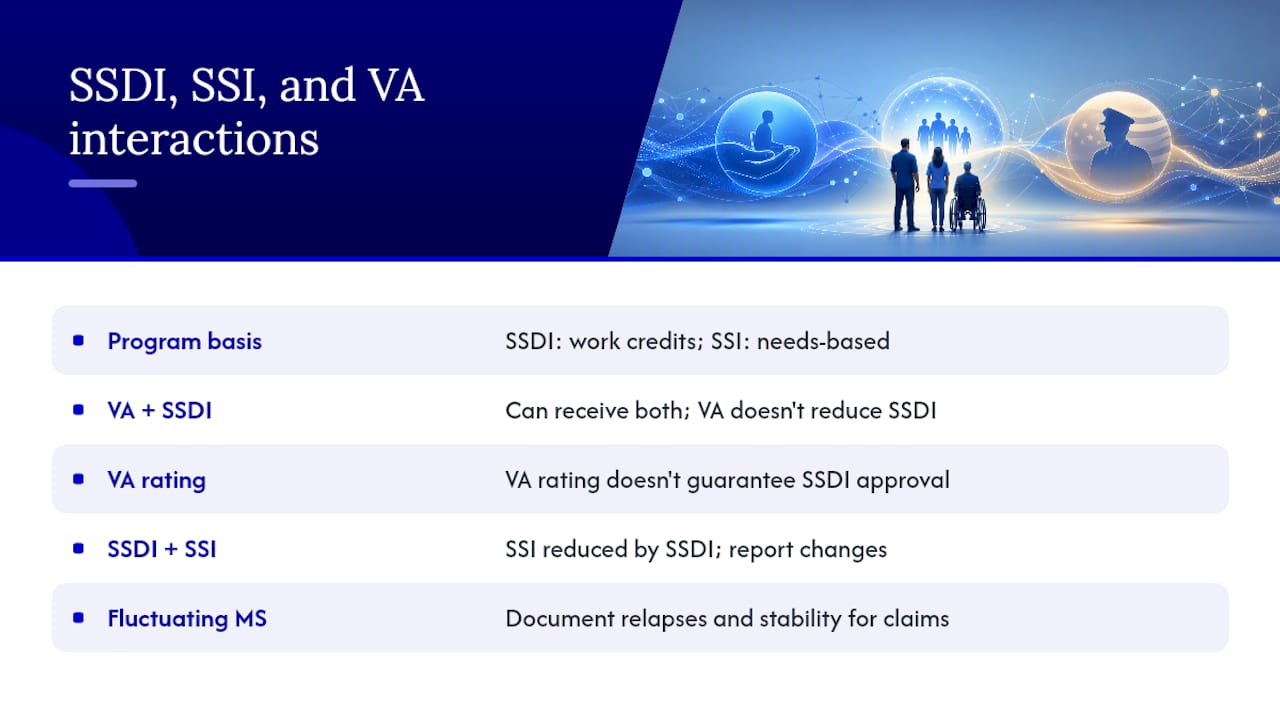
SSDI, Supplemental Security Income, and VA disability compensation are separate programs with different rules, and MS patients sometimes qualify for more than one at once. SSDI is based on your work history and the credits you've earned; SSI is a needs-based program with strict income and asset limits, available to people who haven't worked enough to qualify for SSDI or whose SSDI payment is low enough to still meet SSI's threshold.
A veteran with MS can pursue VA disability compensation and SSDI simultaneously, since the VA rates service-connected conditions on its own scale and doesn't reduce your SSDI payment. The two agencies use different medical standards, so a VA rating, even a high one, doesn't automatically translate into SSDI approval. You still need to independently satisfy Listing 11.09 or prove medical equivalence.
If you're receiving both SSDI and SSI, the SSA reduces your SSI payment based on your SSDI amount and other income, since SSI is designed to fill gaps up to a set federal benefit rate, not stack on top of other income without limit. Report every source of income and benefit change to the SSA promptly, because an unreported SSDI award while receiving SSI is one of the more common causes of overpayment notices down the road. If your MS symptoms fluctuate significantly, relapsing one month and stable the next, that variability itself is worth documenting for both programs rather than assumed to disqualify you from either.
How Do You Keep Your SSDI Benefits Once You're Approved?
Approval isn't permanent by default. The SSA periodically runs Continuing Disability Reviews to confirm your MS still meets disability standards, and how often depends on whether your condition is expected to improve, stay stable, or worsen.
If your file notes "medical improvement expected," you might see a review within six to eighteen months. Conditions marked "not expected to improve," which describes many progressive MS cases, are reviewed roughly every five to seven years instead. You'll receive a form asking about your current treatment, symptoms, and any work activity since your last review.
Report changes as they happen rather than waiting for your review notice. That includes a return to work, even part-time, any change in your address, and significant shifts in your medical treatment or diagnosis. The SSA has a trial work period allowing you to test employment without immediately losing benefits, but you must report earnings during that window regardless of the outcome. Failing to report income changes promptly is one of the more preventable reasons claimants end up owing money back. Keep a folder, physical or digital, with copies of every SSA notice, your treatment updates, and your reporting confirmations, since disputes over whether you reported something on time are far easier to resolve with your own paper trail.
Where Can You Find Support While You Apply?
You don't have to navigate this alone, and trying to is one of the more common reasons claimants miss something in their file. The National MS Society and similar patient advocacy organizations often provide navigators who understand both the medical and procedural sides of an MS diagnosis, and many offer free consultations specifically about disability benefits.
Hospital social workers, particularly those attached to neurology or MS specialty clinics, can help translate your medical file into the functional language the SSA expects, and they frequently have direct experience with what gets claims approved versus denied. Ask your neurology clinic directly whether a social worker is available, even if one hasn't been offered to you.
Local Social Security field offices also have staff who can answer procedural questions, though they can't give legal advice or advocate for your specific claim. For that layer of support, especially once you're heading toward an appeal, an attorney who works MS cases regularly understands which pieces of evidence adjudicators respond to and which get overlooked.
A Publisher's Perspective on Filing MS Claims
The mistake I see most often isn't a weak MS diagnosis. It's a file where fatigue gets described in a sentence instead of proven with a timed test or an activity log. Get your MRI, neurology notes, and an RFC-style statement in hand first, document fatigue objectively, then file. Diagnosis opens the door; documented function is what gets you through it.
— Gerard
Get Matched With an Attorney Who Knows MS Claims
Building an MS SSDI file that survives review takes more than good intentions. It takes records organized around Blue Book language, a treating-source statement that actually addresses your functional limits, and someone who knows what an Administrative Law Judge wants to see at a hearing. That's the gap Ssdilawyer exists to close, matching you with an experienced disability attorney instead of leaving you to interpret Listing 11.09 on your own.
Before you request a match, have three things ready: your diagnosis date, the names of your treating neurologist and any other key providers, and a brief summary of your work history and when you stopped working or reduced hours. With that in hand, submitting a request through Ssdilawyer takes just a few minutes, and it connects you with an attorney who can review your file, flag missing evidence, and prepare your case for the stage you're at, whether that's a first application or an ALJ hearing.
Where to Verify These MS SSDI Rules Yourself
The SSA Blue Book Listing 11.09 is the definitive source for qualifying criteria, worth reading directly rather than relying on summaries. POMS DI 24580.015 shows exactly how adjudicators are instructed to evaluate your file. Cleveland Clinic's disability guidance offers useful medical context to share with your care team, and the NCBI Bookshelf summary breaks down real-world examples of how motor and cognitive findings get assessed.
This article is general information, not a substitute for advice from a qualified financial advisor. Consult a qualified financial professional about your own circumstances before acting on anything here.
Sources
- POMS DI 24580.015 - Evaluation of Multiple Sclerosis (MS)
- Disability | SSA
- U.S. Social Security Administration's Criteria for Qualifying as Disabled from MS - NCBI Bookshelf
FAQ
Is It Hard to Get SSDI for Multiple Sclerosis?
MS claims are approved when the medical file shows objective functional limits, not just a diagnosis, which is why many initial applications get denied for lacking that evidence. Detailed neurology records, an RFC statement, and documented fatigue testing significantly improve your odds compared to a bare diagnosis letter.
How Much Is SSDI for MS?
There's no flat rate. Your monthly SSDI payment is calculated from your lifetime earnings record, so it varies from person to person, and the SSA's disability benefits page explains how that calculation works.
What Benefits Can I Get if I Have Multiple Sclerosis?
Approved SSDI claimants receive a monthly cash benefit based on their earnings history, Medicare coverage starting 24 months after entitlement begins, and potential back pay covering the period from your onset date minus the mandatory waiting period. Some claimants also qualify for SSI or VA benefits depending on their income and veteran status.
Can I Qualify for Social Security Disability Benefits if I Have Multiple Sclerosis?
Yes, when your MS meets or medically equals Listing 11.09 through motor dysfunction, combined physical and mental limitations, or reproducible fatigue, and you're earning below the SGA threshold. If your case involves an aggressive, malignant course, ask about expedited review under Compassionate Allowances.