
The SSDI Blue Book is the Social Security Administration's official Listing of Impairments, the legal document that spells out the medical criteria for every condition that can qualify a claimant for disability benefits. Meeting a listing usually establishes disability at Step 3 of the SSA's review, before work history even enters the conversation, but only if the medical record proves it. A diagnosis alone never satisfies a listing. The record has to show objective findings, test results, and functional limits that last (or are expected to last) at least 12 months.
TL;DR:
- Meeting a Blue Book listing requires objective evidence showing specific, measurable impairments lasting at least 12 months, not just diagnoses.
- An accurate claim needs detailed test results, treatment records over several months, and precise functional assessments referencing listing criteria.
- Claims that do not meet a listing can still succeed through the residual functional capacity path, especially when supported by specific, quantifiable data.
- Fast-track approval may occur through the Compassionate Allowances program if the condition is on SSA's list of severe, well-established disabilities.
- Having a complete, well-documented medical record with specific test numbers, activity logs, and RFC narratives greatly increases chances of approval.
Table of Contents
- What the SSDI Blue Book Is and How It's Organized
- Meeting a Listing vs. Medically Equaling One
- The Medical Evidence SSA Actually Requires
- When Your Condition Isn't on the List: The RFC Path
- Compassionate Allowances: When SSA Fast-Tracks a Claim
- Building a Blue Book-Ready Claim: What to Collect
- Where Claimants Go Wrong: An Editorial Take
- How Ssdilawyer Helps You Build a Stronger Claim
- Sources
What the SSDI Blue Book Is and How It's Organized
Officially titled Disability Evaluation Under Social Security, the Blue Book is codified at 20 CFR Part 404, Subpart P, Appendix 1. It isn't marketing material or a third-party summary. It's federal regulation, which is why adjudicators apply it the same way in Maine as they do in Arizona.
The document has three working parts. Part I covers general information on how SSA evaluates disability claims. Part II lays out evidentiary requirements, the proof you actually need. Part III contains the Listing of Impairments itself, split into adult and childhood standards.
Adults are evaluated under 14 body-system categories, including:
- Musculoskeletal disorders (spine conditions, joint dysfunction)
- Special senses and speech (vision and hearing loss)
- Respiratory disorders (COPD, asthma)
- Cardiovascular system (heart failure, ischemic heart disease)
- Digestive system (inflammatory bowel disease, liver disease)
- Genitourinary disorders
- Hematological disorders
- Skin disorders
- Endocrine disorders (diabetes complications)
- Neurological disorders (epilepsy, MS, Parkinson's)
- Mental disorders (depression, anxiety, bipolar disorder)
- Cancer (malignant neoplastic diseases)
- Immune system disorders (lupus, HIV)
- Congenital disorders affecting multiple body systems
Meeting a Listing vs. Medically Equaling One
Meeting a listing means your record satisfies every single criterion written in that listing, no exceptions. Medical equivalence is the fallback: your combined impairments are just as severe as a listed condition, even if you don't check every specific box. SSA's POMS DI 24508.005 states plainly that a severe, medically determinable impairment must satisfy all listing criteria. Diagnosis alone is not enough.
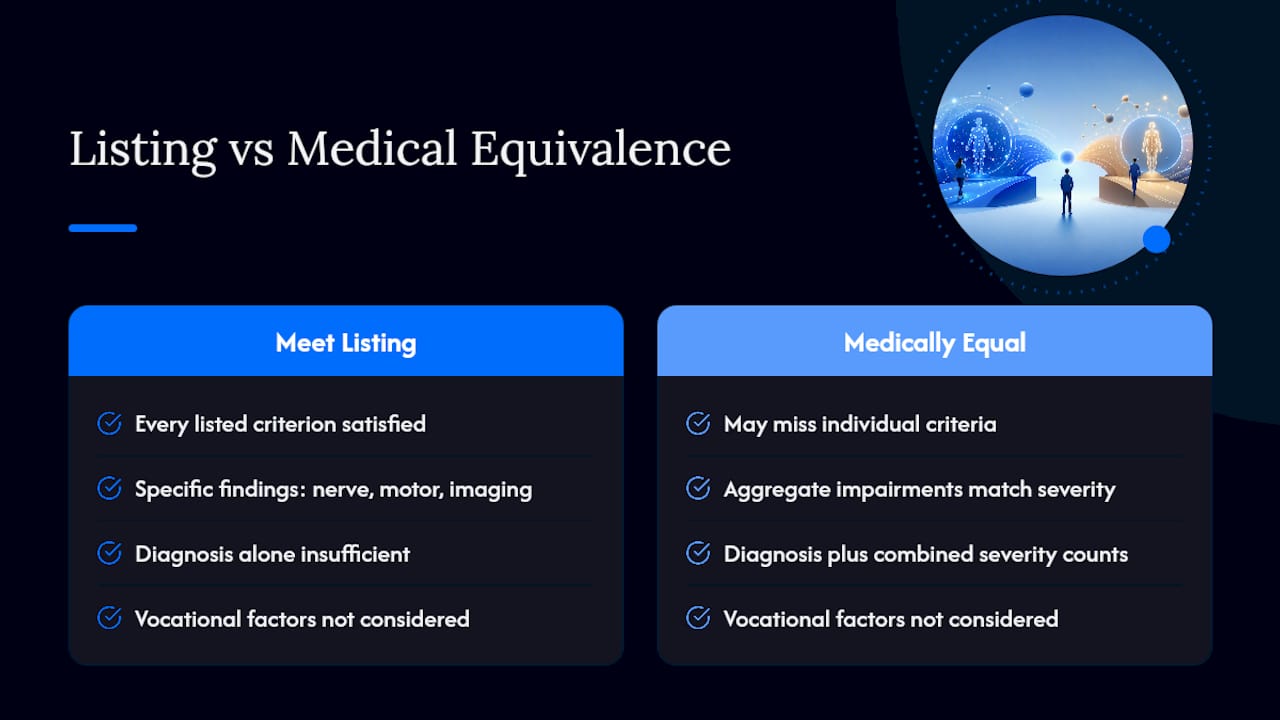
This is where a lot of claims fall apart. Someone diagnosed with degenerative disc disease might genuinely qualify, but only if the file shows the specific nerve root compression, motor loss, and imaging findings the listing demands, not just an MRI report that mentions "disc bulge."
At this stage, adjudicators look strictly at medical severity. Vocational factors like age or job skills don't enter the picture yet, which is exactly why meeting a listing can resolve a claim faster than any other path.
More than 7.2 million disabled workers currently receive SSDI benefits, and a meaningful share of those claims were decided right at this listing-match stage, before vocational analysis was ever needed.
The Medical Evidence SSA Actually Requires
SSA won't take your word for it, and it won't take your doctor's diagnosis at face value either. Evidentiary Requirements call for objective medical evidence: imaging, lab values, clinical findings, and documentation from acceptable medical sources such as licensed physicians, psychologists, and certain nurse practitioners.
Build your file with this sequence in mind:
- Diagnostic imaging and lab results that match the specific values named in the relevant listing (nerve conduction studies, pulmonary function tests, A1C readings).
- Longitudinal treatment notes covering at least several months, showing the condition persists rather than a single flare-up.
- Functional assessments, often documented through residual functional capacity (RFC) narratives, that translate diagnoses into real-world limitations.
- Consultative examination results, if SSA schedules one because your existing records don't cover a gap.
SSA typically orders a consultative examination (CE) when treating records are thin, outdated, or missing a specific test the listing requires. That delay is avoidable.
Pro Tip: Ask your treating physician to reference the specific Blue Book language in their notes, things like exact walking distance, grip strength percentages, or frequency of seizures. Vague phrases like "significant limitations" rarely move a claim forward; numbers do.

When Your Condition Isn't on the List: The RFC Path
Not every impairment maps to a listing, and that's fine. Roughly half of SSDI approvals happen through the medical-vocational allowance rather than a direct listing match. This path runs through your residual functional capacity, a detailed assessment of what you can still do physically and mentally in a work setting.
A strong RFC statement doesn't say "patient has back pain." It says the claimant can stand for short periods at a time, sit limited hours in a workday, and would likely miss multiple days of work per month due to flare-ups. That level of precision is what SSA's later steps actually weigh.
Once SSA confirms you can't meet a listing, it moves to Steps 4 and 5, where age, education, and work history matter:
- Claimants of older age with limited transferable skills often qualify more easily under the medical-vocational grid.
- Younger claimants with more education face a higher bar, since SSA assumes broader job adaptability.
- Physical RFC limits combined with a documented mental impairment (poor concentration, absenteeism) frequently tip a borderline case toward approval.
Compassionate Allowances: When SSA Fast-Tracks a Claim
Compassionate Allowances let SSA approve certain claims almost immediately, without the usual multi-month wait for a full Blue Book review. The program covers conditions with overwhelming, well-established evidence of disability, such as certain aggressive cancers, ALS, and specific rare genetic disorders.
If your condition appears on SSA's published CAL list, tell your attorney or intake specialist immediately; it changes how the file should be assembled.
- CAL claims can be approved in weeks rather than the typical months-long wait.
- The condition still needs medical confirmation, usually a pathology report or specialist diagnosis matching SSA's criteria exactly.
- Not being on the CAL list doesn't disqualify you. It just means you follow the standard listing or RFC route instead.
Building a Blue Book-Ready Claim: What to Collect
Most denials trace back to gaps in the file, not gaps in the underlying medical reality. Here's how to close them before SSA ever sees your application.
- Pull your full treatment history, chronologically, from every provider tied to the impairment. Gaps longer than a few months invite questions.
- Get specialist reports, not just primary care notes. A rheumatologist's assessment carries more weight for lupus than a general practitioner's.
- Collect objective test results, imaging, bloodwork, pulmonary function tests, cognitive testing, anything with a measurable value tied to your listing.
- Keep an activity log documenting bad days versus manageable days, since SSA weighs frequency and duration heavily.
- Request an RFC narrative from your treating physician using concrete numbers: exact sitting/standing tolerances, lifting limits in pounds, and expected monthly absences.
Doctors should write findings the way SSA reads them. "Chronic pain, moderate" convinces nobody. "Lumbar radiculopathy with motor loss in left lower extremity, confirmed via EMG, limiting standing to under 15 minutes" does. That specificity mirrors how the Blue Book's vision-related listings and mental disorder listings are written, in exact, measurable terms.
Pro Tip: If your claim was denied and the letter cites "insufficient medical evidence," don't refile from scratch. Request your case file, identify exactly which listing criterion wasn't met, and target that specific gap on appeal.
Complex claims, especially psychiatric conditions like bipolar disorder, often benefit from attorney involvement at the record-development stage, not just at the hearing.
Where Claimants Go Wrong: An Editorial Take
Most SSDI denials don't stem from a weak medical condition. They stem from a record built around a diagnosis instead of a listing's actual criteria. Claimants assume the diagnosis speaks for itself, and it never does. The second most common mistake is skipping duration evidence, treating notes that stop after three months, leaving SSA no way to confirm the 12-month standard.
The third: functional descriptions that stay vague. "Can't work anymore" tells an adjudicator nothing measurable.
Attorneys tend to close these gaps because they know which listing language actually gets cited in denials, and they push treating physicians toward precise, quantifiable statements before the file ever reaches SSA. Self-filing can work for straightforward, well-documented conditions. Once you're facing a denial, an unusual combination of impairments, or a hearing, professional help stops being optional and starts being the difference between another year of appeals and an actual decision.
— Gerard
How Ssdilawyer Helps You Build a Stronger Claim
Building a Blue Book-ready file while managing a serious medical condition is a lot to carry alone, and one missing test result can stall a claim for months. Ssdilawyer connects you directly with experienced disability attorneys who handle applications, denials, appeals, and hearing representation, at no upfront cost to you.
This matching service makes the most sense once your situation gets complicated: a denial letter citing insufficient evidence, a condition that doesn't cleanly match one listing, or an upcoming hearing where representation changes outcomes. Attorneys matched through Ssdilawyer know how to translate treating physician notes into the language SSA's adjudicators actually look for, including the RFC precision that wins cases outside the listings. Learn how legal representation improves SSDI outcomes and start an intake at Ssdilawyer, where a short questionnaire about your condition and claim status connects you with an attorney suited to your case.
This article is general information, not a substitute for advice from a qualified lawyer. Consult a qualified legal professional about your own circumstances before acting on anything here.
Sources
- Disability Evaluation Under Social Security | Disability | SSA
- SSA - POMS: DI 24508.005 - Impairment Meets a Listing