
Yes, bipolar disorder can qualify for Social Security Disability Insurance when your medical records show the symptoms and work limits SSA Listing 12.04 requires. The Social Security Administration does not pay benefits for a diagnosis alone. It pays for proof that your symptoms stop you from sustaining full-time work, and that proof usually gets tested most rigorously at an ALJ hearing, not at the paperwork stage.
Practitioner reviews of denied claims find a consistent pattern: many mental health cases fail because the file shows a diagnosis without functional limitations attached to it. Three things to do right now: check your insured status and work credits through your my Social Security account, start collecting psychiatric treatment notes, hospitalization records, and medication history, and either begin your application or contact SSDILawyer.co to get matched with a disability attorney who handles bipolar claims.
Key Takeaways
Winning an SSDI claim for bipolar disorder depends on documenting functional limitations under Listing 12.04, not the diagnosis alone, and building that proof into a detailed treating-source RFC and consistent hearing testimony.
| Point | Details |
|---|---|
| Meet Listing 12.04 | Show documented symptoms plus marked or extreme limitation in two or one Paragraph B areas, or a Paragraph C history. |
| Confirm insured status | Check your work credits through my Social Security since SSDI won't pay without enough credits. |
| Document episodes, not stability | Record frequency, duration, and hospitalizations tied to real work disruption, not just calm checkups. |
| Get a detailed RFC | Request a Medical Source Statement quantifying off-task time, absences, and stress tolerance from your psychiatrist. |
| Prepare for the ALJ hearing | Build a hearing binder and line up witness testimony, since hearings are often the decisive stage. |
| Get matched with an attorney | SSDILawyer.co connects claimants with attorneys who build evidence and prepare testimony on contingency. |
Where to Verify SSA Rules and Filing Steps
- SSA Blue Book Listing 12.00/12.04 sets the legal medical criteria.
- POMS DI 34001.032 guides how adjudicators apply those criteria.
- SSA's filing guide (EN-05-10550) covers application steps and required documents.
Table of Contents
- Do You Meet SSA's Criteria for SSI for Bipolar Disorder?
- What Medical Evidence Actually Proves a Bipolar Disability Claim?
- How Do You Apply for SSDI With Bipolar Disorder?
- What Should You Do if Your Bipolar SSDI Claim Is Denied?
- Do You Need a Disability Attorney for a Bipolar Claim?
- What We See Go Wrong in Bipolar SSDI Files
- Get Matched With an Attorney Who Knows Bipolar Claims
- Frequently Asked Questions
- Sources
Do You Meet SSA's Criteria for SSI for Bipolar Disorder?
The SSA reviews bipolar disorder under Blue Book Listing 12.04, "Depressive, bipolar and related disorders." The listing covers bipolar I, bipolar II, cyclothymic disorder, and bipolar disorder caused by another medical condition, and it works on two possible pathways.
The first pathway requires medical documentation of specific symptoms, such as pressured speech, flight of ideas, inflated self-esteem, decreased need for sleep, distractibility, risky or impulsive behavior, and increased goal-directed activity, combined with a marked or extreme limitation in mental functioning. SSA measures that limitation across four areas, often called the Paragraph B criteria:
- Understanding, remembering, or applying information
- Interacting with others
- Concentrating, persisting, or maintaining pace
- Adapting or managing oneself
"Marked" means your functioning in that area is seriously limited on a sustained basis. "Extreme" means you cannot function in that area independently at all. You need an extreme limitation in one area, or a marked limitation in two, to satisfy Paragraph B.
The second pathway, Paragraph C, applies if your bipolar disorder is "serious and persistent": a documented history of at least two years with ongoing treatment that only marginally controls your symptoms.
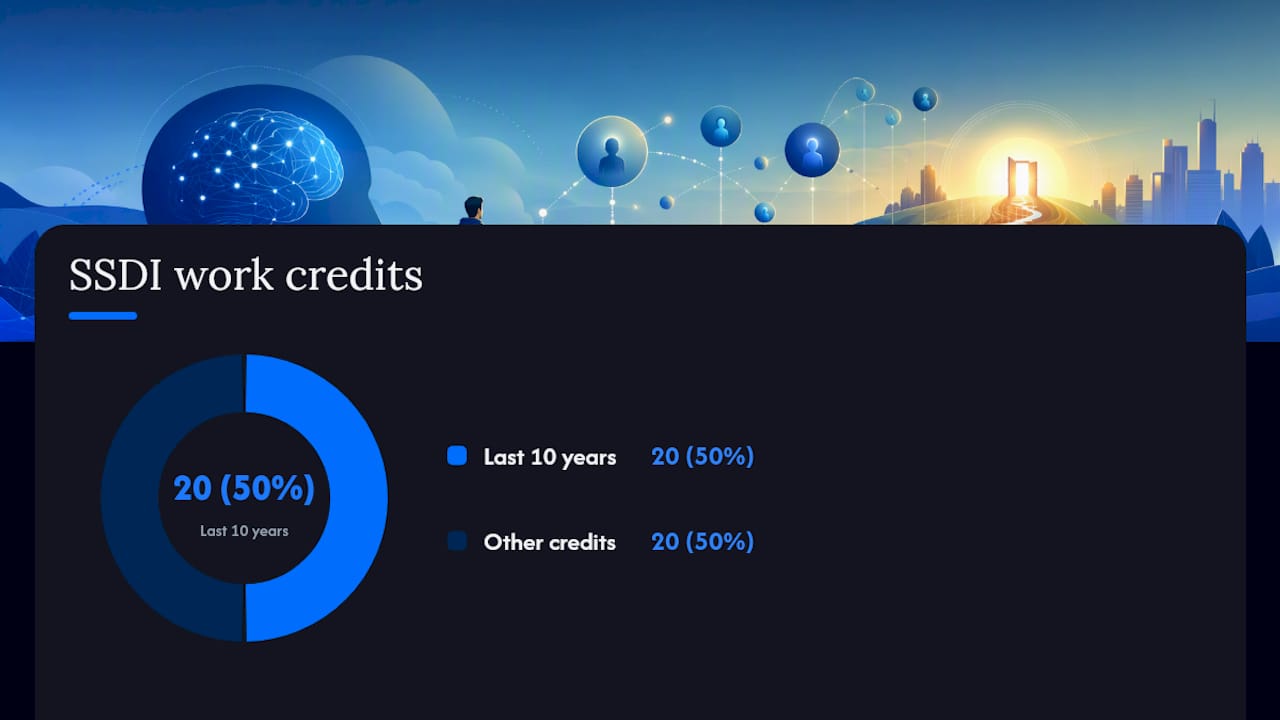
Meeting the medical listing is only half the equation. SSDI also requires insured status, meaning you have enough work credits, typically around 40 credits with 20 earned in the last 10 years for most adults. You can check your credit total through your my Social Security account. Without enough credits, SSA will not pay SSDI even if your bipolar disorder clearly meets Listing 12.04.
What Medical Evidence Actually Proves a Bipolar Disability Claim?
SSA does not evaluate your diagnosis. It evaluates what your diagnosis does to your ability to work, which is why the strongest files build a direct line from clinical symptoms to job tasks. A thin file that shows only "stable" checkup notes tends to get denied, even when the underlying illness is severe, because it never shows what happens during an episode.
Build your record around these documents:
- Treating psychiatrist notes covering at least a year, including notes from mood episodes, not just stable visits
- Therapy or counseling records showing ongoing treatment engagement
- Psychiatric hospitalization and ER discharge summaries
- A full medication history, including drug changes, dosage adjustments, and documented side effects
- Neuropsychological or cognitive testing results, when available
- Third-party statements from family members, roommates, or former supervisors who witnessed real-world impairment
The single most valuable document is often a detailed residual functional capacity (RFC) statement from your treating psychiatrist. A vague note describing "mood swings" carries little weight. A useful RFC quantifies specifics: expected off-task time per shift, likely absences per month, ability to tolerate ordinary workplace stress, and capacity to interact appropriately with supervisors and coworkers on a sustained basis.
Pro Tip: Ask your treating psychiatrist directly for a Medical Source Statement or RFC form rather than a general letter. Request that it name specific work tasks, such as maintaining a production quota or arriving on schedule five days a week, and explain exactly why your symptoms interfere with each one.
How Do You Apply for SSDI With Bipolar Disorder?
Filing follows a defined sequence, and each step feeds directly into how SSA evaluates your case.
- Start your application online through your my Social Security account or at your local SSA office.
- Complete the Disability Report (SSA-3368) and Function Report (SSA-3373-BK), describing your typical day and specific limitations in plain, concrete terms.
- Gather and submit your medical records, or provide SSA with the names and addresses of every treating provider so the agency can request them directly.
- Attend a consultative exam only if SSA schedules one because your existing records are incomplete.
Before you submit, assemble a document pack that mirrors what a reviewer will actually read:
- Psychiatry and therapy notes
- Medication logs with dates and dosage changes
- Hospitalization and ER discharge summaries
- Work records showing missed shifts, write-ups, or performance warnings tied to your symptoms
- Written statements from family or household members
Timelines vary by SSA workload and region, but claimants should plan for several months for an initial decision, a similarly long wait at reconsideration if the first decision is denied, and an ALJ hearing wait that often runs 12 to 24 months. If approved, SSDI also applies a five-month waiting period from your disability onset date before benefits begin. Understanding how SSDI benefits work before you file helps you set realistic expectations for the months ahead.
What Should You Do if Your Bipolar SSDI Claim Is Denied?
Most bipolar disorder claims that eventually win do not win on the first try. The appeals path runs through five potential stages: reconsideration, a hearing before an administrative law judge, Appeals Council review, and, rarely, federal court. Legal commentary on mental health appeals consistently points to the ALJ hearing as the stage where cases most often turn, because it is the first time a judge hears testimony that fills in what chart notes leave out.
Prepare for a hearing methodically:
- Build a hearing binder organized chronologically, from earliest diagnosis to your most recent treatment note.
- Confirm you have a current, detailed treating-source RFC on file, updated within the last several months.
- Line up witnesses, family members, former coworkers, or supervisors, who observed specific failures to sustain work.
- Draft testimony prompts that turn mood episodes into concrete work disruption: how often episodes occur, how long they last, whether they required time off or hospitalization, and what triggers a decompensation.
Effective testimony sounds like this: "In the six months before I stopped working, I missed eleven days and was written up twice for falling asleep at my desk during a depressive episode." That kind of detail does far more than "I have bad days sometimes."
- Keep claimant and witness testimony consistent with the medical record; contradictions get noticed
- Coach witnesses to describe what they saw, not what they think caused it
- Use the hearing to surface real-world functioning the charts never captured
Pro Tip: Judges weigh testimony heavily precisely because clinical notes rarely capture a bad week in real time. If your hearing testimony and your medical records tell the same story from two different angles, that consistency is what moves a denial toward an approval.
If you're building your appeal without representation, a structured appeal strategy can help you avoid the most common self-representation mistakes.
Do You Need a Disability Attorney for a Bipolar Claim?
An experienced disability attorney earns their fee by doing the work most claimants cannot do alone: requesting the right records, pushing treating psychiatrists for a usable RFC, preparing witnesses, and building hearing testimony that lines up with the medical file.
- Attorneys know which gaps in a psychiatric record get claims denied and can request supplemental evidence before a hearing, not after
- They prepare claimants and witnesses so testimony holds up under an ALJ's questions
- They handle appeals procedure and deadlines, which are easy to miss while managing a serious mental illness
Most disability attorneys work on contingency, meaning you owe nothing unless your claim succeeds. Before signing with anyone, ask about their experience with bipolar disorder claims specifically, their track record at ALJ hearings, and a plain explanation of the fee structure. SSDILawyer.co connects claimants with attorneys who handle exactly these cases.
What We See Go Wrong in Bipolar SSDI Files
The most common mistake is submitting a file full of "stable" appointments and nothing else. Records that only capture calm periods make a serious illness look manageable on paper, even when it isn't.

One pattern we see repeatedly: a claimant is denied twice with a file full of routine fifteen-minute check-ins, then wins at hearing after their attorney obtains a detailed RFC and two witness statements describing specific missed shifts and a hospitalization. Nothing about the underlying illness changed. The evidence did.
If you take one action from this article, make it this: ask your psychiatrist for a detailed RFC that ties your symptoms to specific work tasks, and start logging the frequency and duration of your episodes today, before your next appointment.
Get Matched With an Attorney Who Knows Bipolar Claims
SSDILawyer.co is a matching service, not a law firm. It connects you directly with experienced disability attorneys who handle SSDI applications, denials, appeals, and ALJ hearings for claimants with bipolar disorder and other mental health conditions.
Here's what happens after you submit an inquiry: you complete a short intake form describing your condition and claim status, SSDILawyer.co matches you with an attorney experienced in psychiatric disability cases, and that attorney reviews your file, requests the treating-source RFC your case needs, and prepares your evidence and testimony for hearing under a standard contingency-fee arrangement, meaning no upfront attorney fee in most cases. If you're weighing self-representation, understanding what an attorney adds at each appeals stage is worth ten minutes before you decide. Start the matching process at Ssdilawyer and most claimants hear back about a potential attorney match within a few business days.
Frequently Asked Questions
Can you get SSDI for bipolar disorder if you're still working part time? Working part time doesn't automatically disqualify you, but earnings above SSA's substantial gainful activity threshold can. SSA looks at whether your part-time work reflects genuine sustained capacity or accommodations your employer wouldn't normally allow.
How long does an SSDI claim for bipolar disorder usually take? Expect several months for an initial decision, a similar wait at reconsideration if denied, and potentially 12 to 24 months for an ALJ hearing, depending on your region's caseload.
What if I don't have enough work credits for SSDI? Without sufficient insured status, SSDI won't pay regardless of how severe your bipolar disorder is. SSDI and SSI are separate programs with different eligibility rules, so it's worth understanding which one actually fits your work history.
Do I need a psychiatrist's opinion specifically, or can a therapist's notes work? Therapy records help establish ongoing treatment and symptom history, but SSA gives the most weight to a treating psychiatrist's RFC because psychiatrists can speak directly to diagnosis, medication response, and functional capacity. A qualified psychiatric provider can help document that history if you don't currently have one.
Will SSA review my case again after I'm approved? Yes. SSDI cases undergo periodic continuing disability reviews. Bipolar disorder is a chronic condition, so reviews typically focus on whether your treatment history and functional limitations remain consistent with your original approval.
This article is general information, not a substitute for advice from a qualified lawyer. Consult a qualified legal professional about your own circumstances before acting on anything here.
Sources
- 12.00 Mental Disorders - Adult | Disability | SSA
- POMS: DI 34001.032 - Mental Disorders
- How to prepare for filing a disability claim | SSA publication (EN-05-10550)
- Disability for mental illness: how to qualify and what to expect | DisabilityFiled