
Yes, depression qualifies for SSDI when your medical records meet Social Security's standard, either by matching Blue Book Listing 12.04 or by proving your residual functional capacity leaves you unable to sustain full-time work. You get there through documentation, not diagnosis alone. Before filing, confirm your monthly earnings fall under the substantial gainful activity limit, and start collecting specialist treatment notes now, since thin records are the top reason these claims fail.
TL;DR:
- Meeting SSA's listing requires documented symptoms across multiple visits, especially evidence of five or more symptoms like depressed mood or sleep disturbance.
- Functional limitations must be shown through concrete examples of marked or extreme impairments in understanding, social interaction, concentration, or self-management.
- Combining depression with other conditions like chronic pain or heart issues can strengthen a claim if evidence shows they impair daily functioning together.
- Proper evidence includes specialist treatment notes, detailed medication history, hospitalization records, standardized test scores, and third-party reports.
- Earning more than the current substantial gainful activity limit of $1,690 per month generally disqualifies a claim, unless within a trial work period.
Table of Contents
- SSA Blue Book Listing 12.04: Paragraph A, B, and C Explained
- How SSA Evaluates Functional Limits and Builds an RFC
- Evidence That Convinces SSA: Records and How to Organize Them
- Work Rules, SGA, and Benefit Basics You Must Know
- How to Apply and the Appeals Process: Timelines to Expect
- Common Denial Reasons and How to Strengthen an Appeal
- How Attorneys and SSDILawyer.co Help With Depression Claims
- What Claimants Consistently Get Wrong About Documentation
- Consider SSDILawyer.co If You Need Attorney-Level Support
- Sources
SSA Blue Book Listing 12.04: Paragraph A, B, and C Explained
Listing 12.04 is the Social Security Administration's official rulebook for depressive, bipolar, and related disorders, and it works like a three-part test. You need Paragraph A symptoms documented in your medical file, plus either Paragraph B functional deficits or Paragraph C evidence of a long-term, fragile condition. Meeting the symptom checklist alone rarely wins a claim. What decides most cases is whether the paperwork shows the functional damage Paragraph A is supposed to cause.
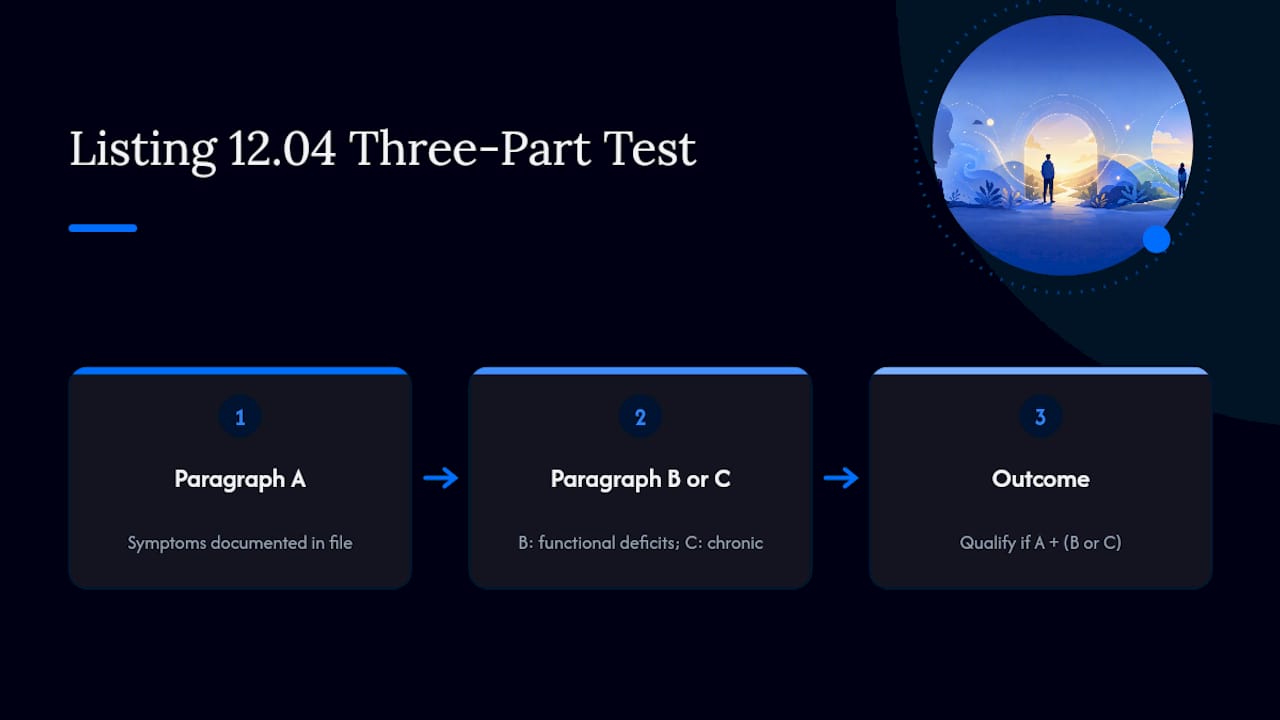
What Paragraph A requires
SSA looks for medical documentation of five or more of the following, appearing consistently across your treatment notes:
- Depressed mood
- Diminished interest in almost all activities
- Appetite disturbance with significant weight change
- Sleep disturbance
- Observable psychomotor agitation or retardation
- Decreased energy
- Feelings of guilt or worthlessness
- Difficulty concentrating or thinking
- Thoughts of death or suicidal ideation
A single mention of "feeling down" during a primary care visit won't cut it. SSA wants a pattern across multiple visits, ideally documented by a psychiatrist or psychologist who tracks these symptoms over time rather than a doctor jotting a quick note between blood pressure checks.
What Paragraph B measures
Paragraph B is where most depression claims actually get won or lost. SSA rates your functioning across four domains, using a scale from none to extreme, and you meet the criteria with an extreme limitation in one domain or a marked limitation in two, according to SSA's POMS guidance:
- Understanding, remembering, or applying information. Can you follow multi-step instructions, or do you forget what you were told five minutes ago?
- Interacting with others. Do you avoid coworkers, snap at family, or cancel plans because leaving the house feels impossible?
- Concentrating, persisting, or maintaining pace. Can you finish a task in a normal timeframe, or do you start and abandon things repeatedly?
- Adapting or managing oneself. Can you keep a routine, manage hygiene, or handle a schedule change without falling apart?
"Marked" means the limitation seriously interferes with your ability to function independently, appropriately, and effectively on a sustained basis. "Extreme" means you can't function in that area at all. Adjudicators look for concrete examples in the record, not vague adjectives like "struggles sometimes."
What Paragraph C offers instead
Paragraph C exists for people whose depression is chronic but doesn't clearly reach "marked" or "extreme" on paper. It requires a documented history of the disorder lasting at least two years, ongoing medical treatment or a highly structured setting that reduces symptoms, and evidence of marginal adjustment. That last term means minimal capacity to adapt to changes in your environment or new demands. Someone who relapses every time work hours increase, or who needs a family member managing appointments and medications, often fits this pathway.
How SSA Evaluates Functional Limits and Builds an RFC
When your file doesn't clearly meet Listing 12.04, SSA doesn't just deny the claim. It builds a Residual Functional Capacity assessment, essentially a map of what you can still do despite your symptoms. Your RFC then gets compared against the demands of your past work and other jobs in the economy. If no job fits, you're found disabled even without meeting a listing outright, based on findings summarized by Disability Exchange.
Each Paragraph B domain translates into specific, real-world restrictions an adjudicator can act on:
- Concentration problems become "cannot maintain attention for two-hour blocks" or "off-task 20% of the workday."
- Social difficulties become "cannot tolerate more than occasional interaction with the public or supervisors."
- Trouble adapting becomes "cannot respond appropriately to routine changes in a work setting."
- Pace deficits become "cannot sustain a normal production rate without excessive breaks."
Pro Tip: Ask your psychiatrist to describe your limitations in work terms, not just clinical terms. "Moderate depression" tells SSA almost nothing useful. "Unable to sustain concentration for two-hour segments without redirection" tells a vocational expert exactly what jobs you can't do.
Combined impairments matter here too. If you have depression alongside chronic pain, fibromyalgia, or a heart condition, none of which alone meets a listing, SSA still has to consider what happens when they're stacked together. A 2021 finding from Disability Exchange notes that combined RFC evidence can show an inability to sustain competitive, full-time employment even when each condition looks moderate in isolation. This is where a lot of claimants sell themselves short, treating each diagnosis as a separate, smaller problem instead of describing how they interact on a bad day.

Evidence That Convinces SSA: Records and How to Organize Them
SSA doesn't take your word for how depression affects you. It relies on paper, and the paper needs to tell a consistent, specific story. Build your file in this order:
- Specialist treatment notes. Records from a psychiatrist or psychologist carry far more weight than a general practitioner's brief mental health checkbox. Therapy notes that describe specific functional struggles, missed work, canceled appointments, panic before job interviews, do more work than a diagnosis code ever will.
- Medication history and treatment response. List every medication tried, dosages, side effects, and whether it helped. A record showing you cycled through five antidepressants over three years with limited relief supports the "serious and persistent" argument far better than a single prescription that's never been adjusted.
- Hospitalizations and crisis visits. Inpatient stays, ER visits for suicidal ideation, or emergency psychiatric holds are some of the strongest evidence SSA reviews, according to DisabilityFiled's claim guidance.
- Psychological testing scores. Standardized instruments like the PHQ-9 for depression severity or WHODAS 2.0 for functional disability give adjudicators a number they can compare over time, based on assessment tools referenced by the American Psychological Association. A PHQ-9 score that stays in the severe range for a year is harder to dismiss than a subjective narrative.
- Third-party function reports and employment records. Statements from a spouse, close friend, or former supervisor describing what they've observed, missed shifts, forgotten responsibilities, withdrawal from family events, add a layer of corroboration SSA weighs alongside medical evidence.
Be honest about gaps. If you missed appointments because you couldn't afford copays or couldn't leave the house, say so in your own function report. SSA's adjudicators have seen every excuse; a documented reason for a treatment gap is far more credible than a record that pretends the gap doesn't exist. For claimants with related mood disorders, the documentation approach for bipolar disorder claims follows nearly identical logic.
Work Rules, SGA, and Benefit Basics You Must Know
Before SSA even looks at your medical evidence, it checks your income. If you're earning above the substantial gainful activity threshold, your claim typically gets denied at the first step, regardless of how severe your depression is.
The number that decides everything first: SSA sets the non-blind SGA limit at $1,690 per month in 2026. Earn more than that in countable income, and your claim usually doesn't get past the initial screening.
There's a narrow exception worth knowing about: the trial work period. If you're already receiving SSDI and attempt to return to work, you can test your ability for up to nine months without automatically losing benefits, as long as you report the work. This exists specifically because SSA recognizes that mental health conditions like depression can fluctuate, and someone might try to work during a stable stretch only to relapse months later.
As for what benefits actually pay, the amount depends entirely on your individual earnings history, not your diagnosis. Reported figures put the average monthly SSDI benefit around $1,630, with a maximum near $4,152, according to Disability Exchange. If you want a clearer personal estimate before you file, a Social Security benefit calculator can give you a rough figure based on your own earnings record.
How to Apply and the Appeals Process: Timelines to Expect
Filing is the easy part. Getting through the review is where patience gets tested.
- Choose your filing channel. You can apply online through SSA's iClaim system, call the SSA hotline, or schedule an appointment at a local field office. Before you start, have your work history, medication list, treating providers' contact information, and a summary of your daily limitations ready.
- Wait for the initial decision. Standard processing typically runs a few months, though mental health claims often take longer if SSA orders a consultative examination or requests additional records from a provider who's slow to respond. Delays frequently trace back to incomplete medical evidence, so a well-organized file at filing genuinely speeds things up.
- Expect a possible consultative exam. If your existing records don't answer SSA's questions about your functional limits, the agency schedules a consultative examination with a psychologist it selects. These exams are brief, often 30 to 45 minutes, and shouldn't be treated as a formality. Answer honestly about bad days, not just how you feel on your best one.
- File for reconsideration if denied. Most initial claims are denied, mental health claims included. Reconsideration is a paper review by a different examiner, and it's where new evidence, especially updated specialist notes, matters most.
- Request an ALJ hearing. If reconsideration fails, you can request a hearing before an Administrative Law Judge. This stage often runs the longest wait of the entire process and is also where legal representation tends to make the clearest difference, since a lawyer can prepare a medical source statement and manage questioning from a vocational expert.
- Escalate to the Appeals Council or federal court if needed. These final stages are rare but exist for claimants who believe the ALJ made a legal or factual error. For a full breakdown of what happens at each stage and how long claimants typically wait, see this appeals process walkthrough.
Common Denial Reasons and How to Strengthen an Appeal
Depression claims get denied for predictable reasons, and most of them are fixable with the right documentation strategy.
- Insufficient specialist records. A claim built on primary care visits alone rarely survives. If you haven't seen a psychiatrist or psychologist regularly, start now, and ask your current provider for a referral if cost is the barrier.
- Gaps in treatment. SSA reads unexplained gaps as a sign your condition improved. If you stopped therapy because you couldn't afford it or couldn't get out of bed to attend, document that reason directly in your function report.
- Inconsistent activity statements. Posting on social media about a weekend trip while claiming you can't leave the house creates a credibility problem. Be consistent and specific about what you can and can't do, and on which days.
- Earnings above SGA. Even part-time work can trip this wire if it pushes your countable income over the $1,690 monthly threshold.
The single most effective fix is a medical source statement, a form your treating psychiatrist or psychologist completes that translates clinical findings directly into work restrictions. Request one before your hearing, not after another denial. A strong statement paired with function reports from family or former employers is often what separates a case that gets approved on appeal from one that gets denied a second time. For claimants also managing PTSD or anxiety alongside depression, co-occurring conditions strengthen a claim when the record shows how the disorders compound each other's limitations rather than existing as isolated diagnoses.
How Attorneys and SSDILawyer.co Help With Depression Claims
Attorneys who focus on SSDI work do three things well: they develop medical evidence that actually maps to Listing 12.04, they prepare claimants for what an ALJ will ask, and they cross-examine the vocational expert who testifies about available jobs. Representation tends to matter most after a denial, when records need strengthening, or heading into a hearing where testimony and expert questioning decide the outcome.
Ssdilawyer connects claimants with attorneys experienced in these cases. Intake is straightforward: you describe your situation, and the match is based on your claim stage and needs, whether you're filing fresh or fighting a denial.
What Claimants Consistently Get Wrong About Documentation
The gap between a strong depression claim and a weak one usually comes down to habits nobody tells you to build. Keep a daily function diary. Not a mood journal, a factual log: "Didn't shower until 4pm," "Canceled dentist appointment, couldn't make the call," "Forgot to pay rent, third time this year." These specifics map directly onto SSA's functional domains in a way vague self-reports never do.
See a psychiatrist or psychologist on a fixed schedule, and ask them, plainly, to write down what you can't do, not just how you feel. Most claimants expect one denial. Plan your documentation like you'll need to survive two, because you probably will.
— Gerard
Consider SSDILawyer.co If You Need Attorney-Level Support
Ssdilawyer exists for the moment when the paperwork stops being manageable alone, whether that's after a first denial, before a hearing date lands on your calendar, or when your case involves overlapping conditions that make the RFC picture complicated. Instead of researching attorneys one by one and cold-calling firms, Ssdilawyer matches you directly with disability attorneys experienced in mental health claims.
Reach out with your claim stage, whether you're applying for the first time, waiting on reconsideration, or preparing for a hearing, and have your denial letter, treatment history, and current medication list on hand. That single step often replaces weeks of searching with a direct connection to someone who can start building your case. Start your match with an SSDI attorney today.
Sources
For rules straight from the source, skip secondary summaries and go to SSA directly:
- 12.00 Mental Disorders - Adult | Disability | SSA
- SSA - POMS: DI 34001.032 - Mental Disorders
- How to Get SSDI for Depression: What the SSA Needs to Approve You | DisabilityFiled
For practical claim-building steps, a case development guide and a functional limitations resource translate these rules into concrete document checklists.
This article is general information, not a substitute for advice from a qualified lawyer. Consult a qualified legal professional about your own circumstances before acting on anything here.