
A medical vocational allowance is the SSA's path to approval when your medical records don't match a Blue Book listing but your residual functional capacity and vocational factors show you cannot do any other work in the national economy. The five levers are RFC, age, education, past relevant work, and non-exertional limits. Start by gathering current medical records and a detailed functional capacity statement, then consider talking to a disability attorney familiar with own occupation disability insurance.
TL;DR:
- Most SSDI approvals occur through medical vocational allowances rather than meeting a Blue Book listing, relying on residual functional capacity and vocational factors.
- Age, education, and past relevant work significantly influence grid rules, with older age and limited skills often favoring approval under the framework analysis.
- Non-exertional limits require detailed documentation and expert testimony, as they prevent the direct application of grid rules and demand case-specific weighing.
- Strong evidence includes consistent medical records, objective test results, detailed RFC forms, and accurate job descriptions, all tailored to SSA’s language.
- Unsupported or vague RFC forms and job descriptions are the main reasons cases are denied, making detailed documentation and legal help essential.
Table of Contents
- What Is a Medical Vocational Allowance?
- How SSA Uses Your RFC and the Medical Vocational Grids
- Age, Education, and Past Work: The Factors That Move the Grids
- Non-Exertional Limits and Why Rule 204.00 Isn't a Shortcut
- Evidence That Actually Strengthens Your MVA Claim
- What an Allowance Gets You and How Long It Takes
- If SSA Denies You: Appeals, Hearings, and the Case for Counsel
- A Straight Look at Where Claims Usually Fall Apart
- Connect With a Disability Attorney Through Ssdilawyer
- Where to Verify These Rules Yourself
- Sources
What Is a Medical Vocational Allowance?
A medical vocational allowance, or MVA, is an approval SSA grants when your condition doesn't technically meet or equal a listed impairment in the Blue Book, but your functional limitations still rule out substantial work. Instead of checking your diagnosis against a checklist, SSA looks at what your body and mind can still do and whether any job in the national economy fits that capacity.
This is where most approvals actually happen. According to Nolo's explanation of medical vocational allowances, the majority of claimants who win benefits do so through an MVA rather than by meeting a listing outright, since RFC and vocational factors drive the outcome.
MVAs come into play at two specific points in SSA's sequential evaluation:
- Step 4: SSA compares your RFC to the physical and mental demands of your past relevant work.
- Step 5: if you can't return to past work, SSA checks whether your RFC allows you to adjust to other work, factoring in age, education, and skills.
How SSA Uses Your RFC and the Medical Vocational Grids
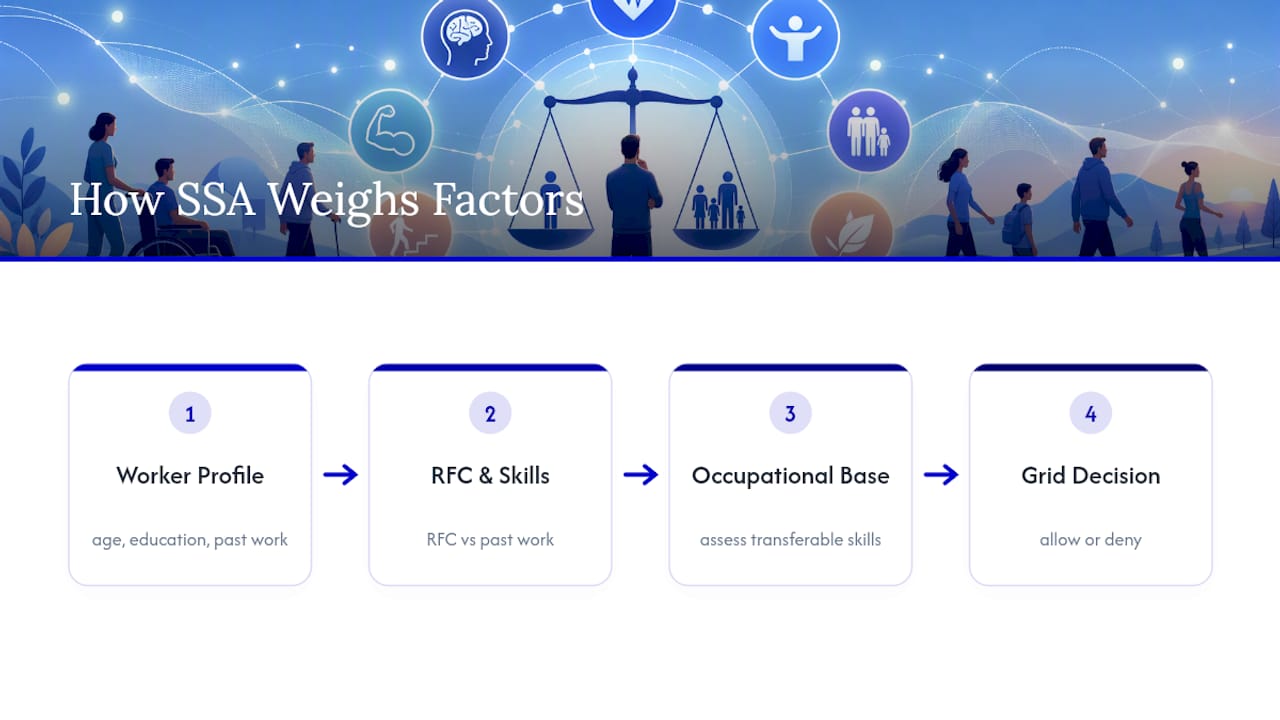
Your residual functional capacity is SSA's technical estimate of what you can still do on a sustained, full-time basis. It covers how long you can sit, stand, or walk in a workday, how much weight you can lift or carry, and mental factors like concentration, memory, and stress tolerance.
SSA sorts that RFC into an exertional category, and each category lines up with one of three grid tables described in DI 25025.001:
- Table No. 1 applies to sedentary work (mostly sitting, occasional lifting up to 10 pounds).
- Table No. 2 applies to light work (standing/walking most of the day, lifting up to 20 pounds).
- Table No. 3 applies to medium work (lifting up to 50 pounds).
Once your exertional level is set, the grid cross-references it against your age, education, and past work to answer one question: does other work exist that you could realistically do? When your RFC and vocational profile line up exactly with a grid rule, that rule "directs" a finding of disabled or not disabled, no further vocational testimony needed.
Age, Education, and Past Work: The Factors That Move the Grids
The grids don't just look at what's wrong with you physically. They weigh who you are as a worker, and that's where the real leverage often sits.
Age matters more than most claimants expect. SSA splits applicants into younger individual, closely approaching advanced age, advanced age, and closely approaching retirement age categories. The "Older Worker" rules exist because SSA recognizes that a 58 year old with a limited work history has far less realistic shot at retraining for new work than someone in their 30s, and that fact alone can flip a grid rule from denied to approved.
Education categories, from illiterate through college graduate, affect how easily SSA assumes you can shift into different work. Illiteracy or a marginal education narrows the occupational base significantly.
Past relevant work gets compared function by function against your current RFC. If your skills don't transfer to less demanding jobs, that absence of transferable skills often becomes the deciding factor, especially when combined with older worker status.
Non-Exertional Limits and Why Rule 204.00 Isn't a Shortcut
Non-exertional limitations don't show up on a lifting chart. They include trouble concentrating, difficulty handling workplace stress, sensitivity to noise or fumes, and problems with fine manipulation. These limits are easy to underdocument because they don't produce an obvious physical marker the way a torn rotator cuff does.
When non-exertional limits are present, SSA can no longer let a grid rule automatically direct the outcome. Instead, rule 204.00 gets used as a framework, not a directing rule, per DI 25025.005. That distinction changes everything about how a case gets built. Under framework analysis, an adjudicator has to actually weigh how much your specific limitations erode the pool of available jobs, often relying on vocational expert testimony to estimate what's left of the occupational base.
Evidence That Actually Strengthens Your MVA Claim
Approvals hinge on paperwork that ties your symptoms to objective findings. Vague complaints rarely move the needle. Specific, well-documented restrictions do.
- Treating physician records. Consistent notes over time, showing your condition and its limitations, carry more weight than a single visit.
- Objective testing. Imaging, nerve conduction studies, pulmonary function tests, and psychological evaluations back up subjective complaints.
- A detailed RFC form from your treating doctor. Ask them to tie each restriction (lifting limits, time off task, absences) to a specific test result or clinical finding, not just a general impression.
- A precise description of your past job duties. Function by function, not a job title. Misclassifying a job as "light" when it was actually "medium" can flip the entire grid analysis, a point Nolo's guide covers in detail.
- Consultative exam or vocational expert input, when your file lacks recent objective data or your case involves complex non-exertional limits.
Pro Tip: Ask your doctor to describe restrictions in SSA's own language, terms like "occasional," "frequent," and "off task 15% of the workday," rather than general statements like "limited mobility." Specific language maps directly onto the RFC form SSA actually uses.
What an Allowance Gets You and How Long It Takes
An SSDI allowance means monthly benefits and, after a 24 month waiting period, Medicare coverage. SSI allowances bring monthly payments and often immediate Medicaid eligibility, depending on your state.
Timelines vary widely. Initial decisions often take three to six months, and many strong MVA claims still get denied at that stage, pushing claimants toward reconsideration and eventually a hearing. If you're also managing veteran status, VA disability compensation runs on a separate track. State vocational rehabilitation services can support a return to work without jeopardizing your claim.
If SSA Denies You: Appeals, Hearings, and the Case for Counsel
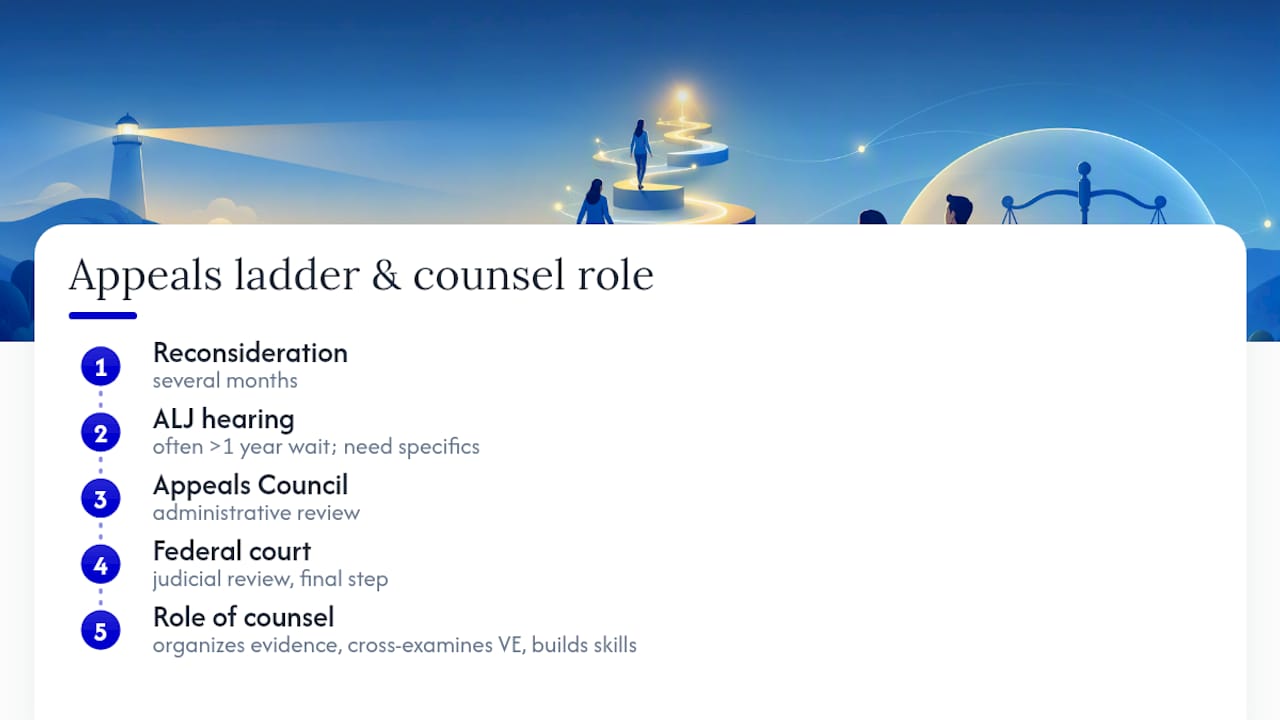
A denial isn't the end of the road. The appeals ladder runs through reconsideration, then a hearing before an Administrative Law Judge, then the Appeals Council, and finally federal court. Reconsideration alone often takes several months, and hearing wait times commonly stretch beyond a year in many regions.
ALJ hearings tend to favor claimants who arrive with tightly documented non-exertional limits and credible vocational testimony, because that's exactly where framework analysis lives. A judge weighing rule 204.00 needs specifics, not generalities, to shrink the occupational base in your favor.
This is where legal representation tends to pay off. An experienced attorney organizes medical evidence around the grid rules, cross-examines the vocational expert's job estimates, and builds the transferable-skills argument that often decides the case. Gerard and the team at SSDILawyer.co regularly connect claimants with attorneys who understand ALJ hearing strategy for exactly this kind of framework case.
A Straight Look at Where Claims Usually Fall Apart
The most common mistake isn't a weak medical condition. It's a thin RFC form and a vague job description that leaves SSA guessing instead of deciding in your favor. Claimants often describe their old job in generic terms, when the specific lifting requirements and time-on-task details are what actually move a grid rule.
Three things to do now: request a detailed RFC from your treating doctor, compile the last 12 months of medical records, and talk to an attorney before your hearing date, not after a denial arrives.
— Gerard
Connect With a Disability Attorney Through Ssdilawyer
Building a strong medical vocational allowance claim means pairing solid medical evidence with someone who knows how ALJs actually apply rule 204.00 in practice. Ssdilawyer is the alternative to guessing your way through SSA's grid rules alone. Instead of researching vocational expert tactics on your own, Ssdilawyer connects you directly with an experienced disability attorney who already knows how to frame transferable-skills arguments and cross-examine vocational testimony.
Here's what to expect when you start:
- A short intake covering your medical history, work background, and current claim status.
- A review of your existing records to spot gaps before SSA does.
- A discussion of representation options, including hearing-stage support if you've already been denied.
Start the process at the Ssdilawyer and get matched with an attorney who handles cases like yours.
Where to Verify These Rules Yourself
For readers who want to check SSA's own language, DI 25025.005 on using the medical vocational guidelines explains directing versus framework analysis. DI 25025.001 covers the three grid tables directly. Nolo's overview of medical vocational allowances offers a plain-language walkthrough of RFC and PRW comparisons.
This article is general information, not a substitute for advice from a qualified lawyer. Consult a qualified legal professional about your own circumstances before acting on anything here.
Sources
- DI 25025.001 - The Medical‑Vocational Guidelines
- Getting disability through a medical‑vocational allowance (Nolo)