
A protective filing date is the day Social Security officially records that you intend to apply for SSDI or SSI, even before your paperwork is complete. It becomes your legal filing date under SSA POMS GN 00204.010, which can preserve months of retroactive benefits you would otherwise lose while gathering medical records or waiting for an appointment.
TL;DR:
- Claimants must explicitly notify SSA of their intent to file through a documented contact to establish a valid protective filing date; mere browsing does not suffice.
- SSDI claimants have only six months to complete and submit their application after establishing protective filing, while SSI claimants have a 60-day window.
- Failing to meet the closeout deadlines or not recording confirmation details can result in losing the protective filing date and the associated retroactive benefits.
- An earlier protective filing date can significantly increase retroactive benefits and potentially shift the five-month SSDI waiting period earlier.
- Proper documentation, timely action, and professional case management improve the chances of preserving benefits and avoiding costly procedural mistakes.
Table of Contents
- Why the Protective Filing Date Matters
- SSDI vs. SSI: The Rules Are Not the Same
- How to Establish a Protective Filing Date
- Deadlines and What Happens If You Miss Them
- What a Protective Filing Date Actually Changes
- Mistakes That Cost Claimants Their Protective Date
- Why Deadline Tracking Separates a Strong Claim From a Lost One
- Getting Help Preserving Your Filing Date
- Why Getting This Right the First Time Matters
- Sources
Why the Protective Filing Date Matters
The protective filing date exists because completing a full disability application takes time, and Social Security does not want claimants penalized for that delay. Once you notify the Social Security Administration (SSA) of your intent to file, that date locks in as your official filing date under GN 00204.010, the current POMS section governing protective writings for both Title II (SSDI) and Title XVI (SSI) claims. That policy carries fresh weight in 2026: updated guidance took effect April 27, 2026. It changes how certain filings interact between programs.
The date itself does three things for your claim.
- It sets the earliest point SSA will use when calculating retroactive benefits.
- It starts the clock on program-specific closeout periods, meaning you still have to file a complete application.
- It can determine your SSDI five-month waiting period or your SSI eligibility month, both of which hinge on the calendar.
None of this happens automatically just because you thought about applying. You have to tell SSA, in a way the agency can document, that you intend to file. Skip that step and the date you actually submit your paperwork becomes your only filing date, no matter how long you struggled with symptoms beforehand.
SSDI vs. SSI: The Rules Are Not the Same
Claimants often assume protective filing works identically across programs. It does not, and the April 2026 POMS update sharpened that distinction in a way that trips up a lot of applicants.
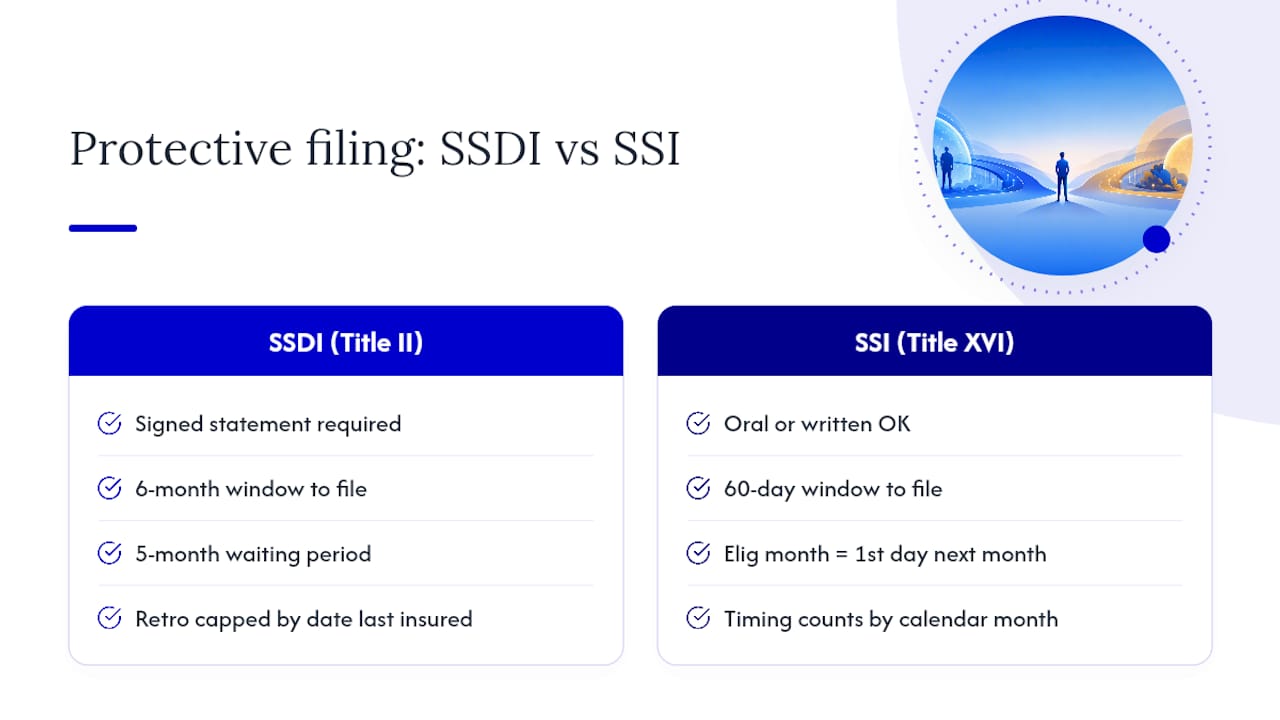
For SSDI (Title II), you generally need a signed written statement, or a phone or in-person contact that SSA documents with your signature on file, to establish protective filing. You then have six months to submit the completed application. Miss that window and the protective date disappears. Because SSDI also carries a five-month waiting period before benefits begin, and retroactive pay is capped by your date last insured, an early protective date can matter enormously to how much back pay you eventually collect.
For SSI (Title XVI), the bar is lower. You can establish protective filing orally or in writing, and you get a 60-day period to file the full application. Your eligibility month is set as the first day of the calendar month following your protective filing date, according to AARP's consumer explainer, so timing to the month, not just the day, actually counts.
One change worth flagging: as of the April 27, 2026 update, initiating or completing an SSI redetermination (RZ) no longer automatically creates a protective filing for SSDI. If you're pursuing both programs, you must state your intent to file for each one separately.
How to Establish a Protective Filing Date
Establishing an amended onset date is not one of these steps. That comes later, once your claim is already open. Locking in the protective date comes first, and it takes deliberate action on your part.
- Contact SSA directly. Call the national number, visit a field office, or use the online application system, and clearly state that you intend to file for SSDI, SSI, or both. Vague browsing or downloading a form does not count. If you use the online portal, save your re-entry number, since a partial online record can serve as your protective filing date if you finish the signed application within the closeout period.
- Submit a signed written statement when required. SSDI generally needs a signature from you or a "proper applicant," which can include a legal guardian or representative in specific circumstances. Get written or documented confirmation that SSA received your statement.
- Keep your own paper trail. Write down the date, the method of contact, and the name of the representative you spoke with. Save any confirmation number, letter, or printed screen. If SSA's own file ever shows a gap, your records are what protect you.
- Know when to amend your alleged onset date. If new medical evidence supports an earlier or later disability onset, your representative can request an amended alleged onset date, which triggers additional review under DI 25501.230. This is usually raised with the field office or Disability Determination Services before a decision, or during a hearing if the case has already been denied once.
Pro Tip: Never rely on memory alone. Ask the SSA representative to confirm your protective filing date in writing, and keep that confirmation with your claimant file so there's no dispute months later.
Deadlines and What Happens If You Miss Them
The closeout periods are not suggestions. SSI gives you a 60-day period to convert a protective filing into a complete application. SSDI gives you a six-month period. Both windows are spelled out in GN 00204.010, and both are strictly enforced.
If you're using a partial online record, the clock generally starts from the date of that earliest saved record, not the date you finally submit the signed version. That is a detail a lot of claimants get wrong, assuming they have unlimited time once they've started an online application.
Miss the closeout window and the protective filing date simply expires. When that happens:
- Your official filing date reverts to whatever date you eventually submit a valid application.
- Any retroactive months tied to the earlier protective date are gone, not delayed, gone.
- You cannot appeal your way back into a lapsed protective filing; the remedy is filing again from scratch.
If you're unsure whether your window is closing, ask SSA directly for written confirmation of your protective filing date and its expiration. Don't assume silence means you're covered.
What a Protective Filing Date Actually Changes
An earlier protective filing date translates into real dollars and real timing, not just paperwork.
- Retroactive pay. SSDI can pay retroactive benefits for up to 12 months before your protective filing date if your medical evidence supports an earlier onset, according to AARP. SSI has no retroactive benefit before the application month, which is exactly why locking in the earliest possible protective date matters more for SSI claimants than for SSDI claimants.
- The five-month waiting period. SSDI benefits don't start until five full months after your established onset date. An earlier protective filing date, paired with medical evidence of an earlier onset, can shift that waiting period earlier too. Our breakdown of SSDI waiting period rules walks through how the calendar math works.
- Amended onset dates. If your representative later determines the medical evidence actually supports a different onset date, amending it doesn't erase your protective filing date. The protective date stays fixed as your placeholder; the amended onset date changes when SSA believes your disability actually began.
- Appeals. A protective filing date generally stays in force through the appeals process, so if your initial claim is denied, you're not starting the clock over by appealing rather than filing new.
Mistakes That Cost Claimants Their Protective Date
The most common error is assuming that visiting SSA's website or downloading a form is the same as filing. It isn't. Protection requires a documented statement of intent, not casual browsing.
- Assuming online activity alone counts, without a re-entry number or signed confirmation.
- Letting the 60-day or six-month closeout period lapse without checking in.
- Failing to write down names, dates, and confirmation numbers from SSA contacts.
Pro Tip: If you expect delays gathering medical records, ask your doctor to date every note and report clearly. A dated medical record is often what supports an earlier onset date later, and documenting conditions promptly strengthens that timeline.
If your case involves a disputed onset date, a denied claim heading to appeal, or a retroactive pay calculation that doesn't look right, that's when a disability attorney typically adds the most value. Reviewing your claimant file with a professional can catch gaps before SSA does.
Why Deadline Tracking Separates a Strong Claim From a Lost One
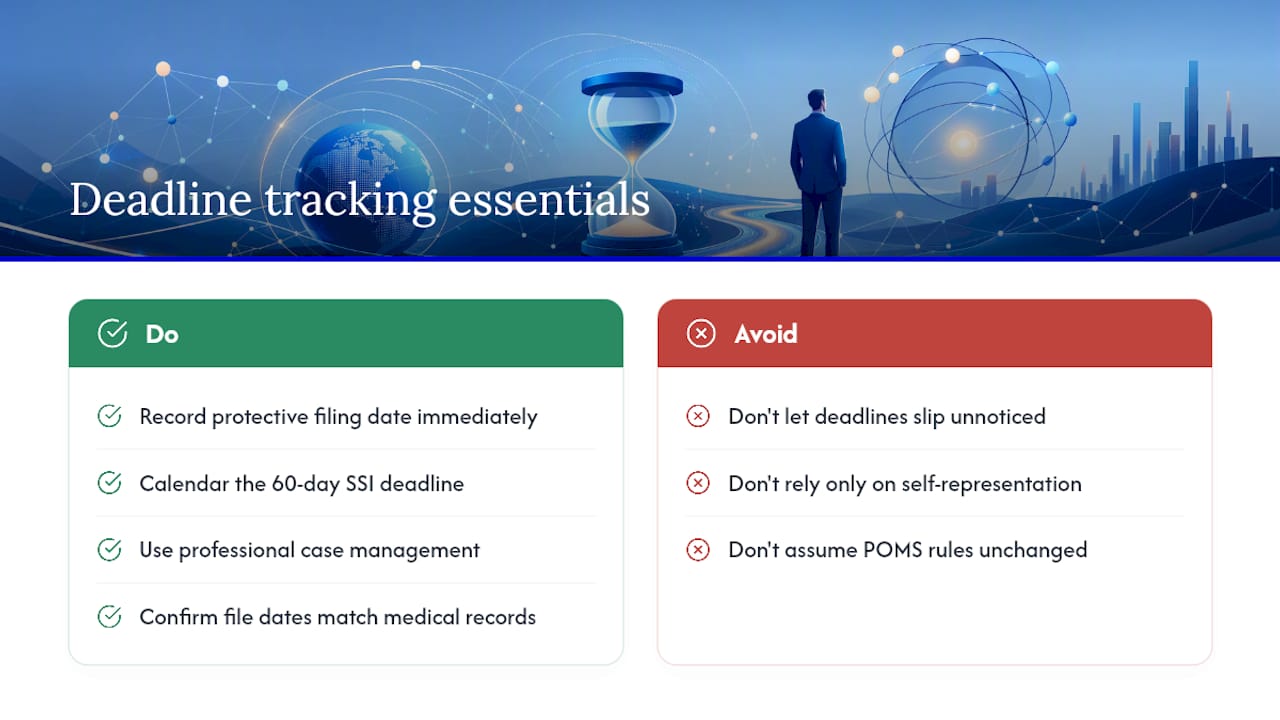
Attorneys who handle SSDI and SSI claims routinely treat protective filing dates as the first thing to nail down, not an afterthought. That's because the closeout windows are unforgiving, and claimants juggling medical appointments, symptoms, and paperwork are the ones most likely to let a 60-day SSI deadline slip past unnoticed.
Content series exist to walk through exactly these mechanics in plain language, because the POMS updates that took effect April 27, 2026 caught a lot of self-represented claimants off guard. Professional case management won't guarantee an approval. What it typically does is make sure the dates on your file match what actually happened, so an avoidable technicality never becomes the reason you lose months of back pay.
Getting Help Preserving Your Filing Date
Locking in a protective filing date is only the first move. Closing it out correctly, documenting your onset date, and tracking every deadline SSA sets afterward is where a lot of claims quietly fall apart.
Services exist that connect you with disability attorneys who handle this kind of case management, provide representation based on your situation, assist in tracking the closeout windows, collecting onset evidence, and preparing your file for submission or appeal. That's a meaningfully different starting point than trying to monitor a six-month SSDI deadline or a 60-day SSI window on your own while managing a medical condition. Ssdilawyer doesn't promise a particular outcome or a faster approval, and no attorney can guarantee one. What the matching process offers is access to representation that already understands how protective filing dates interact with retroactive pay and the five-month waiting period, including the auxiliary benefit timing issues covered in our piece on protecting dependent back pay. If you want help sorting out where your claim stands, start with Ssdilawyer and get matched with an attorney who can review your dates before any deadline closes.
Why Getting This Right the First Time Matters
Most claimants only learn what a protective filing date is after they've already lost months to it. That's the part conventional advice glosses over: the SSA process doesn't punish you for being slow to gather medical records, it punishes you for being slow to tell SSA you intend to file at all. Those are two very different failures, and only one of them is preventable with a phone call.
What surprises people most is how little SSA requires to start the clock, and how unforgiving the agency is once it's running. A five-minute phone call can preserve six months of potential back pay. A missed 60-day SSI deadline can erase it permanently, with no appeal path back to the original date. That asymmetry is the entire argument for treating protective filing as step one, not paperwork to handle "eventually."
The April 2026 POMS clarification on redeterminations is a good example of why claimants can't rely on general knowledge or last year's blog post. Policy details shift, and the gap between "I thought I was protected" and "I was actually protected" is exactly where attorneys earn their value, not by knowing the law better in the abstract, but by knowing which specific document, signature, or confirmation number actually satisfies SSA's current standard.
— Gerard
This article is general information, not a substitute for advice from a qualified financial advisor. Consult a qualified financial professional about your own circumstances before acting on anything here.
Sources
The policy claims in this article trace back to SSA's own guidance and one consumer-facing explainer:
- GN 00204.010 - Protective Writings for Title II and Title XVI
- What is a Social Security Protective Filing Date?