
No public "residual functional capacity form" exists for you to fill out yourself. The claimant-facing document is the SSA-3373-BK (Adult Function Report), and your treating doctor should complete an SSA-787 or SSA-787A medical source statement tied to objective findings. Disability Determination Services (DDS) fills out internal worksheets on its own. Download SSA-3373 and SSA-787/787A from ssa.gov/forms and bring them to your physician.
TL;DR:
- Claimants must focus on providing detailed, objective medical evidence through SSA-787 or SSA-787A forms, as doctor statements heavily influence RFC assessments.
- Internal DDS worksheets are completed after denial and can reveal inconsistencies or gaps between your records and RFC conclusions, so requesting and reviewing them is crucial.
- A strong RFC argument relies on specific test results and objective findings, not just claimant statements or vague medical opinions.
- Ensuring your medical records and claims forms are consistent prevents flagged discrepancies that can weaken your case during adjudication.
- Consulting a disability attorney can significantly improve the quality of medical evidence submitted and increase chances of a favorable RFC determination.
Table of Contents
- Which RFC-related forms matter and where to get them
- How do you get a treating doctor to complete a useful RFC statement?
- How SSA and DDS actually build the RFC
- What to do after a denial to obtain your RFC worksheets
- How Ssdilawyer approaches RFC evidence for clients
- What most claimants get backward about RFC forms
- Get help turning your medical records into a strong RFC case
- Sources
Which RFC-related forms matter and where to get them
The forms that actually shape your residual functional capacity evaluation split into two categories: what you fill out and what your doctor fills out. Neither one is labeled "RFC form," which is exactly why so many claimants search for something that doesn't exist.
- SSA-3373-BK (Function Report - Adult): You complete this yourself. Section D, covering your daily abilities, and the section on side effects from medication carry significant weight because adjudicators use them to gauge nonexertional limits like concentration and pace. Download the PDF directly from SSA's Function Report form.
- SSA-787 and SSA-787A (Medical Source Statements): These ask your treating physician to rate specific physical and mental functions, hour by hour, rather than give a vague opinion. Pull both from the SSA forms repository and hand them to your doctor at your next visit.
- SSA-4734-F4-SUP and SSA-4735: These are internal DDS worksheets, one for physical capacity and one for mental capacity. You never fill these out. A DDS medical consultant completes them after reviewing your file, and you can only obtain a copy after a decision has been made, usually by requesting your exhibit file.
- SSA-3441-BK: Use this for appeals when you're reporting new conditions, treatments, or work attempts since your last application. It doesn't replace the RFC evidence but updates the record the RFC gets built from.
Our guide to completing the Adult Function Report walks through common wording mistakes on SSA-3373 that can undercut an otherwise strong claim.
How do you get a treating doctor to complete a useful RFC statement?
Getting a treating physician to hand over a persuasive medical source statement is often harder than filling out your own paperwork. Doctors are busy, wary of legal exposure, and sometimes unclear on what SSA actually needs. A little preparation on your end changes the outcome.
- Pick the right clinician. A specialist who has treated you regularly for months carries far more weight than a doctor you've seen once. SSA and DDS both look for a longitudinal treatment relationship, not a single office visit.
- Assemble a packet before the appointment. Bring SSA-787 or SSA-787A, your most recent labs or imaging, a current medication list, and a one-page timeline of symptoms and treatments. A tight, organized packet raises the odds a physician actually completes the form instead of shelving it.
- Book a dedicated appointment for the form. Don't slip it in during a five-minute follow-up. Ask the front desk if the practice charges a form-completion fee, and pay it upfront rather than leaving it unresolved.
- Ask for function-by-function answers, not conclusions. Steer your doctor toward checkbox-style limits (how many pounds can you lift, how many hours can you stand in an 8-hour day) rather than a blanket "cannot work" statement.
- Never write the answers yourself. A statement drafted by the claimant and just signed by the doctor gets flagged and often disregarded by adjudicators.
SSA regulations make this concrete: a doctor's opinion carries the most weight when it's tied to objective medical evidence rather than a general impression. That means statements citing specific test results, imaging findings, and clinical exam notes, with explicit numbers for how long you can sit, stand, or walk across an 8-hour workday.
Pro Tip: If your clinic has a "we don't fill out disability forms" policy, ask specifically for a letter summarizing function-by-function limitations instead. Many practices will write a letter even when they refuse the standardized form, and SSA accepts either format as long as it's evidence-linked.
How SSA and DDS actually build the RFC
The residual functional capacity itself is not a form. It's an administrative conclusion adjudicators reach after reviewing your entire medical file, guided by SSR 96-8p and POMS DI 24510.000. The ruling defines RFC as the most you can still do on a sustained basis, not on your best day.
Adjudicators separate your limitations into two buckets:
- Exertional functions: sitting, standing, walking, lifting, carrying, pushing, and pulling.
- Nonexertional functions: postural movements (bending, kneeling), manipulative tasks (reaching, handling), visual and communicative limits, environmental restrictions (heat, fumes, heights), and mental demands like concentration and social interaction.
"Regular and continuing basis" in SSR 96-8p means a full work schedule on most days of a typical workweek. If your doctor documents that you can only manage limited hours before needing to lie down, that detail matters more to the RFC than almost anything else in your file.
DDS medical consultants must write a narrative explaining why they credit or discount each piece of evidence for every function, a requirement spelled out in POMS DI 24510.050. That narrative obligation is exactly why vague statements from either you or your doctor get little traction. Adjudicators need something specific to cite, and "he seems limited" gives them nothing to point to.
What to do after a denial to obtain your RFC worksheets
A denial doesn't mean the RFC assessment vanishes. DDS already completed internal worksheets, and you have a right to see them. The process for getting your hands on that paperwork follows a fairly predictable path.
- Request your claim file in writing. Ask specifically for the completed SSA-4734-F4-SUP or SSA-4735 worksheet, any consultative exam reports, and the full exhibit list. Naming the exact documents speeds up the response.
- Expect a multi-week turnaround. Attorneys representing claimants at the hearing level typically pull the electronic file well ahead of the hearing date rather than waiting on a mailed copy.
- Read the worksheet for inconsistencies. Compare the DDS medical consultant's findings against your treating doctor's records. Gaps often show up around standing/walking tolerance or concentration limits.
- Request a treating-source clarification if something's missing. If your doctor's records don't address a function DDS relied on, a short follow-up letter can close that gap before your hearing.
- Consider an attorney once the file gets complicated. Multiple denials, thick medical records, or a worksheet that contradicts your treating physician's notes are strong signals it's time for legal help rather than a second solo attempt.
Our breakdown of what's inside your SSDI claimant file covers exactly what to request and how attorneys typically use it to prepare hearing testimony.
How Ssdilawyer approaches RFC evidence for clients
Ssdilawyer connects claimants with disability attorneys who know how to build an RFC record instead of guessing at one. That means getting SSA-3373 filled out with the right level of detail, getting SSA-787/787A into the hands of a treating doctor who will actually complete it, and pulling DDS worksheets from the exhibit file the moment a denial comes in.
The checklist stays consistent across cases: download SSA-3373, request SSA-787/787A from the treating physician, and request the DDS worksheets in writing after any denial. Our guide on functional limitations for older claimants shows how this evidence shifts for claimants near retirement age, where RFC findings often carry even more weight at the hearing stage.
What most claimants get backward about RFC forms
Most people treat the RFC stage like a form to fill out correctly. It isn't. It's an argument built from evidence, and the biggest mistake claimants make is assuming a well-written personal statement will move the needle the way a doctor's objective findings will.
I've seen the pattern play out the same way across hundreds of denials: claimants spend hours perfecting their SSA-3373 language and almost no time coaching their doctor on what SSA actually needs. That's backward. Adjudicators are required to write a narrative tying every functional limit to specific evidence under POMS DI 24510.050, which means a claimant's own words rarely move a decision unless a doctor's chart notes back them up.
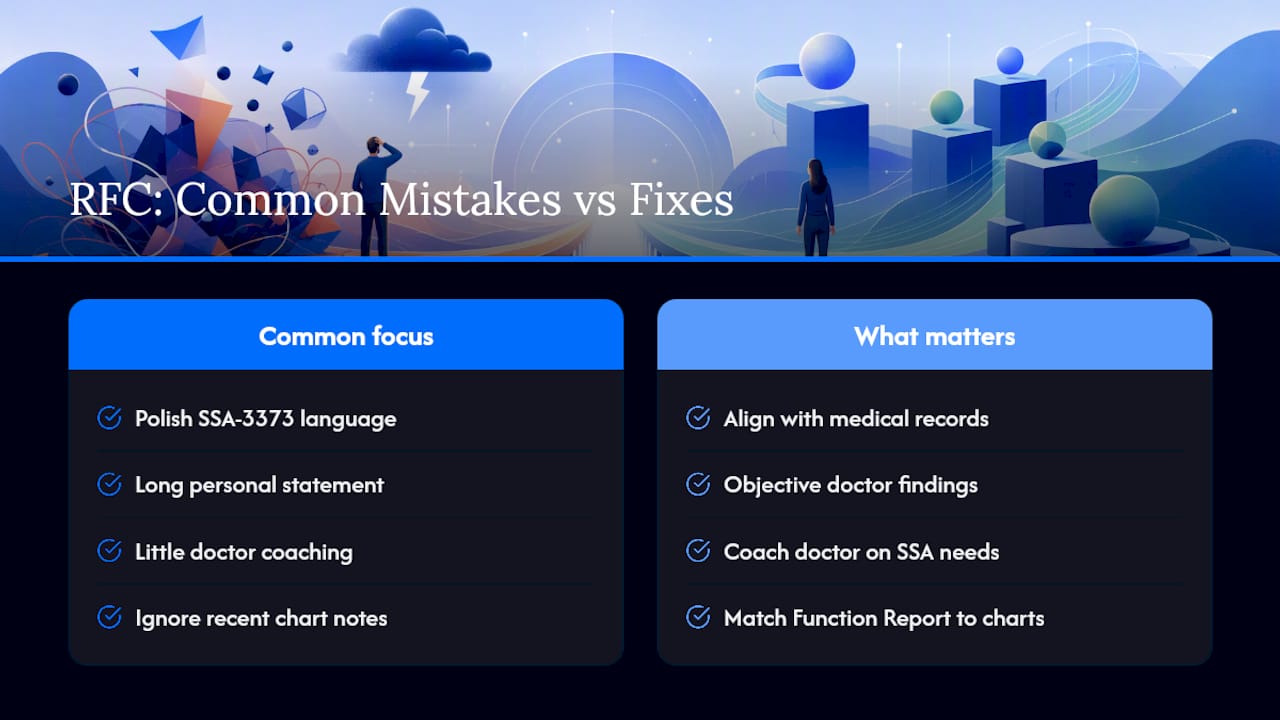
The second blind spot is discrepancies between what claimants write on SSA-3373 and what their medical records actually document. Say you write that you can't stand for more than ten minutes, but your last exam note says "gait normal, no assistive device." That gap doesn't just get ignored. It gets flagged, and it can undercut the credibility of everything else in your file. Before you submit anything, read your own recent chart notes and make sure your Function Report doesn't contradict what's already on paper.
If there's one thing worth fixing before you submit anything to SSA, it's this mismatch between what you say and what your medical records say. Close that gap first. The forms matter far less than the consistency behind them.
— Gerard
Get help turning your medical records into a strong RFC case
Ssdilawyer matches you with a disability attorney who knows how to pull your exhibit file, get the right medical source statement out of your doctor, and spot the gaps that sink RFC determinations before they become a hearing problem.
Rather than guessing which forms to bring to your next appointment or waiting weeks to request your DDS worksheets on your own, a free case review connects you with an attorney who already knows what SSA needs to see. If you're also estimating retirement benefits alongside a disability claim, PsyFi's Social Security calculator can help you see the full financial picture while your case moves forward. Start your free SSDI case review today and find out whether your current medical evidence is strong enough to support your claim.
This article is general information, not a substitute for advice from a qualified lawyer. Consult a qualified legal professional about your own circumstances before acting on anything here.
Sources
- SSA-3373-BK Function Report - Adult (SSA form PDF)
- POMS: DI 24510.000 Residual Functional Capacity (RFC)