
Form SSA-3369-BK is the official Social Security work history report you complete when the Disability Determination Services (DDS) office asks for it. Download the current edition, SSA-3369-BK (06-2024), directly from the Social Security Administration. It's a PDF you can fill in and print or complete by hand.
The form asks for granular detail on every job you held during the years before you became unable to work. DDS examiners use this data at Step 4 of the sequential evaluation to decide whether you can still perform your past relevant work. A vague answer here can stall or sink an otherwise strong claim.
Before you write a single word, do three things:
- Download the current PDF. Confirm you have edition SSA-3369-BK (06-2024), not an outdated copy from a third-party site.
- List every job from the lookback period, most recent first, and skip any job that lasted fewer than 30 calendar days.
- Describe what you actually did, not what your job title implies. Include exact hours, weights lifted, and physical or mental demands for each position.
Pro Tip: Fill this out on a day when you're not rushed. Most claimants underestimate how physically demanding their old jobs were, and that single mistake can cost more than any other error on the form.
Key Takeaways
Accurately completing the SSA-3369-BK with specific, activity-based job descriptions directly affects whether DDS approves your claim at Step 4 of the sequential evaluation.
| Point | Details |
|---|---|
| Download the current edition | Use SSA-3369-BK (06-2024) directly from the official SSA forms page, not a third-party copy. |
| Cover the full lookback period | List every job from the years before your disability began, skipping any that lasted less than 30 calendar days. |
| Describe actual daily demands | Use exact weights, hours, and tasks instead of job titles, since examiners evaluate frequency and intensity, not labels. |
| Use supplementary forms correctly | Mark extra pages "Supplementary," include only your name and SSN on the front, and reference job numbers for cross-referencing. |
| Get a professional review when needed | Ssdilawyer matches claimants with disability attorneys who review work history entries against medical records before submission. |
Table of Contents
- What Is Form SSA-3369 and How Does SSA Use It?
- When Does SSA Request the SSA-3369 Work History Report Form?
- How Do You Fill Out the SSA-3369 Form Section by Section?
- What Job Details Do DDS Examiners Actually Need?
- How Do You Turn Vague Job Descriptions Into Examiner-Friendly Answers?
- How Do You Submit the Completed SSA-3369 Form?
- What Mistakes on the SSA-3369 Hurt a Disability Claim?
- How Do SSDI Attorneys Handle the Work History Report?
- A Practitioner's View on Getting the Work History Report Right
- Get Help Completing or Reviewing Your Work History Report
- Where to Find Official SSA-3369 Forms and Guidance
- Frequently Asked Questions
- Sources
What Is Form SSA-3369 and How Does SSA Use It?
Form SSA-3369-BK, officially the Work History Report, is a supplementary disability report form. It exists to capture detailed information about every job you held in the the years before your disability began. Unlike a resume, it asks for specifics: hours per shift, pounds lifted, and how much of the day you spent standing versus sitting.
DDS examiners rely on this form to complete Step 4 of the five-step sequential evaluation process, the stage where they determine whether you retain the capacity to perform your past relevant work. If the examiner concludes you can still do a job you held in the last five years, even a job you no longer hold, your claim can be denied at this step before it ever reaches the medical vocational grid.
Two sets of internal Social Security policy manual sections, known as POMS, govern this form. POMS DI 22515.030 explains when and how the Work History Report gets mailed to claimants and how DDS processes it once returned. POMS DI 11005.025 lays out the section-by-section procedure field office staff follow when they help complete or review the form. These aren't obscure internal memos. They're the actual rulebook examiners use to judge whether your answers are complete enough to make a determination.
DDS examiners compare what you say you did on paper against your medical records and, later, against vocational expert testimony at a hearing. A work history report that understates your job's demands can create a contradiction that follows your case all the way to an administrative law judge.
The form works alongside, not instead of, your primary disability report. Here's the relationship in short:
- Form SSA-3368-BK, the Disability Report - Adult, is your main intake document covering medical conditions, treatment, and a brief work history.
- Form SSA-3369-BK supplements it when you held more than one job, or when Section 6 of the SSA-3368 doesn't leave enough room for the detail DDS needs.
- Both forms feed the same case file, so consistency between them matters more than either one in isolation.
When Does SSA Request the SSA-3369 Work History Report Form?
SSA doesn't send the Work History Report to every applicant automatically. It typically shows up when your case needs more work detail than the initial disability report captured.
According to POMS DI 22515.030, the field office may mail you a partially completed SSA-3369-BK, sometimes pre-filled using information already collected from your SSA-3368, along with a cover letter asking you to document each job you held. You'll typically receive this request when:
- You reported more than one job on your initial disability report and Section 6 of the SSA-3368 didn't have room for full detail on each.
- Your job descriptions on the SSA-3368 were too brief for an examiner to assess physical or mental demands accurately.
- DDS needs clarification on dates, hours, or duties before it can complete the past relevant work analysis at Step 4.
- Your case involves several short-term or seasonal jobs that need individual breakdowns.
There's also a scenario where the field office itself completes the form rather than mailing it to you. POMS DI 11005.025 specifies that FO staff step in when a claimant is homeless, difficult to reach, or otherwise unavailable to complete the paperwork independently. In those cases, a Social Security representative gathers whatever information is available and documents the source.
Who actually needs to complete and sign it:
- In the overwhelming majority of cases, you or your appointed representative fill out and sign the SSA-3369.
- Someone else, a family member, a friend, or your attorney's staff, may help you complete the form, but you still need to sign it unless specific mark or signature-by-proxy rules apply due to a disability that prevents you from signing.
- If your disability report already contained thorough job descriptions, you may not be required to repeat every detail on the SSA-3369, but submitting comprehensive answers here is the safer move. Ambiguity at this stage tends to generate follow-up requests that slow your case down.
How Do You Fill Out the SSA-3369 Form Section by Section?
The form is organized into three parts, and each one plays a distinct role in how DDS builds your case file.
Section 1: Claimant identification
Verify your name, Social Security number, and contact information exactly as they appear on your other disability paperwork. A mismatched SSN digit or an old address can cause your form to get separated from your file or delay processing while staff track down the discrepancy. Double-check this section even if it feels like a formality. It isn't.
Section 2: The work history table
This is the core of the form. List every job from your lookback period, starting with your most recent position and working backward. For each entry, record:
- Job title and the type of business (a grocery store, a construction firm, a call center), not the employer's name.
- Dates worked in MM/YY format, both start and end.
- Hours worked per day and days worked per week.
- Rate of pay and how often you were paid (hourly, weekly, biweekly, salary).
Include self-employment. If you ran a lawn care business or did freelance bookkeeping, that counts as work history and needs its own entry. The same goes for jobs performed outside the United States. Both categories get overlooked constantly, and both matter to the 30-day minimum threshold SSA applies. Jobs that lasted less than 30 calendar days don't need to be listed at all.
If you held the same job title at two different employers with different duties, list them as separate entries. DDS treats duty differences as materially relevant even when the title on paper looks identical.
The job subsections
Each job you list gets its own detailed subsection asking about the actual physical and mental demands of the work. This is where claims get won or lost. For every job, be ready to describe:
- How many hours per day you spent walking, standing, sitting, climbing, stooping, kneeling, crouching, or crawling.
- The heaviest weight you lifted or carried, and the weight you lifted or carried most frequently.
- Whether you used machines, tools, or equipment, and what kind.
- Any supervisory responsibilities, including how many people you supervised.
- Whether you wrote reports, completed forms, or made independent decisions as part of the job.
Section 3: Remarks and continuation
Use Section 3 for anything that didn't fit elsewhere, clarifications, unusual scheduling, or context about why a job ended. If you run out of room anywhere on the form, use an additional SSA-3369-BK marked "Supplementary" across the top. On supplementary pages, include only your name and Social Security number on the front, and reference the job number from the original form so the examiner can match your remarks to the correct entry without confusion.
Pro Tip: If you're cross-referencing entries you already made on the SSA-3368, note the job number or page reference in your remarks. Examiners process dozens of files a week, and anything that saves them a cross-check step reduces the odds of a form getting flagged for clarification.
What Job Details Do DDS Examiners Actually Need?
DDS examiners and, later, vocational experts at a hearing use your job descriptions to match your past work against occupational classifications. That means generic answers don't hold up. Vague language like "office work" or "management" gives an examiner nothing to evaluate against your medical limitations.

Every job entry should include these specific data points:
| Category | What to include |
|---|---|
| Identification | Job title, type of business (not employer name), MM/YY start and end dates |
| Schedule and pay | Hours per day, days per week, rate of pay, and pay frequency |
| Physical demands | Heaviest weight lifted/carried, weight lifted/carried most often, hours per day standing, walking, sitting, stooping, kneeling, or climbing |
| Equipment and environment | Tools, machines, or equipment operated; exposure to heights, extreme temperatures, or hazards; travel required |
| Mental and supervisory demands | Number of people supervised, whether you wrote reports or made independent decisions, tasks requiring sustained concentration |
Mental demands matter just as much as physical ones, especially for claims involving cognitive or psychiatric conditions. If your job required constant multitasking, tight deadlines, or supervisory judgment calls, say so specifically. "Managed a team" tells an examiner nothing. "Supervised three employees, reviewed their work daily, and made staffing decisions when someone called in sick" gives them something to evaluate.
Here's a short template you can adapt for each entry:
- Job title / business type: Warehouse associate, distribution company
- Dates: 03/20 to 11/23
- Hours/days: 8 hours per day, 5 days per week
- Pay: $17.50/hour
- Physical demands: Lifted boxes up to 50 pounds regularly, stood or walked 7 of 8 hours daily, used a pallet jack and hand truck
- Supervisory duties: None
Pro Tip: When you're not sure how to phrase a physical demand, describe the action, not the job description language your employer used. "Bent down to load shelves 40 times per shift" is far more useful to an examiner than "stocking duties as assigned."
How Do You Turn Vague Job Descriptions Into Examiner-Friendly Answers?
The single biggest quality gap between strong and weak SSA-3369 submissions comes down to specificity. Examiners can't evaluate what they can't measure, and vague language forces them to guess, which rarely works in your favor. Using plain, accurate language that describes actual movements and duties, rather than job titles, gives examiners the frequency and intensity data they need.
| Vague original | Examiner-friendly revision |
|---|---|
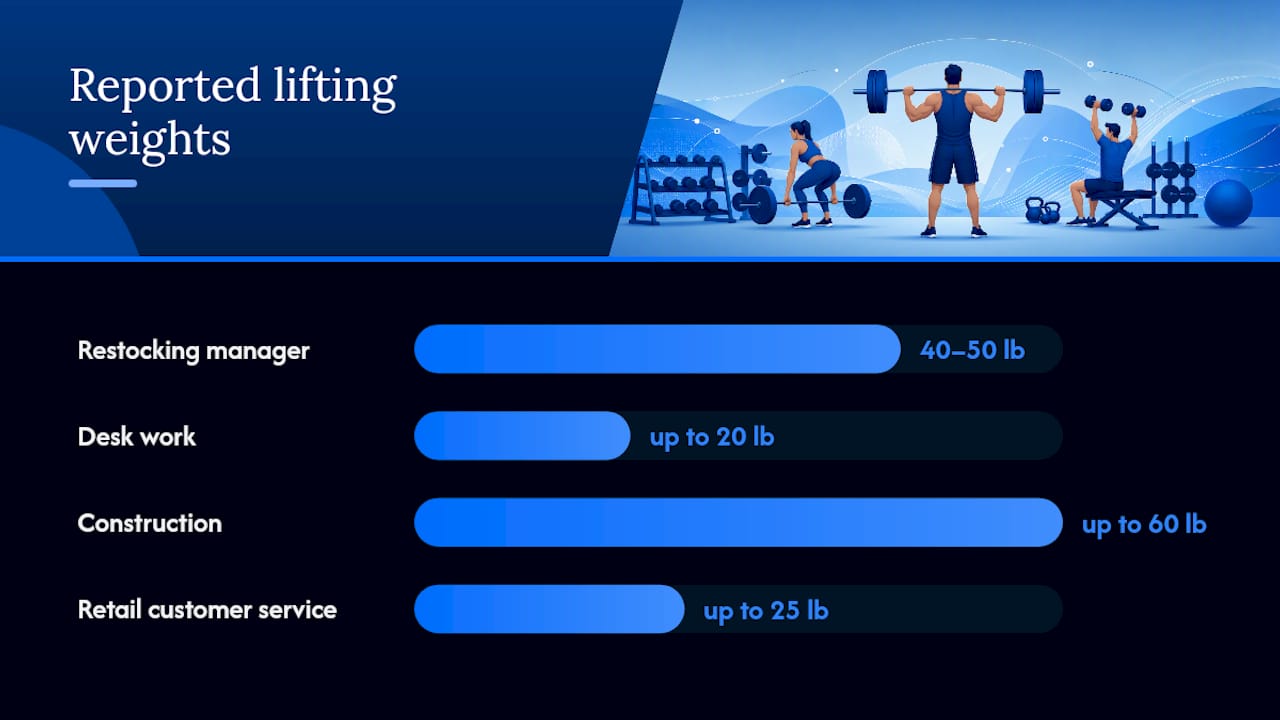
| "Manager" | "Supervised three staff on the afternoon shift and loaded 40 to 50 pound boxes for restocking" |
| "Office work" | "Sat at a desk 7 hours daily entering data, occasionally lifted file boxes up to 20 pounds" |
| "Construction" | "Operated a jackhammer and carried lumber up to 60 pounds, stood or knelt most of the 10 hour shift" |
| "Customer service" | "Stood at a register 8 hours daily, lifted merchandise up to 25 pounds, walked the sales floor frequently" |
A few habits separate strong submissions from weak ones:
- Use concrete numbers everywhere you can: exact weights, exact hours, exact frequency, rather than "sometimes" or "occasionally."
- List the actual tools and machines you operated by name, not by category.
- Don't overstate your abilities to seem capable, and don't understate your demands to seem more limited than the job required. Both distort the record and create inconsistencies an examiner or judge will notice.
- Attach supporting documents when they clarify your answers: recent pay stubs, W-2s, old work schedules, or a job description letter from a former employer.
If you're mailing physical pay stubs or payroll documents, send copies rather than originals, and avoid including anything with a full account number or unnecessary personal financial detail beyond what's needed to verify pay and dates. Sensitive payroll data doesn't need to travel through the mail in full when a redacted copy tells the examiner everything they need.
How Do You Submit the Completed SSA-3369 Form?
Once your form is complete, you generally have a few submission options depending on how your local field office operates and whether DDS mailed you the form directly.
- Mail it back to the address provided in your cover letter, ideally with a short cover note referencing your case or file number.
- Submit it in person at your local Social Security field office if you prefer face-to-face confirmation that it was received.
- Attach it to your SSA-3368 if you're completing both forms at the same time as part of your initial application.
- Check the SSA forms page for any electronic submission option available for your case, keeping in mind some forms require additional identity verification before they can be submitted online.
A solid cover letter takes two minutes to write and can prevent unnecessary delays. Include:
- Your name and Social Security disability claim or file number.
- A note confirming whether the field office sent you a partially completed form or you're starting from scratch.
- A request for confirmation of receipt if you're mailing rather than delivering in person.
After DDS receives your form, expect it to become part of the broader case review rather than trigger an immediate response. If something is unclear, examiners typically follow up by phone rather than by returning the form, so keep your contact information current. If you genuinely need more time to gather accurate job details, especially for jobs from years ago where you need to track down old pay records, call your field office or DDS contact and ask for an extension before your deadline passes rather than after.
What Mistakes on the SSA-3369 Hurt a Disability Claim?
Certain errors show up constantly, and they carry more weight than claimants expect because they feed directly into the Step 4 past relevant work analysis.
- Vague job titles with no activity detail. "Supervisor" or "technician" without accompanying duties gives an examiner nothing concrete to evaluate.
- Understating lifting or postural demands. Describing what you were theoretically capable of rather than what you actually did daily is one of the most common and costly mistakes on this form.
- Omitting self-employment or foreign work. Both count as work history and both need their own entries if they lasted 30 days or longer.
- Leaving dates vague. "A few years in the 2010s" isn't sufficient. Use MM/YY formatting and be as precise as your records allow.
- Forgetting to mark supplementary forms. If you needed extra pages, failing to write "Supplementary" and reference the job number can cause your remarks to get disconnected from the right entry.
Red flags that tend to trigger a phone call or additional information request from DDS include contradictions between your stated job demands and your medical records, or hours and dates that don't match what you reported on the SSA-3368. If your work history report says you stood 8 hours a day but your medical file describes a mobility limitation that predates your alleged onset date, expect a follow-up.
If you catch a mistake after submitting, don't panic and don't leave it uncorrected. Call your local field office or your DDS contact directly, explain the specific correction needed, and ask whether you should submit an amended page or a written clarification. Keep a copy of everything you send, and note the date and the name of whoever you spoke with. Documentation of your correction attempt matters almost as much as the correction itself if questions come up later in the process.
How Do SSDI Attorneys Handle the Work History Report?
Experienced disability representatives treat the SSA-3369 as one of the more consequential documents in a case file, not paperwork to rush through. Their review process typically follows a consistent checklist:
- Cross-check every job entry against the claimant's medical records for consistency in dates and physical capacity.
- Tie each job's physical and mental demands directly to the claimant's residual functional capacity (RFC) limitations, since that comparison is exactly what a vocational expert will make at a hearing.
- Rewrite vague entries into activity-specific language that matches how DDS examiners and administrative law judges actually evaluate past relevant work, an approach detailed further in how disability lawyers prepare written reports.
- Prepare the claimant, and sometimes a family member, to give consistent testimony about job demands if the case reaches a hearing.
A work history report that reads well on paper but contradicts a claimant's hearing testimony is one of the fastest ways to lose credibility with a judge. Attorneys who catch inconsistencies before submission prevent that problem entirely.
An attorney's edit might turn "worked at a warehouse" into "loaded and unloaded delivery trucks, lifted boxes up to 60 pounds regularly, stood the entire 8 hour shift, and operated a forklift for roughly two hours daily." That level of detail is exactly what turns a Step 4 denial into a Step 5 evaluation, where the analysis broadens to whether any job in the national economy fits the claimant's limitations, not just their specific past work as detailed in guidance on past relevant work.
Legal help becomes strategically important when your work history includes conflicting job descriptions across multiple forms, when your medical evidence seems to clash with your stated job demands, or when a hearing date is approaching and you haven't had time to review your paperwork carefully. Complex work histories, several jobs, career changes, self-employment mixed with traditional employment, benefit the most from a second set of trained eyes before submission.
A Practitioner's View on Getting the Work History Report Right
Claimants often treat the SSA-3369 as a formality, something to fill out quickly between medical appointments and phone calls with the field office. That's the wrong instinct. This form, more than almost any other document in your file, gives an examiner a factual basis to either move your case forward or deny it at Step 4 without ever considering your medical limitations against other work in the economy.
What tends to surprise people is how much the wording matters compared to the facts themselves. Two claimants with nearly identical job histories can get very different outcomes depending on whether one describes "general labor" and the other describes "lifted 50 pound bags of concrete repeatedly for 6 of 8 hours daily." The facts didn't change. The specificity did.
A few habits make a real difference:
- Ask for help if any section feels unclear, whether from your representative, a family member, or your local field office.
- Save a copy of everything you submit, including the exact dates and pay figures you used.
- Document your work history as you remember it now, before more time passes and details get harder to recall.
- Request an extension if you need more time rather than guessing at dates and hours you're not sure about.
Accuracy on this form isn't about making your case sound worse than it is. It's about making sure the examiner sees what actually happened.
Get Help Completing or Reviewing Your Work History Report
If you've already started your SSA-3369 and you're unsure whether your job descriptions give DDS enough detail, Ssdilawyer connects you with an experienced disability attorney who can review your entries before you submit them, at no cost to you upfront.
Attorneys who work SSDI cases daily know exactly what language turns a vague job description into one that survives a Step 4 review. Ssdilawyer's intake process starts with a free case review: you share your work history and claim details, and a matched attorney tells you whether your SSA-3369 answers hold up or need revision before they reach DDS. If your case involves multiple jobs, self-employment, or a history that doesn't fit neatly on one form, that kind of second opinion catches problems while there's still time to fix them.
There's no obligation tied to the review, and no cost unless representation moves forward. If you're at the point where your work history report is due back and you want it checked by someone who reviews these forms for a living, start your free case review today.
Where to Find Official SSA-3369 Forms and Guidance
For the primary documents referenced throughout this guide, go directly to the source rather than a secondhand summary:
- POMS DI 22515.030, covering when and how the Work History Report gets used and processed.
- POMS DI 11005.025, the field office procedure for completing the form section by section.
- Form SSA-3368-BK PDF, the Disability Report - Adult that SSA-3369 supplements.
- The SSA forms index for related forms and current electronic submission options.
Frequently Asked Questions
Is Form SSA-3369 the same as Form SSA-3368?
No. SSA-3368-BK is the primary Disability Report - Adult, covering your medical conditions and a summary of your work history. SSA-3369-BK is a supplementary form used specifically to capture detailed job data when the SSA-3368 doesn't provide enough information for DDS to complete the past relevant work analysis.
Do I need to complete SSA-3369 if I only had one job in the last five years?
Not always. If your SSA-3368 already includes a thorough description of that one job, including hours, pay, and physical demands, DDS may not need a separate SSA-3369. Field offices most commonly request it when a claimant reported multiple jobs or the existing description lacks detail.
What happens if I leave out a job on the SSA-3369 form?
Omitting a job, especially self-employment or foreign work that lasted 30 days or longer, can create gaps that examiners notice when comparing your form to other records like tax filings. If you realize you left something out after submitting, contact your field office or DDS as soon as possible to submit a correction.
Can someone else fill out my SSA-3369 for me?
Yes. A family member, representative, or attorney's staff can help you complete the form, but you generally still need to sign it yourself unless specific circumstances prevent you from doing so. Field offices may complete the form directly for claimants who are homeless or otherwise unreachable.
How detailed do my job descriptions need to be?
Very detailed. Include exact hours per day, days per week, pay rate, and specific physical demands like weights lifted and time spent standing, walking, or sitting. Generic titles like "manager" or "clerk" without supporting detail give examiners nothing concrete to evaluate against your medical limitations.
This article is general information, not a substitute for advice from a qualified lawyer. Consult a qualified legal professional about your own circumstances before acting on anything here.
Sources
- DI 22515.030 - Use of Work History Report Form SSA-3369-BK
- DI 11005.025 - Completing the SSA-3369
- Form SSA-3368-BK - Disability Report - Adult (SSA PDF)
- SSA - Forms