
The SSA-827 lets Social Security and state disability agencies collect your medical, educational, and related records for a disability claim. It covers sensitive records like substance abuse and HIV treatment (psychotherapy notes stay excluded) and generally stays valid for 12 months. Sign it as part of your claim filing, using SSA's click-and-sign or attestation process, rather than mailing the PDF separately.
TL;DR:
- The SSA-827 broadens record collection, including confidential information such as substance abuse and HIV treatment records, which are necessary for comprehensive disability evaluations.
- Signing the SSA-827 can be done online via click-and-sign, by attestation, or in paper form, with each method influencing how quickly records are requested and processed.
- Correct completion of key fields like expiration date and source identification is crucial, as errors can cause delays or refusals, especially if forms are altered or contain mismatched information.
- The form's design aligns with HIPAA, protecting privacy rights, but revocation only halts future disclosures; records already shared cannot be retracted.
- Confusion between the SSA-827 and the SSA-1696 can hinder the claim process, as each form authorizes different actions—medical records release versus appointment of a legal representative.
Table of Contents
- What the SSA-827 Medical Release Authorizes
- Who Can Sign the SSA-827 Form
- How to Sign and Submit the SSA-827 Medical Release
- Completing Key Fields Without Triggering Delays
- Privacy Protections, Sensitive Records, and Revocation Rights
- Where the Signed Form Goes and How to Follow Up
- SSA-827 vs. SSA-1696: Two Different Forms, Two Different Jobs
- Why SSA Requests Medical Records Using the SSA-827
- HIPAA and Your Legal Rights When Records Move to SSA
- Disputing or Correcting Records SSA Has Already Received
- When SSA-827 Complications Call for Legal Help
- Get Help Completing Your SSA-827 and Building Your Claim
- Sources
What the SSA-827 Medical Release Authorizes
The SSA-827 medical release is a broad authorization. It permits the Social Security Administration and state Disability Determination Services (DDS) to request records from nearly any source that has documented your condition, not just your primary doctor.
The form's language covers a wide sweep of record types, including some categories that ordinary medical releases often carve out:
- Hospital, clinic, and physician records, including mental health treatment
- Substance abuse treatment records
- HIV testing and treatment records
- Genetic test results
- Educational and vocational records, when relevant to a claim
Psychotherapy notes kept separately from a general treatment record stay outside the authorization. That distinction rarely trips up claimants, since most providers store therapy notes within the broader chart anyway.
The form also authorizes a wide range of sources beyond doctors: hospitals, the Department of Veterans Affairs, schools, employers, social workers, and state agencies can all release information once SSA presents a signed SSA-827. That breadth exists for a practical reason. Disability examiners weigh combined impairments, and a claimant with diabetes, depression, and a back injury needs records from three or four different systems to build a complete picture.
The scale is worth understanding. SSA processes more than 14 million requests for medical information every year, and a signed SSA-827 medical release accompanies nearly every one of them.
Who Can Sign the SSA-827 Form
Signature authority on the SSA-827 form depends on who is filing and whether the claimant can act on their own behalf. The form includes distinct boxes for different signers:
- The claimant signs directly in the majority of cases, whether filing online, by phone, or in person.
- A parent or legal guardian signs for a minor claimant or for an adult who has been declared legally incompetent.
- A personal representative or power of attorney holder signs when a court order or valid POA document grants that authority, and SSA may ask to see that documentation before accepting the signature.
The instructions for completing the SSA-827 stress filling out identity fields exactly. Your name, date of birth, and Social Security number need to match SSA's records precisely, since a mismatch is one of the more common reasons a signed form gets kicked back for correction.
How to Sign and Submit the SSA-827 Medical Release
The signing process depends entirely on how you're filing your claim, and getting this step wrong is one of the easier ways to add weeks to a case.
- Filing online: Adults completing an SSDI or SSI application through SSA's online system use a click-and-sign process built into the application itself. Once you click through the authorization, it saves directly to your electronic claim file.
- Filing by phone or in person: SSA staff record your attestation, essentially your verbal or witnessed agreement to the same terms, and log it as part of your case record.
- Paper filing: You sign the printed SSA-827 and it becomes part of your paper claim file, handled the same way as any other signed exhibit.
Both the click-and-sign and attestation processes save the authorization directly to your electronic claim file, which is why SSA discourages independently uploading a signed PDF to a general document portal. A form floating outside the claim record can get lost or duplicated, and it does nothing to speed up processing.
Pro Tip: If a specific hospital or clinic later tells your attorney or SSA that they need a provider-named authorization instead of the general SSA-827, don't treat that as a red flag. Some systems simply require their own release language, and SSA will issue a second, targeted form when that happens.
Completing Key Fields Without Triggering Delays
The SSA-827 form has a handful of fields that cause outsized trouble when filled in incorrectly.
The EXPIRE WHEN field controls how long your authorization stays active. The form generally expires 12 months from the date you sign it, so a claim that drags on past a year may need a fresh signature before SSA can request newer records.
The purpose checkbox section asks you to confirm the authorization is for determining disability or blindness benefits. Leave this unchecked and a source may question why SSA is asking for records at all.
The source identification section lets you either name a class of providers ("all treating physicians") or list specific sources by name and address. SSA's instructions note that naming a broad class usually works fine, but some providers insist on seeing their own name and address before releasing anything.
Common errors worth avoiding:
- Leaving the signature page blank while completing everything else
- Missing or mismatched date of birth or Social Security number
- Altering the form's printed language, including striking through sections
Pro Tip: Never cross out or rewrite any part of the printed SSA-827 language. SSA has specifically warned that altering the form can lead providers to refuse the release entirely, since they can no longer verify it matches SSA's approved version.
Privacy Protections, Sensitive Records, and Revocation Rights
The SSA-827 medical release was built to satisfy HIPAA's authorization requirements, and SSA developed the form with the Department of Health and Human Services specifically so providers wouldn't need a separate release for every sensitive category.
That includes substance abuse treatment records. Federal privacy rules under 42 CFR Part 2 protect substance-use treatment history more tightly than general medical records, but SAMHSA's updated rules recognize a properly executed SSA-827 as sufficient authorization for SSA to obtain those files.
A signed SSA-827 does not authorize disclosure forever, and revoking it does not undo what's already been shared. Once SSA or DDS has copies of your records, a later revocation stops new requests going forward. It doesn't claw back what a hospital already sent last month.
To revoke authorization, you submit written notice to SSA and, ideally, directly to the sources involved. Key points to keep in mind:
- Revocation is prospective only; disclosures already made stand
- Providers cannot condition your treatment or payment on signing an SSA-827
- Some states or individual facilities require a provider-specific version of the form regardless of the general authorization you've already signed
Where the Signed Form Goes and How to Follow Up
Once you sign, the authorization moves into your electronic claim file and becomes the basis for every records request SSA sends out on your case. Examiners attach a copy (or reference to the electronic version) each time they contact a hospital, clinic, or agency.
Delays happen when a source demands its own version of the release, or when a facility says your signed SSA-827 is too old to honor. That mismatch is one of the more preventable reasons a claim stalls in the evidence-gathering stage.
If you suspect your case is stuck waiting on records, a few steps help:
- Ask your SSA claims examiner or DDS contact exactly which sources have been contacted and which haven't responded
- Request your own copies directly from providers as a backup, especially for any facility that closed or changed record systems recently
- Confirm whether your original authorization has expired and needs to be resigned
SSA-827 vs. SSA-1696: Two Different Forms, Two Different Jobs
The SSA-827 medical release and the SSA-1696 solve entirely different problems, and confusing them is a common mistake among first-time claimants.
The SSA-827 authorizes the release of your records to SSA and DDS. It's a medical records release form, full stop. It says nothing about who represents you or who can speak to SSA on your behalf.
The SSA-1696, by contrast, is the Claimant's Appointment of a Representative form. It names your attorney or non-attorney representative and grants them authority to receive information about your case, submit evidence, and communicate directly with SSA staff.
Claimants sometimes assume that hiring an attorney and filing an SSA-1696 automatically covers medical records authorization too. It doesn't. Your attorney still needs your signed SSA-827 (or your attestation) to request records from your providers on SSA's behalf, and SSA still needs its own signed copy to process your claim independently.
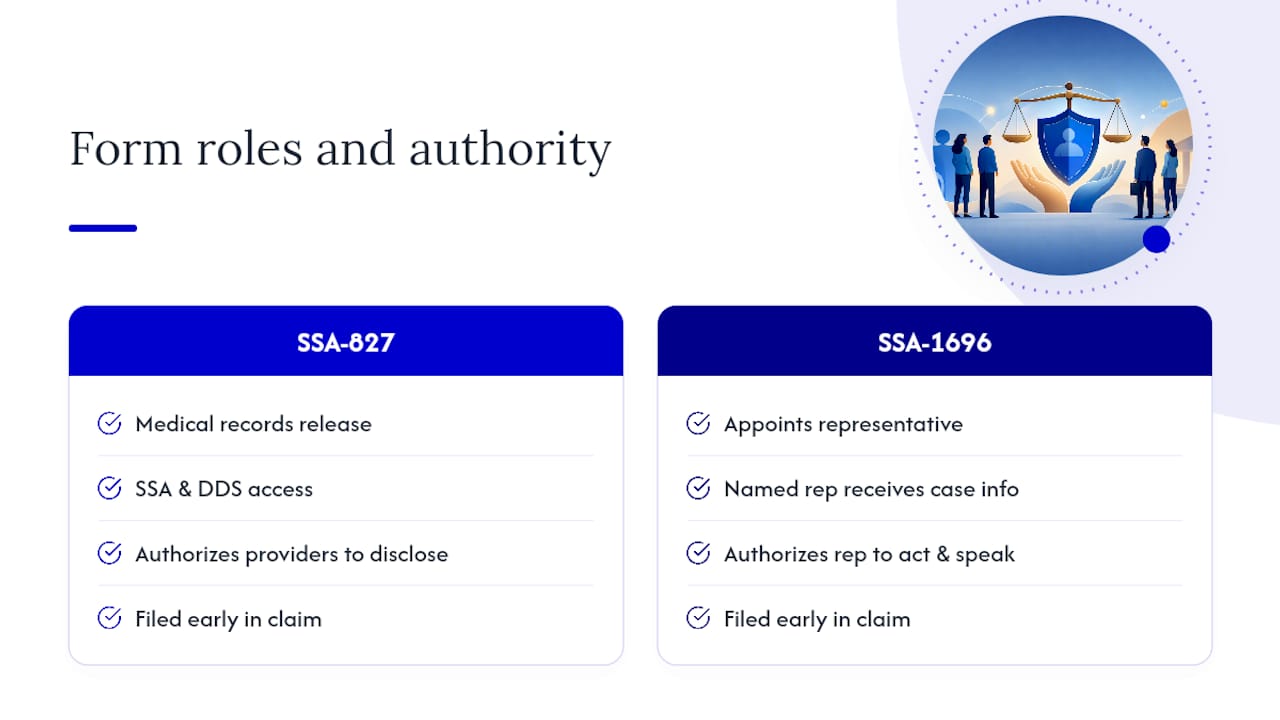
Both forms typically get filed early in a claim, often within the same intake session, but they authorize completely different things. If you're working with a representative, expect to sign both: one so your representative can act for you, and one so SSA and your providers can share your medical history.
Why SSA Requests Medical Records Using the SSA-827
SSA doesn't request records reflexively. Each request ties back to a specific step in evaluating your disability claim.
The most common trigger is simply building the initial medical evidence file. When you first file for SSDI or SSI, examiners need documentation of every impairment you've listed, which means contacting every treating source you named.
Appeals generate a second wave of requests. If your claim moves to reconsideration or a hearing before an administrative law judge, SSA often needs updated records covering the months since your initial filing, since a judge wants to see how your condition has progressed.
Consultative examinations create a third trigger. When your existing records don't give SSA enough detail to evaluate a specific impairment, the agency may schedule its own exam and needs the SSA-827 on file to obtain the resulting report and share it with your file.
Continuing disability reviews are the fourth major reason. SSA periodically reevaluates ongoing benefits, and each review cycle requires a fresh look at your current medical status, which means new record requests under a valid authorization.
Finally, discrepancies prompt targeted follow-up requests. If a claimant's stated symptoms don't match what an initial record shows, or if two sources offer conflicting information, examiners will go back to specific providers for clarification, always backed by your signed SSA-827.
HIPAA and Your Legal Rights When Records Move to SSA
HIPAA's Privacy Rule sets the baseline for how your medical information can be shared, and the SSA-827 was specifically designed to meet HIPAA's authorization requirements rather than sidestep them.
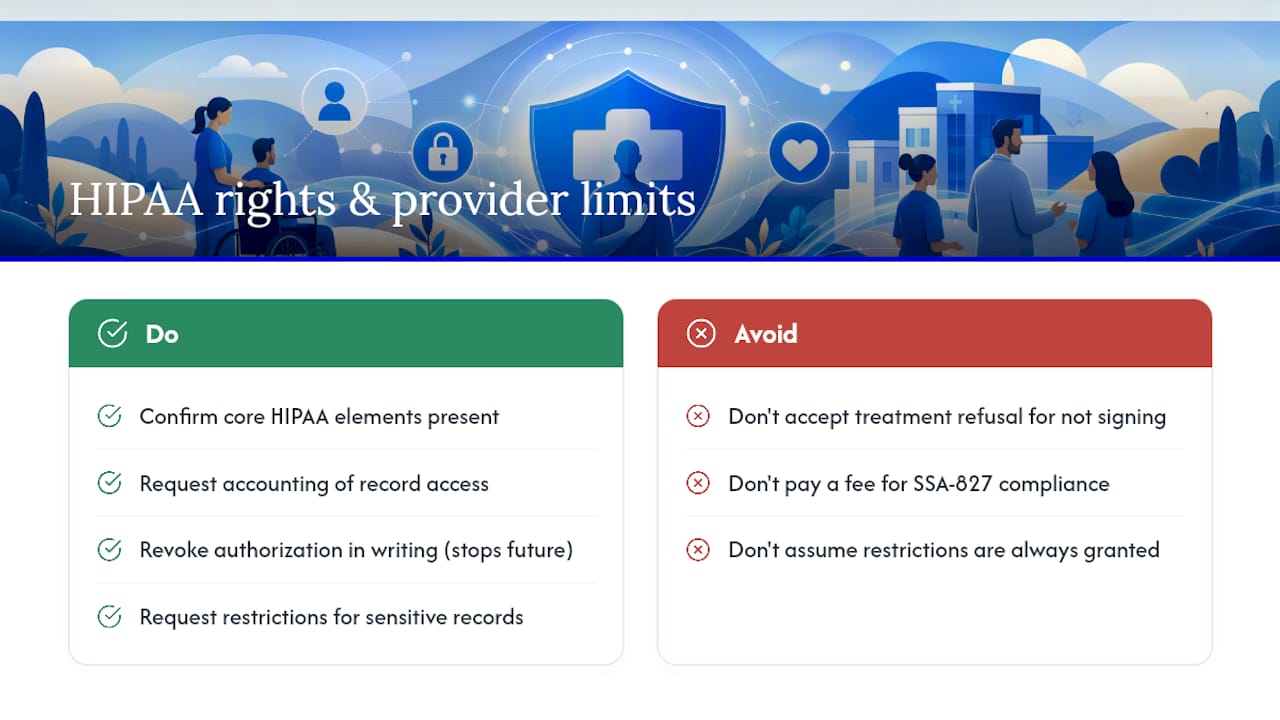
That means the form has to include the same core elements any valid HIPAA authorization needs: a description of the information being released, who's authorized to disclose it, who's receiving it, the purpose, and an expiration point. The SSA-827's 12-month expiration and named purpose checkbox exist precisely to satisfy that standard.
You retain rights throughout this process that HIPAA guarantees to every patient, regardless of the disability claim running in parallel. You can request an accounting of who has accessed your records. You can revoke authorization in writing at any time, understanding that revocation only stops future disclosures. You can also request that SSA restrict how certain sensitive categories, like substance abuse or HIV-related records, get used within your file, though SSA's ability to grant restrictions varies depending on the specific request and applicable federal rules.
Providers, for their part, cannot refuse you treatment or coverage because you declined to sign a release, and they cannot charge you a fee to comply with a valid SSA-827 the way they might for a private records request. The form's design, built jointly with HHS, exists to keep that balance intact: SSA gets what it needs to evaluate your claim, and you keep the privacy protections HIPAA already promises you.
Disputing or Correcting Records SSA Has Already Received
Mistakes in medical records happen more often than most claimants expect, and they can genuinely affect a disability decision if left uncorrected. A wrong diagnosis code, a misattributed test result, or an outdated medication list can all shape how an examiner reads your file.
Start with the source, not SSA. Federal privacy law gives you the right to request an amendment directly from the provider or facility that created the record. Most hospitals and clinics have a formal process for this, usually through their medical records or health information management department, and they're required to respond within a set timeframe.
If the provider agrees to the correction, ask them to send SSA an updated copy directly, since your existing SSA-827 authorization typically still covers that follow-up disclosure as long as it hasn't expired. If the provider declines to change the record, you still have the right to submit a written statement of disagreement, which becomes part of your permanent file alongside the original entry.
Tell SSA about the dispute regardless of how the provider responds. Your claims examiner or your representative, if you have one, can flag the disputed information and make sure the file reflects both the original record and your correction request. Waiting until a hearing to raise a records dispute is far riskier than addressing it as soon as you notice the error, since judges and examiners generally give more weight to a documented correction made in real time.
When SSA-827 Complications Call for Legal Help
Common friction points include unsigned pages, mismatched identity fields, providers demanding their own authorization language, and claimants who revoke a release without realizing it can stall their own case. None of these are dramatic mistakes, but they compound.
An experienced SSDI attorney tracks which sources have responded, follows up before deadlines slip, and knows when a provider's track record with SSA requests calls for a targeted, provider-specific form instead of waiting on a general one. That kind of attention often separates a claim built on solid evidence from one stuck in limbo.
— Gerard
Get Help Completing Your SSA-827 and Building Your Claim
Some services connect claimants directly with SSDI attorneys who troubleshoot slow responses from providers and fix authorization problems before they cause delays. That's the real advantage over trying to track fourteen separate record requests yourself while also managing a medical condition.
If your SSA-827 is tied up with a provider dispute, an expired authorization, or a case that's stalled waiting on records, a matched attorney can pick up the follow-up work and push your claim forward. Attorneys can also provide assistance with related paperwork, including the attorney authorization form and evidence tied to your residual functional capacity assessment. Start a free case review on our SSDI attorney matching page to get a qualified attorney looking at your file.
This article is general information, not a substitute for advice from a qualified lawyer. Consult a qualified legal professional about your own circumstances before acting on anything here.