
SSDI has no asset or resource limits. You can have savings, investments, retirement accounts, and property and still qualify, as long as you meet the work-credit and medical tests the Social Security Administration requires. The program that does cap what you own is Supplemental Security Income (SSI), a separate benefit. The bigger threat to your SSDI check is earned income above the 2026 Substantial Gainful Activity limit of $1,690 a month for non-blind applicants.
TL;DR:
- SSDI has no asset or resource limits, so savings, investments, and property generally do not affect eligibility unless combined with earned income above the SGA threshold.
- Earned income exceeding the 2026 Substantial Gainful Activity limit of $1,690 per month for non-blind applicants can disqualify SSDI benefits, but passive income like interest does not.
- If receiving both SSDI and SSI, a resource limit of $2,000 for individuals applies to the SSI portion, with certain assets like primary residence and one vehicle excluded from count.
- Selling an excluded item, such as a vehicle, converts its value to cash, which then counts against SSI resource limits if not spent quickly.
- Proper documentation and prompt reporting are essential when receiving large sums like SSDI back pay or inheritances to avoid overpayment issues or benefit suspension.
Table of Contents
- SSDI vs SSI: What Each Program Actually Evaluates
- What Counts as a Resource, and What Doesn't
- Why SSDI Doesn't Care About Your Bank Balance
- When Assets Suddenly Start to Matter
- How the SSA Verifies Your Resources
- What To Do if You Get Back Pay, an Inheritance, or Just Want to Save Safely
- Why This Distinction Deserves More Attention Than It Gets
- How Ssdilawyer Can Help You Sort This Out
- Where to Verify These Rules Yourself
- Sources
- FAQ
SSDI vs SSI: What Each Program Actually Evaluates
SSDI and SSI get confused constantly, and the mix-up costs people real money in bad decisions. They are built on completely different foundations.
SSDI is insurance. You paid into it through payroll taxes for years, so the SSA's job is to confirm you earned enough work credits and meet the medical definition of disability. It is not a poverty program, so there is no reason for the agency to ask what is sitting in your brokerage account.
SSI is different. It's needs-based, funded by general tax revenue rather than your work history, and designed for people with very limited income and resources regardless of work background.
Here's what the SSA actually checks for each program:
- SSDI: work history and credits, current medical evidence, and whether your earnings exceed the SGA threshold.
- SSI: monthly income, countable resources, and household composition.
The SSI resource caps are strict: $2,000 for an individual and $3,000 for a couple, according to the Social Security Administration. Certain items don't count toward that ceiling, including your primary home, one vehicle, household goods, and burial plots. If you only receive SSDI, none of that math applies to you. If you receive both, it applies to the SSI half of your benefits.
What Counts as a Resource, and What Doesn't
For SSI purposes, a countable resource is anything you own that could be converted to cash and used for food or shelter. That includes checking and savings balances, stocks, bonds, and any real estate beyond the home you live in.
A shorter list escapes the count entirely. The SSA excludes your primary residence, one vehicle regardless of value, household goods and personal effects, and burial plots or a limited amount set aside for burial expenses, per its SSI resource guidance.
One of the most useful protections is the ABLE account. ABLE accounts let a person with a qualifying disability onset before age 26 (a threshold recently expanded) save without those savings counting against the SSI limit, up to a $100,000 exclusion. Recent law changes have also refined how certain retirement accounts get treated for resource purposes, so it's worth checking current status rather than assuming an old rule still applies.
A few practical wrinkles trip people up:
- Joint bank accounts are generally presumed fully countable to the SSI applicant unless proven otherwise.
- Selling an excluded item, like your car, converts the proceeds into cash. That cash becomes countable the moment it lands in your account.
- Timing matters. A resource is measured on the first day of the month, so a sale near month's end can create a brief window where you're over the limit before you spend the funds down.
None of this touches your SSDI eligibility. It only matters if you're also drawing SSI.
Why SSDI Doesn't Care About Your Bank Balance
SSDI eligibility rests on two tests: enough work credits, and a medical condition that meets the SSA's disability standard. Net worth plays no role in either one.
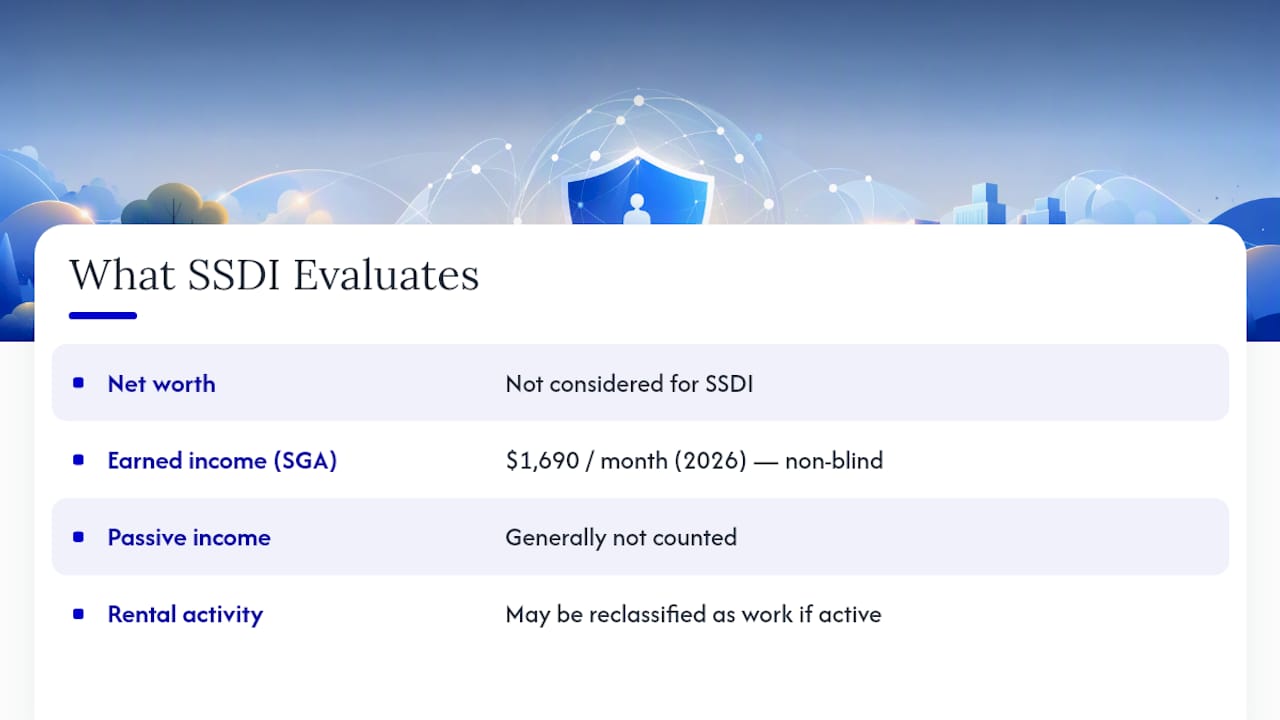
What can knock you off SSDI is earned income, specifically work at a level the SSA calls Substantial Gainful Activity. For 2026, the SGA threshold is $1,690 a month for non-blind individuals; the limit is higher for statutorily blind beneficiaries. Cross that line with active work and the SSA may decide you're no longer disabled for benefit purposes, regardless of how much you have saved.
Passive income is treated differently than earned income, and the distinction trips people up more than any other part of this system.
Interest, dividends, and rental income generally don't count against SSDI, but the moment you're actively managing that rental property, screening tenants, fixing the furnace, collecting rent by hand, the SSA may reclassify that involvement as work. It's the activity that matters, not the check.
That single distinction explains why one landlord on SSDI stays fully compliant while another, doing the exact same thing on paper, ends up flagged for review.
When Assets Suddenly Start to Matter
Assets are irrelevant to SSDI on its own, but three situations change that calculus fast.
- Concurrent benefits. If you receive SSDI and SSI together, the SSI resource limit governs your SSI portion at all times. A jump in savings can suspend the SSI payment even though the SSDI payment continues untouched.
- SSDI back pay. A lump-sum retroactive payment can temporarily push a concurrent beneficiary's resources over the SSI cap. The SSA generally allows a nine-month window to spend that money down on allowable expenses before it counts against you.
- Inheritances and windfalls. These must be reported promptly. An inheritance that sits in a standard account past the reporting deadline can trigger an SSI overpayment finding, and clawing that back is a slow, unpleasant process.
Transfers deserve their own warning. If you give away money or property to get under the resource limit, the SSA can look back 36 months and penalize you with a period of SSI ineligibility.
Pro Tip: If you're expecting SSDI back pay and you also receive SSI, open a separate account for the retroactive payment the day it arrives. Mixing it with everyday funds makes the nine-month spend-down almost impossible to document later.
How the SSA Verifies Your Resources
The SSA has a real tool for checking bank balances, but it isn't aimed at everyone. Through its Access to Financial Institutions process, the agency can request account information from banks to verify SSI eligibility. SSDI-only recipients are not routinely subject to this kind of check, because their resources never entered the equation.
Verification tends to happen at specific moments:
- Initial SSI application, when the agency establishes your baseline resources.
- Periodic redeterminations, typically every one to six years depending on your situation.
- Any time you report a change, like a new job, an inheritance, or a move.
Keep a simple folder ready regardless of which program you're on: recent bank statements, ABLE account records, trust paperwork if one exists, and receipts from any major purchase or sale. If a question ever comes up, that paper trail settles it fast.
What To Do if You Get Back Pay, an Inheritance, or Just Want to Save Safely
Start by confirming exactly which program covers you. If it's SSDI only, saving money creates no risk to your benefit at all. If you're on SSDI and SSI together, treat every dollar of new money as something to log the day it arrives.
- Separate the funds. Move back pay or an inheritance into its own account immediately, apart from routine income.
- Document everything. Write down the amount, the date received, and the source. This record becomes your defense if the SSA ever asks questions.
- Match spending to allowable categories. During a spend-down window, money spent on a home, a vehicle, medical equipment, or debt repayment is typically safer than money left sitting in cash.
- Consider protective tools before you spend anything. An ABLE account can shelter up to $100,000. A first-party special needs trust can hold larger sums, though it carries a Medicaid payback requirement, per the SSA's ABLE account guidance. A PASS plan (Plan to Achieve Self-Support) can let you set aside income or resources for a specific work goal.
- Report changes to the SSA promptly, ideally in writing, and keep a copy of what you submitted.
Pro Tip: Don't wait for the SSA to ask about a large deposit. Reporting it yourself, even before you've decided what to do with it, almost always goes better than having the agency discover it during a review.
Get an attorney involved when the back pay is substantial, when you're navigating a denial or appeal alongside a resource question, or when a transfer you made in the past 36 months might trigger a penalty. Those situations rarely resolve cleanly without someone who knows the SGA and eligibility rules cold.
Why This Distinction Deserves More Attention Than It Gets
The no-asset rule for SSDI is one of the more reader-friendly facts in a system that usually rewards confusion. It removes an entire category of worry for millions of beneficiaries, and it should let people save, invest, and plan without second-guessing every deposit.
The mistakes I see most often aren't about SSDI at all. They're about people on concurrent benefits who treat a back-pay check like SSDI money when the SSI half of their case is watching every dollar. A little documentation and a same-day account separation would have prevented most of those problems.
Keep good records even when the rules say you don't strictly need to. It costs nothing and it settles arguments before they start.
— Gerard
How Ssdilawyer Can Help You Sort This Out
Consider seeking an experienced disability attorney to help you navigate SSA paperwork. Matching services can connect you with attorneys based on your situation, whether you're filing a first application, appealing a denial, or heading into a hearing.
Consider using an attorney when your case involves concurrent SSDI and SSI benefits, a large back-pay award that could brush against SSI's resource limit, an appeal after a denial, or a past transfer that might trigger a penalty period. These are exactly the moments where a small mistake in reporting or timing turns into months of lost benefits. Related reading on Substantial Gainful Activity and SSDI back payments can help you prepare questions before that first call.
Start by submitting your case details through Ssdilawyer's intake process to get matched with an attorney who handles cases like yours.
Where to Verify These Rules Yourself
The SSA's disability benefits page and SSI page are the primary sources for eligibility and resource rules. POMS SI 01140.205 covers financial-institution verification in detail. AARP's savings account explainer offers a plain-language second opinion worth reading alongside the official pages.
This article is general information, not a substitute for advice from a qualified financial advisor. Consult a qualified financial professional about your own circumstances before acting on anything here.
Sources
- Disability Benefits | Social Security Administration
- POMS SI 01140.205 – Joint Checking and Savings Accounts / Access to Financial Institutions (SSA POMS)
FAQ
How Much Money Can You Have in the Bank on SSDI?
There is no limit. SSDI has no asset or resource test, so your bank balance has no bearing on eligibility, per the Social Security Administration.
Can You Qualify for Disability With $100,000 in Savings?
Yes, for SSDI, since assets don't factor into eligibility at all. For SSI, that amount would put you well over the $2,000 individual resource limit unless it sits in a protected vehicle like an ABLE account.
What Assets Can You Have on SSDI?
Any assets at all. Savings, investment accounts, retirement funds, and property don't affect SSDI, though earned income above the 2026 SGA limit of $1,690 a month can.
Can Social Security See How Much Money Is in Your Bank Account?
For SSI cases, yes, through the Access to Financial Institutions process. For SSDI-only cases, the SSA doesn't routinely check bank balances since resources aren't part of eligibility.
Does an Inheritance Affect SSDI Benefits?
An inheritance never affects SSDI on its own. It can affect the SSI portion of a concurrent claim if it pushes resources over the limit, so reporting it promptly matters.