
Most people qualify for SSDI on work credits alone once they hit 40 lifetime credits, with at least 20 earned in the 10 years before disability began (the 20/40 rule) — though workers under 31 need fewer. In 2026, one credit equals $1,890 in covered earnings, and four credits (the yearly max) require $7,560. If your recent work history is thin, credits, not medical severity, may be what stops your claim.
TL;DR:
- Most claimants qualify for SSDI after earning 20 credits in the last 10 years, but workers under 31 need fewer credits.
- A credit in 2026 requires $1,890 in covered earnings, with four credits possible annually regardless of income above $7,560.
- The recent work test depends on earning enough credits within a rolling 10-year window before disability, not just overall lifetime credits.
- Gaps in employment, public-sector work without Social Security taxes, or earnings outside the lookback window can disqualify claims despite long career totals.
- Checking and correcting earnings records early is crucial, as discrepancies may delay or deny SSDI benefits if left unaddressed.
Table of Contents
- SSDI Work Credit Requirements: How Credits Are Earned in 2026
- How Many Work Credits You Need for SSDI by Age
- Recent Work Test Pitfalls and Your Date Last Insured
- Exceptions: Blindness, Military Service, and Self-Employment Rules
- How to Check Your SSDI Work Credits and Fix Errors
- No SSDI Work Credits? Consider SSI and Other Options
- When an SSDI Attorney's Help Changes the Outcome
- A Practical Checklist Before You File
- Get Help Verifying Your Work Credits and Insured Status
- Sources
SSDI Work Credit Requirements: How Credits Are Earned in 2026
A work credit is the unit Social Security uses to measure how long you've paid into the system through payroll or self-employment taxes. In 2026, you earn one credit for every $1,890 in covered earnings, and the SSA caps credits at four per year no matter how much you make above $7,560. Earn $30,000 in a single year, and you still walk away with four credits, not forty.
Credits accumulate based on your total annual covered earnings, not on a calendar-quarter timeline, despite the old "quarters of coverage" nickname still floating around. Once a credit posts to your record, it stays there permanently.
Not every paycheck counts toward this total. Earnings that typically build credits include:
- W-2 wages from most private and government jobs
- Self-employment income reported on Schedule SE
- Active military pay, including certain deployment-related wage credits
Earnings that often don't count: some state and local government pensions where Social Security tax wasn't withheld, and limited categories of religious or nonprofit work exempted from payroll tax. If you've bounced between public-sector and private jobs, check your record early. A work history report can flag these gaps before they become a denial reason.
How Many Work Credits You Need for SSDI by Age
Social Security actually runs two separate tests, and confusing them is the single most common misunderstanding claimants have. The duration of work test asks whether you've earned enough lifetime credits overall. The recent work test asks whether enough of those credits fall inside a recent window before your disability began. You can clear the first test and still fail the second, which is exactly what trips up workers who had a long career decades ago but haven't worked steadily since.
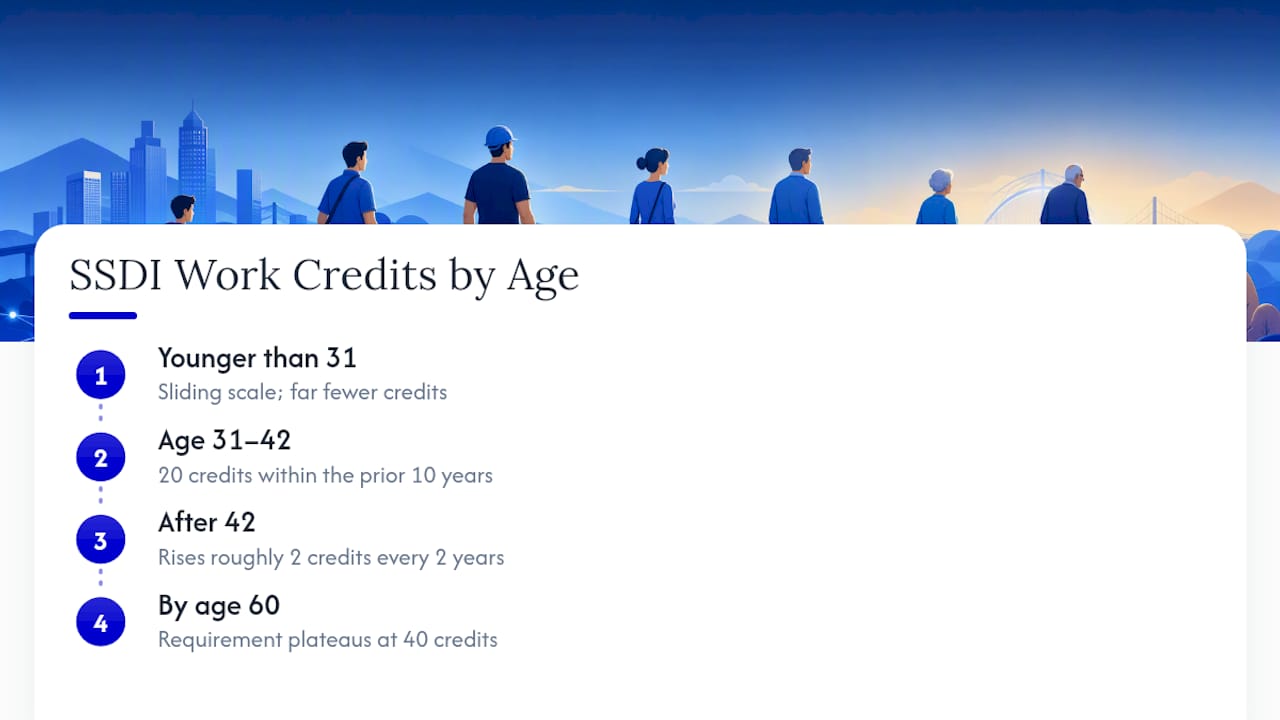
For most adults 31 and older, the standard is the 20/40 rule: 20 credits earned within the 10 years immediately preceding disability onset. Workers younger than 31 fall under a sliding scale that requires far fewer credits, since they've had less time in the workforce to earn them.
The SSA's age-based table breaks the sliding scale down this way:
Notice how the requirement climbs by two credits roughly every two years after 42, plateauing at 40 by age 60. If you're 55 and haven't worked steadily since your late 40s, this table is where a claim quietly falls apart.
Recent Work Test Pitfalls and Your Date Last Insured
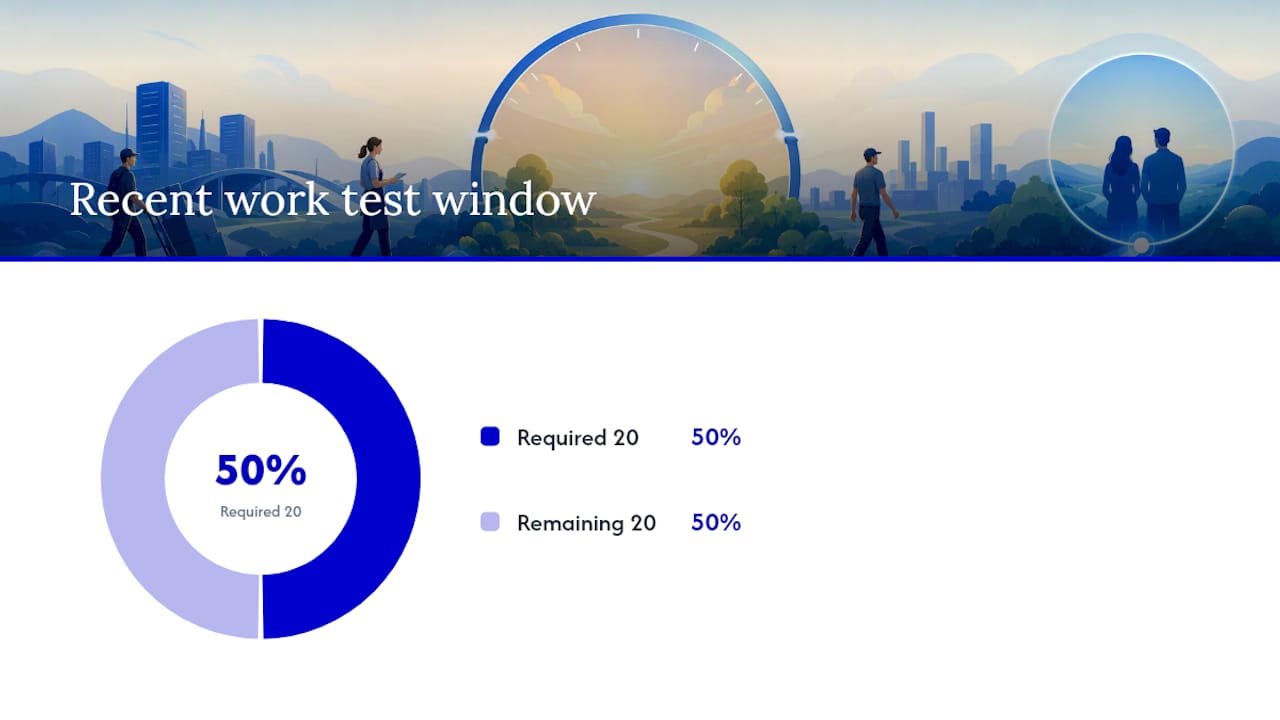
The recent work test looks backward from your disability onset date across a rolling window, commonly described as the last 40 calendar quarters (10 years) for workers 31 and up. Twenty of those quarters need covered earnings attached. Miss that window and lifetime credits, even 40 or more of them, won't save the claim.
This connects directly to your date last insured (DLI): the point at which your insured status expires if you stop earning credits. File a claim with an onset date after your DLI, and SSA can deny it on technical grounds before anyone even reviews your medical records. Understanding your date last insured matters as much as documenting the disability itself.
Common pitfalls that cause technical denials:
- Relying on credits earned 15 or 20 years ago that fall outside the lookback window
- W-2 errors or an employer's late/incorrect wage reporting
- Unreported or under-reported self-employment income
- Extended unpaid leave, caregiving gaps, or long stretches out of the workforce that quietly erode insured status
Pro Tip: If your health started declining years before you stopped working, talk to a professional about whether your true onset date falls inside your insured period, even if you didn't file right away.
Exceptions: Blindness, Military Service, and Self-Employment Rules
A handful of situations change the standard math. Statutory blindness removes the recent work test entirely, so a legally blind applicant only needs to meet the duration of work test, regardless of how long ago those credits were earned.
Other notable exceptions:
- Military service: Active duty pay counts toward credits like ordinary wages, and certain periods carry special wage credit rules for service members.
- Self-employment: Credits depend on net earnings reported through Schedule SE. Net earnings below $400 in a year generally generate zero credits, which surprises a lot of small-business owners who assumed any income counted.
- Public employees: Some state, county, and municipal workers, along with certain religious-order staff, may have pay that was never subject to Social Security tax, leaving unexpected holes in an otherwise solid record.
Self-employed claimants should double-check that Schedule SE filings actually match reported net income each year, since inconsistent tax reporting is a quiet but common source of missing credits.
How to Check Your SSDI Work Credits and Fix Errors
- Sign in to my Social Security and pull your Social Security Statement, which lists your yearly earnings and current credit total.
- Cross-check against your own W-2s and tax returns, year by year, looking for any year where reported income doesn't match SSA's record.
- Request a paper earnings statement from SSA if you can't access the online portal, or if you need a formal copy for an attorney or appeal.
- File Form SSA-7004 if you need a certified earnings record for a specific purpose.
- Contact SSA directly, or consult a disability attorney, if you find a discrepancy. Corrections generally go faster the sooner they're flagged, and old, undocumented errors get harder to fix with time.
Pro Tip: Keep your own folder of pay stubs and tax filings going back at least 10 years. SSA's record is usually accurate, but when it isn't, your own paperwork is what settles the dispute.
No SSDI Work Credits? Consider SSI and Other Options
SSDI runs on an insurance model. No qualifying credits, no benefit, regardless of how severe the disability is. Supplemental Security Income works differently: it's needs-based, ignores work history entirely, and instead applies strict income and asset limits.
If your credit count falls short, a few realistic paths forward:
- Apply for SSI if your income and resources fall under the program's limits.
- Check whether the statutory blindness exception applies to your case.
- Gather medical evidence pinpointing an onset date that falls inside your insured period, even if that date is earlier than when symptoms became severe enough to stop working.
- Consider filing for both SSDI and SSI simultaneously (a "concurrent claim") if you're close to qualifying for either.
One practical difference worth knowing: SSDI recipients become eligible for Medicare after a 24-month waiting period, while SSI recipients in most states qualify for Medicaid immediately.
When an SSDI Attorney's Help Changes the Outcome
Legal representation tends to matter most in a specific set of situations: insured-status denials, disputes over the correct onset date, complicated work histories spanning self-employment and public-sector jobs, and any case headed to appeal or a hearing before an administrative law judge. For specialized assistance, consider Arizona catastrophic injury claims for relevant legal counsel on severe injury claims. These are technical fights, often decided on documentation rather than medical severity alone.
The matching service connects claimants with experienced SSDI attorneys who handle exactly these scenarios. A typical intake reviews your insured status, checks whether your earnings record needs correction, and evaluates whether an appeal is likely to succeed before you invest more time in it. For related groundwork, see how SSDI eligibility and work history interact with medical determinations.
A Practical Checklist Before You File
Sign in to my Social Security today, not the week before you plan to file. Compare that statement line by line against your W-2s and tax returns, note your date last insured, and set aside a folder with anything you'd need to request a correction. If insured status looks shaky or you're already facing a denial, get a second set of eyes from someone who handles appeals for a living. Waiting rarely makes an insured-status problem easier to fix.
— Gerard
Get Help Verifying Your Work Credits and Insured Status
This service can be the practical next step when a credit count or insured-status question is standing between you and a filed claim, not another form to fill out alone. Unlike trying to decode SSA's earnings record by yourself or guessing whether your date last insured leaves room to file, it can connect you with an experienced SSDI attorney who reviews the technical details before you commit to anything.
A typical intake looks at your insured status, flags any earnings record that needs correcting, and gives you a straight answer on whether an appeal or hearing is likely to help your case. If your credits are borderline, your onset date is in dispute, or you've already received a denial tied to insured status, Ssdilawyer and get matched with an attorney who handles exactly this kind of case.
This article is general information, not a substitute for advice from a qualified financial advisor. Consult a qualified financial professional about your own circumstances before acting on anything here.