
What is a disability lawyer's written closing argument?
A disability lawyer's written closing argument is a formal, post-hearing document submitted to the Administrative Law Judge (ALJ) after a Social Security disability hearing closes. It summarizes the key evidence, applies the relevant legal standards, and argues why the claimant qualifies for benefits. The document does not introduce new facts. It works strictly within the evidence already admitted into the hearing record.
This written submission serves as the attorney's final opportunity to frame the case on the claimant's behalf. Think of it as a focused legal brief that connects the medical records, testimony, and applicable Social Security rules into one coherent argument for the judge to review.
Key functions of a written closing argument in a disability case:
- Summarizes testimony and medical evidence already in the record
- Applies Social Security legal criteria to the specific facts of the case
- Addresses potential weaknesses in the claim before the judge does
- Reinforces the strongest evidence supporting the claimant's limitations
- Provides the ALJ with a written reference during the decision-making process
- Serves as a supplement or alternative to an oral closing statement
Table of Contents
- When and why disability lawyers submit written closing arguments
- What goes into a written closing argument, and what is off-limits
- How claimants can prepare to help their lawyer write a strong closing
- Expert insights on the impact of written closing arguments in disability cases
- What an effective written closing argument looks like in practice
- Ssdilawyer connects you with attorneys who know how to close
- Key Takeaways
When and why disability lawyers submit written closing arguments
Lawyers typically file written closing arguments shortly after the hearing concludes and the administrative record closes. At that point, no new evidence can enter the record, but the attorney can still shape how the judge interprets what is already there.
Several factors drive the decision to submit one:
- Case complexity. When a claim involves multiple conditions, conflicting medical opinions, or a long work history, a written brief helps organize the argument clearly.
- Limited oral argument time. ALJ hearings are often brief. A written closing gives the attorney space to develop points that could not be fully addressed during the hearing itself.
- Judge preference. Some ALJs rely heavily on written submissions when reviewing the record before issuing a decision.
- Reinforcing credibility. A well-organized written argument signals preparation and professionalism, which can influence how the judge weighs the attorney's positions.
Written closings supplement or replace oral arguments depending on the hearing's constraints and the attorney's strategy. Not every case requires one, but in complex or borderline claims, filing a written closing is often the right call.
What goes into a written closing argument, and what is off-limits
The content of a disability attorney closing argument follows strict boundaries. The cardinal rule is that counsel must confine all factual references to evidence already in the record. Anything outside that boundary is prohibited.
What belongs in the argument:
- A factual summary drawn entirely from admitted medical records and testimony
- An explanation of how the evidence satisfies the Social Security five-step sequential evaluation
- References to the claimant's Residual Functional Capacity (RFC) and how it limits work activity
- Responses to any vocational expert testimony that may have hurt the claim
- Citations to applicable Social Security rulings and regulations
What is prohibited:
- New medical records or opinions not submitted before the record closed
- Personal opinions from the attorney not grounded in the record
- Emotional appeals that go beyond the facts, such as statements about the attorney's personal beliefs regarding the claimant's character
- Misstatements of the evidence or the law
Tone matters as well. Overly emotional or opinionated language can damage credibility and undermine the argument's persuasive force. The writing should be professional, clear, and grounded in the facts. A well-organized structure, moving from factual summary to legal analysis to conclusion, keeps the argument readable and persuasive without crossing into advocacy that oversteps the record.
How claimants can prepare to help their lawyer write a strong closing
The quality of a written closing argument depends heavily on the information the claimant provides before and during the hearing. Complete and accurate claimant input supports more persuasive and detailed closing briefs.
Practical steps claimants can take:
- Submit all medical records early. Records from every treating physician, specialist, and hospital should reach the attorney well before the hearing date.
- Describe functional limitations in specific terms. Statements like "I can stand for no more than 10 minutes before pain forces me to sit" are far more useful than general descriptions of pain.
- Give clear, consistent testimony at the hearing. The closing argument will reference what was said under oath, so accuracy and detail during testimony directly affect what the attorney can argue.
- Communicate priorities. If there are specific limitations or medical findings the claimant believes are most important, sharing that with the attorney before the hearing helps ensure those points receive emphasis.
- Avoid adding new information after the record closes. Once the hearing ends, the record is sealed. New medical visits or updated opinions cannot be included in the closing argument and must wait for a separate submission or appeal.
Reviewing a draft of the closing argument, if the attorney allows it, gives the claimant a chance to catch factual errors before the document reaches the judge. Not all attorneys offer this step, but it is worth asking about.
Pro Tip: Ask your attorney directly: "What evidence do you plan to emphasize in the closing argument?" That one question can reveal gaps in the record while there is still time to address them.
Expert insights on the impact of written closing arguments in disability cases
Written closing arguments carry real weight in Social Security disability hearings. They serve as a critical lens through which disability lawyers focus the ALJ's attention on the most compelling evidence and applicable legal criteria.
Several principles separate effective closing arguments from weak ones:
- A unifying theme strengthens the argument. A strong narrative thread helps the judge follow the argument and remember the key points. Themes that address the claim's most vulnerable aspects are particularly effective.
- Linking testimony to legal standards is essential. The argument should connect specific witness statements and medical findings directly to the Social Security criteria the ALJ must apply.
- Analogies can aid comprehension but carry risk. Comparing a claimant's limitations to a familiar situation can help a judge understand the practical impact of a condition, but analogies must stay grounded in the record.
- Reading the argument verbatim at the hearing is a mistake. Lawyers must avoid reading written arguments verbatim in hearings, as it eliminates the opportunity to demonstrate genuine advocacy and engagement.
- Lawyer experience shapes the outcome. An attorney who has conducted hundreds of hearings understands which arguments resonate with ALJs and which fall flat. That pattern recognition is difficult to replicate without direct experience.
The benefits of hiring a disability attorney extend directly to this stage of the process. A well-crafted closing argument can clarify ambiguous evidence, counter unfavorable vocational testimony, and present the claimant's limitations in the most legally relevant terms.
What an effective written closing argument looks like in practice
A strong disability closing argument follows a predictable structure, even though the specific content varies by case. The U.S. Courts' guide to writing closing arguments identifies the core components: factual evidence summary, witness credibility analysis, and a clear bottom-line conclusion.
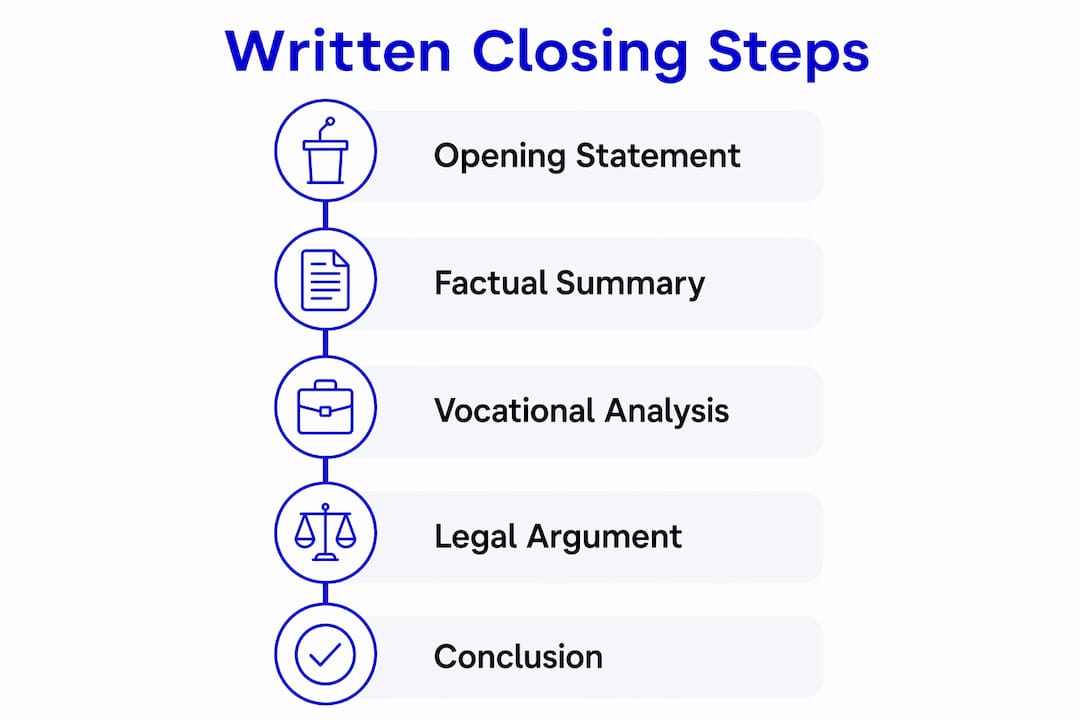
For a Social Security disability case, that structure typically looks like this:
Opening statement of the issue. One or two sentences identifying the claim and the legal standard at issue. Example: "This brief addresses whether claimant Jane Doe meets the criteria for disability under Title II of the Social Security Act due to degenerative disc disease and major depressive disorder."
Factual summary. A section-by-section review of the medical evidence, organized by condition. Each paragraph cites specific records by exhibit number and explains how the finding supports the claimant's limitations.

Vocational analysis. If a vocational expert testified, this section addresses the hypothetical questions posed by the ALJ and argues why the claimant's actual limitations rule out the jobs the expert identified.
Legal argument. A direct application of the relevant Social Security rulings, such as SSR 96-8p on RFC assessments or SSR 16-3p on symptom evaluation, to the specific facts of the case.
Conclusion. A clear, direct request for a fully favorable decision, summarizing the two or three strongest reasons the evidence supports the claim.
For claimants who want to see how winning SSDI cases are structured, reviewing examples with an attorney can clarify what a persuasive argument looks like in practice.
Ssdilawyer connects you with attorneys who know how to close
Preparing for a Social Security disability hearing is demanding. The written closing argument is one of the most technical parts of the process, and getting it right requires an attorney who understands both the medical evidence and the legal standards the ALJ applies.
Ssdilawyer connects claimants across the United States with experienced disability attorneys who handle hearings, prepare closing briefs, and advocate for benefits at every stage of the SSDI process. The attorneys in the network have direct experience with ALJ hearings and understand how to frame evidence persuasively within the strict limits of the hearing record. If your hearing is approaching or you have already received a denial, the right legal representation can make a concrete difference in how your case is presented and decided. Visit Ssdilawyer to get connected with a qualified disability attorney today.
Key Takeaways
A disability lawyer's written closing argument is the final, record-bound document that frames the claimant's case for the ALJ after the hearing closes, and its quality directly affects how the judge evaluates the evidence.
| Point | Details |
|---|---|
| Strict record limits apply | Written closing arguments may only reference evidence already admitted into the hearing record. |
| Timing follows the hearing | Lawyers typically submit the closing brief shortly after the hearing concludes and the record closes. |
| Structure drives persuasion | Effective arguments move from factual summary to legal analysis to a clear conclusion tied to Social Security criteria. |
| Claimant input matters | Specific descriptions of functional limitations and complete medical records directly strengthen what the attorney can argue. |
| Ssdilawyer provides access | Ssdilawyer connects claimants with experienced disability attorneys who prepare written closing arguments for ALJ hearings. |