
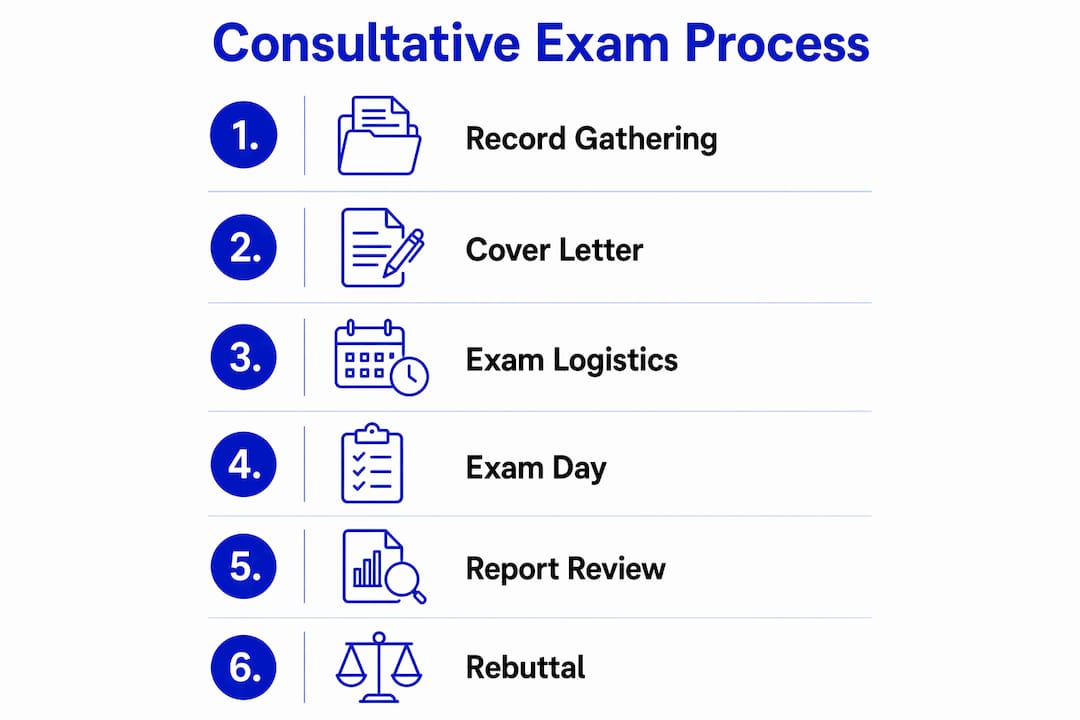
An attorney's role in consultative exam preparation covers four concrete tasks: building the medical record before the exam, advising you on how to conduct yourself during it, protecting your procedural rights throughout, and executing a rebuttal plan if the report comes back unfavorable. Attorney involvement is most critical at appeal and hearing stages, but groundwork starts the moment SSA schedules the exam.
What your attorney should do for CE prep:
- Gather and organize treating-source records, flagging gaps the CE examiner needs to address
- Draft and submit a cover letter to Disability Determination Services (DDS) and the CE source identifying unresolved medical questions and requesting specific testing
- Advise you on how to describe symptoms and functional limits accurately, without understatement or overstatement
- Arrange reasonable accommodations in advance (accessible exam space, extended appointment time) and document those requests
- Request the CE report promptly after the exam and review it for factual errors, omissions, or signs of a rushed examination
- Build a rebuttal plan: obtain a detailed Residual Functional Capacity (RFC) statement from your treating physician if the CE report is incomplete or inconsistent with your records
After the exam, contact your attorney with four pieces of information: how long the exam lasted, which tests were performed, which tests were skipped, and any examiner comments that seemed inaccurate.
Table of Contents
- What is a consultative exam and why does SSA order one?
- What attorneys do before the CE: a practical preparation checklist
- What attorneys can and cannot do on the day of the CE
- How attorneys use and respond to the CE report after the exam
- Practical strategies attorneys use to challenge a harmful CE report
- Common mistakes claimants and attorneys make with consultative exams
- How long decisions typically take after a consultative exam
- Questions to ask your attorney about the CE
- Key Takeaways
- Why CE preparation is where attorney work actually matters
- Ssdilawyer connects you with attorneys who handle CE preparation
- Authoritative sources and further reading
What is a consultative exam and why does SSA order one?
A consultative examination (CE) is a one-time medical evaluation that SSA orders when the existing medical evidence in your file is not sufficient for a disability decision. DDS purchases the exam on SSA's behalf, and SSA covers the cost. You pay nothing.
CEs come in two forms: physical and mental. A physical CE typically involves a history review, a focused physical examination, and possibly basic diagnostic tests. A mental CE assesses cognitive function, mood, memory, and daily functioning. In both cases, the examining doctor writes a report that goes into your file. That doctor does not decide your claim.
| Factor | Details |
|---|---|
| Who orders the CE | Disability Determination Services (DDS) on behalf of SSA |
| Who pays | SSA/DDS covers the full exam cost |
| Typical duration | 30–60 minutes |
| CE types | Physical or mental evaluation |
30–60 minutes is the typical length of a consultative exam per SSA guidance. An exam that runs significantly shorter may indicate an incomplete evaluation.
DDS selects CE sources that are currently licensed and equipped to perform the requested tests. The examiner must personally review and sign the report. If the examiner lacks the appropriate specialty or equipment, that is a documented defect your attorney can raise later.
What attorneys do before the CE: a practical preparation checklist
The weeks before a consultative exam are when attorney preparation does the most work. A well-prepared record and a targeted cover letter can shape what the examiner focuses on.
- Gather and organize treating-source records. The attorney pulls all relevant medical records, highlights the most probative findings, and identifies any gaps. Missing records are requested before the CE, not after.
- Submit a cover letter to DDS and the CE source. Attorneys can submit supporting evidence and a targeted letter explaining unresolved medical questions and requesting specific testing or examination areas. This letter is addressed to both DDS and the CE source.
- Request specific testing. If your condition requires a particular test (spirometry for a pulmonary claim, range-of-motion measurements for a musculoskeletal claim), the attorney requests it in writing before the exam date.
- Arrange reasonable accommodations. If you need an accessible exam room, a longer appointment, or a language interpreter, the attorney documents those requests in advance and confirms them with the CE source.
- Confirm scheduling accuracy. The attorney verifies that the CE is scheduled with an appropriately licensed examiner in the correct specialty and that the notice letter contains accurate information.
- Prepare you for the exam. The attorney reviews how to describe your symptoms and functional limits clearly and accurately. You should describe your worst typical day, not your best.
- Prepare a document packet for you to bring. This includes your current medication list, recent imaging reports, treatment notes, and any assistive devices (cane, brace, CPAP equipment).
Sample cover letter outline an attorney sends to DDS and the CE source:
- Opening: claimant name, SSN, scheduled CE date, and examiner name
- Summary of the disabling condition and the specific medical questions that remain unresolved in the file
- List of records attached and a brief explanation of their relevance
- Specific tests or examination areas requested (e.g., grip strength, gait assessment, mental status exam components)
- Attorney contact information and a request for confirmation
Pro Tip: When time is short before a CE, prioritize submitting the treating physician's most recent office notes and any imaging reports from the past 12 months. Document every attempt to obtain records that have not yet arrived — a written request log protects you if the CE proceeds without complete records.
What attorneys can and cannot do on the day of the CE
Attorneys generally do not attend the consultative exam. The CE is a medical examination conducted by a licensed clinician, and the examiner's job is to evaluate you directly. An attorney answering medical questions on your behalf or intervening in the examination would undermine the process and potentially the claim.

What attorneys can do on exam day is limited to logistics and advance preparation. The attorney may confirm your identity and paperwork with the CE source's office, provide contact information in case questions arise, and arrange any accommodations that were requested in advance. All substantive preparation happens before you walk in.
What the attorney should have already done is prepare you with clear instructions on how to answer. The guidance is straightforward: describe your symptoms as they are on a typical day, not on your best day. If a task causes pain, say so and describe the pain. If you cannot complete a task, say you cannot complete it. Do not minimize to appear cooperative, and do not exaggerate. Accuracy is the goal.
Brief scripts for describing symptoms and functional limits:
- "I can walk about half a block before the pain becomes too severe to continue."
- "I can sit for about 20 minutes before I need to stand or shift position."
- "I have difficulty concentrating for more than a few minutes at a time due to my medication and pain level."
These are factual, specific, and measurable. They give the examiner something concrete to record.
Pro Tip: If accommodations were requested (accessible exam space, extended time), confirm them with the CE source's office the day before the exam. Bring written documentation of the accommodation request. If the accommodation is not provided, note that immediately and report it to your attorney.
How attorneys use and respond to the CE report after the exam
The CE report arrives in your file, and your attorney's job is to assess it against everything else in the record. This is where the post-CE strategy takes shape.
- Request the CE report promptly. You have the right to request and receive a copy of the CE report. Your attorney should request it as soon as it is available, typically within a few weeks of the exam.
- Review for factual errors. The attorney compares the report against your documented history. Common errors include incorrect dates, wrong medications listed, misstatements about your reported symptoms, and omitted body systems.
- Document the exam's conduct. The attorney reviews the notes you made immediately after the exam: how long it lasted, which tests were performed, which were skipped, and any examiner comments. A contemporaneous record of the exam's conduct is key evidence if the report is later challenged.
- Compare against treating-source records. The attorney weighs the CE report against your long-term treating physician's records. A one-time CE that contradicts years of consistent treating-source documentation is a weak piece of evidence.
- Determine whether a rebuttal RFC is needed. If the CE report is unfavorable and inconsistent with your treating records, the attorney requests a detailed RFC statement from your treating physician. Treating-source RFC opinions generally carry more weight than a single CE report.
- Submit additional records or clarifying evidence. If the CE missed relevant conditions or testing, the attorney submits supplemental records before the file closes or before the hearing.
Sample post-CE follow-up timeline:
| Step | Typical timing |
|---|---|
| Request CE report from DDS | Within 1–2 weeks of exam |
| Review report and compare to file | Within 1 week of receipt |
| Contact treating physician for RFC | Within 2–3 weeks of receipt if rebuttal needed |
| Submit rebuttal records to DDS or ALJ | Before file closes or hearing date |

Practical strategies attorneys use to challenge a harmful CE report
A CE report cannot be appealed on its own. What attorneys do instead is reduce the weight the report receives before an Administrative Law Judge (ALJ). The ALJ can discount a CE report that is incomplete or inconsistent with the long-term treating record.
Tactical steps attorneys take:
- Correct factual errors in writing. If the report contains incorrect information (wrong diagnosis, wrong medications, misquoted symptom description), the attorney submits a written correction with supporting documentation.
- Submit contemporaneous notes about the exam. Your written account of the exam's duration, conduct, and any omissions becomes part of the record. An exam that lasted less than the typical 30–60 minutes is a documented defect.
- Obtain a detailed RFC from a treating source. This is the most effective rebuttal tool. A treating physician who has seen you regularly over months or years carries more credibility than a one-time examiner. The RFC should address specific functional limitations: sitting, standing, walking, lifting, concentration, and attendance.
- Retain a medical expert if needed. When a CE reports a functional capacity that is plainly inconsistent with years of treating records, attorneys may retain an independent medical expert to provide a written opinion or testify at hearing.
- Raise procedural defects at the hearing. Signs that a CE report deserves less weight include: the exam was unusually short, the examiner did not examine all relevant body systems, the examiner lacked the appropriate specialty, or the report contains internal inconsistencies. Attorneys document these defects and present them to the ALJ.
The realistic expectation: a strong treating-source RFC, combined with documented procedural defects in the CE, gives an ALJ a clear basis to assign the CE report reduced weight. That combination has shifted outcomes at hearing stage in cases where the CE alone would have supported a denial.
Common mistakes claimants and attorneys make with consultative exams
Most CE-related errors are avoidable. The ones that hurt claims most tend to cluster around communication failures and documentation gaps.
Claimant mistakes:
- Failing to notify counsel about the CE. If you receive a CE notice and do not tell your attorney immediately, the preparation window closes. Contact your attorney the day the notice arrives.
- Not documenting the exam immediately after. Memory fades quickly. Write down the exam's duration, every test performed, every test skipped, and any examiner comments within hours of leaving. This record is what your attorney works from.
- Minimizing symptoms during the exam. Describing your condition as better than it is on a typical day produces a report that does not reflect your actual limitations. Be accurate.
- Accepting an incomplete CE without follow-up. If the examiner skipped a body system or declined to perform a requested test, report that to your attorney immediately. It may support a request for additional testing.
- Failing to bring documentation. Arriving without your medication list, recent records, or assistive devices leaves the examiner without context.
Attorney process pitfalls:
- Over-relying on the CE without pressing for treating-source opinions. A CE is one data point. Attorneys who do not secure a treating-source RFC before a hearing leave a gap in the record.
- Missing deadlines to submit rebuttal evidence. DDS and ALJ deadlines are firm. Late submissions may not be considered.
- Failing to submit a pre-CE cover letter. Skipping this step means the examiner receives no guidance on what the file's unresolved questions are.
How long decisions typically take after a consultative exam
A CE does not trigger an automatic decision. It is one item in a file that DDS or an ALJ reviews alongside all other evidence. Decision timing varies based on where the claim is in the process.
At the initial application level, DDS typically issues a decision within a few months of receiving all evidence, including the CE report. At the reconsideration or hearing level, timelines are longer. ALJ hearing wait times have historically run over a year in many regions, though that varies by hearing office.
Common causes of delay after a CE:
- The CE report is delayed or incomplete, requiring follow-up by DDS
- Additional testing was requested and has not yet been completed
- The file is missing records that DDS is still attempting to obtain
- The claim is at the hearing level, where ALJ scheduling controls the timeline
Your attorney should track CE-related deadlines and follow up with DDS if the report has not arrived within a reasonable period. If you are waiting for a decision and several months have passed since the CE, your attorney can contact DDS for a status update. At the hearing level, the ALJ's office is the appropriate contact for scheduling questions.
Questions to ask your attorney about the CE
Before your consultative exam, a short conversation with your attorney covers the most important ground. These questions get direct, specific answers from a prepared lawyer.
"What will you submit before the CE?" A prepared attorney names specific documents: the cover letter, the records being submitted, and any accommodation requests. A vague answer ("we'll send what we have") is a sign to press for more detail.
"How will you document the CE if it seems rushed or incomplete?" The attorney should explain that you will take notes immediately after the exam and report back with specific details: duration, tests performed, examiner comments. The attorney should also explain what they will do with that information.
"When should I contact you after the exam?" The answer should be: the same day, or within 24 hours. The attorney needs your contemporaneous account before details fade.
"What happens if the CE report is unfavorable?" A prepared attorney describes the rebuttal process: reviewing the report for errors, contacting your treating physician for an RFC, and presenting the defects to the ALJ. If the attorney cannot describe these steps, that is a gap in CE preparation strategy.
"What should I bring to the exam?" Medication list, recent treatment notes, imaging reports, and any assistive devices. The attorney should confirm this list based on your specific conditions.
Your responsibilities after the exam: Write down everything you remember about the exam within hours of leaving. Do not discuss the exam on social media. Contact your attorney with the details before doing anything else.
Key Takeaways
An attorney's value in consultative exam preparation comes from building the record before the exam, protecting your rights during it, and neutralizing a harmful report afterward through treating-source evidence and documented procedural defects.
| Point | Details |
|---|---|
| Pre-CE record preparation | Attorneys gather records, submit a cover letter to DDS, and request specific testing before the exam date. |
| Day-of limitations | Attorneys do not attend the CE; their preparation happens beforehand through claimant coaching and accommodation requests. |
| Post-CE rebuttal toolkit | Request the CE report, document defects, and obtain a treating-source RFC to counter an unfavorable finding. |
| ALJ weight arguments | ALJs can discount a CE report that is rushed, incomplete, or inconsistent with long-term treating records. |
| Ssdilawyer matching service | Ssdilawyer connects claimants with experienced disability attorneys who handle CE prep, rebuttal evidence, and hearing advocacy. |
Why CE preparation is where attorney work actually matters
The conventional view is that attorneys earn their value at hearings. That is partly true, but cases where CE reports cause the most damage are those where no preparation happened before the exam. By the time the unfavorable report is in the file, the attorney is working to undo something that could have been shaped from the start.
The pattern that appears repeatedly in denied claims: the claimant received a CE notice, did not tell their attorney promptly, went to the exam without preparation, and came back with a report that described functional capacity inconsistent with years of treating records. The attorney then had to spend hearing preparation time building a rebuttal that should have been unnecessary.
When an attorney submits a targeted cover letter before the CE, the examiner receives context. When the claimant arrives prepared to describe symptoms accurately, the report reflects actual limitations. When the attorney secures a treating-source RFC before the hearing, the ALJ has a direct, longitudinal counterweight to a one-time CE. That combination does not guarantee approval, but it gives the claim its best evidentiary foundation.
The claimants who benefit most from legal representation for SSDI are those who engage counsel before the CE, not after the denial.
This article provides general information about the SSDI process and is not legal advice. Consult a qualified disability attorney for guidance specific to your situation.
Ssdilawyer connects you with attorneys who handle CE preparation
When a consultative exam is scheduled, the preparation window is short. Ssdilawyer connects SSDI claimants with experienced disability attorneys who handle the full CE process: pre-exam record submission, cover letters to DDS, claimant coaching, post-CE report review, and rebuttal RFC coordination.
The matching service is straightforward. You submit a case inquiry with basic details about your condition and claim status. Ssdilawyer reviews the inquiry and connects you with a disability attorney suited to your case. The initial review carries no fee, and disability attorneys work on a contingency basis, meaning attorney fees are paid only if your claim is approved, subject to SSA's fee schedule.
To get started, submit your case details at Ssdilawyer.co. Include your condition, where your claim currently stands (initial application, reconsideration, or hearing), and whether a CE has been scheduled or already completed. An attorney can act on a CE that has already happened as effectively as one that has not yet occurred.
Authoritative sources and further reading
The following sources cover SSA procedures, CE guidelines, and SSDI process rules in detail.
- POMS DI 22510.001 — Introduction to Consultative Examinations: SSA's internal policy guidance on when and how CEs are ordered, what qualifies a CE source, and procedural requirements. Use this to verify CE ordering procedures and examiner qualification standards.
- SSA Greenbook — Consultative Examination Guidelines: Practitioner-facing guidance on CE source qualifications, report requirements, and what DDS expects from a CE. Use this to understand what a complete CE report should contain.
- 20 CFR Part 404, Subpart P — eCFR: The federal regulations governing disability determinations under Title II. Use this for the regulatory basis of evidentiary standards and ALJ decision-making.
- Disability Attorney Consultation Preparation Guide — Ssdilawyer: Step-by-step guidance on how attorneys help claimants prepare for CEs and what to bring to appointments.
- The Role of a Disability Attorney in Your Appeal — Ssdilawyer: Detailed explanation of attorney actions during appeals and hearings, including how to challenge CE reports before an ALJ.
- Examples of Winning SSDI Cases — Ssdilawyer: Case examples showing how treating-source evidence and strategic rebuttals have offset unfavorable CE reports at the hearing level.