
Experienced SSDI attorneys raise hearing-level approval odds in a measurable way. At the ALJ hearing stage, represented claimants have significantly higher approval rates compared to those without representation. The SSA caps attorney fees at 25% of back pay, with a maximum fee to keep representation affordable, so cost is not a barrier to getting qualified help.
Attorney experience matters most in three situations:
- Your medical records are complex, incomplete, or span multiple conditions.
- You have already received one or more denials and are approaching an ALJ hearing.
- Your case may need to go beyond the Appeals Council to federal court.
Table of Contents
- How does attorney experience level affect SSDI approval odds?
- What do the different SSDI attorney experience tiers actually mean?
- How does attorney experience change outcomes at each SSA stage?
- When should you hire an SSDI attorney, and what will it cost?
- How do you evaluate an SSDI attorney's experience and fit?
- How this article's recommendations were developed
- Key Takeaways
- What the data actually tells you about attorney experience
- Ssdilawyer connects you with experienced SSDI attorneys at no upfront cost
- Useful sources and further reading
How does attorney experience level affect SSDI approval odds?
The data on this is consistent. Represented claimants at the hearing level are approved at approximately 62%, compared to roughly 34% for those who appear without an attorney. That gap does not close at the initial application stage, but it widens significantly once a case reaches an Administrative Law Judge.
| SSA Stage | Unrepresented Approval Rate | Represented Approval Rate |
|---|---|---|
| Initial application | ~40% | — |
| ALJ hearing | ~34% | ~62% |
| Overall (all stages) | Lower | Materially higher |
At the hearing level, national data shows represented claimants have an approval rate of approximately 62%, while those without representation are approved at about 34%.
Sources: Disability Exchange analysis; industry summaries across multiple reports.
Hearing-level representation produces the largest measurable benefit. Attorneys control how evidence is presented, prepare claimant testimony, and challenge vocational and medical expert opinions. Those tasks require courtroom familiarity and knowledge of individual ALJ preferences.
The lift at the initial stage is smaller because the SSA's initial review is largely a paper exercise. An attorney can help organize records and avoid procedural errors, but the decision turns heavily on medical documentation. At the hearing stage, the attorney's ability to cross-examine experts and frame the claimant's limitations for a specific judge becomes the deciding variable.
Some experienced firms report hearing win rates above 80% for selected case mixes. That figure reflects selective dockets and experienced practitioners, not a guarantee, but it illustrates how much attorney quality can shift outcomes beyond the baseline 62% average. You can learn how to verify attorney approval rates before you commit to any representation.
What do the different SSDI attorney experience tiers actually mean?
Not all disability attorneys carry the same depth of practice. Three practical tiers describe most of what you will encounter when evaluating counsel.
Novice (0–3 years handling SSDI)
A novice attorney may have passed the bar recently or shifted into disability law from another area of practice. They can handle straightforward initial applications and some reconsideration filings, particularly when the medical record is clean and the disabling condition is well-documented. Their limits show up at the hearing stage, where ALJ familiarity and cross-examination skill matter most. Ask directly: How many ALJ hearings have you conducted in the past 12 months? A novice may answer fewer than 10, which is a meaningful data point for a complex case.

Mid-level (3–8 years, SSDI as primary practice area)
A mid-level practitioner has developed systems for evidence-gathering, understands RFC (Residual Functional Capacity) deadlines, and has appeared before multiple ALJs. They handle the majority of SSDI cases competently, including hearings and Appeals Council submissions. The key question here is what percentage of their practice is devoted to SSDI. Attorneys who split their time across personal injury, family law, and disability work often lack the specialized depth that a full-time disability practice builds.
Senior/specialist (8+ years, majority of practice in SSDI)
Senior practitioners know the local ALJ roster. They understand which judges rely heavily on vocational expert testimony, which ones respond to specific medical frameworks, and how to structure a pre-hearing brief for a particular hearing office. Specialist SSDI practitioners who devote a majority of their practice to disability work typically have better systems for evidence-gathering and deadline management, which matters most for complex medical claims. For cases involving multiple impairments, prior federal court filings, or disputed onset dates, a senior specialist is the appropriate level.
Minimum threshold questions to ask at any tier:
- How many SSDI cases have you handled in the past three years?
- What percentage of your current caseload is SSDI or SSI?
- How many ALJ hearings did you conduct in the past 12 months?
- Will you personally attend my hearing, or will another attorney or non-attorney representative appear?
- Can you share your hearing-level approval rate or point me to where I can verify it?
Pro Tip: Local ALJ familiarity and recent hearing volume often predict outcomes better than raw years of practice. An attorney with five years of experience who conducts 40+ hearings per year in your hearing office will generally outperform a 15-year generalist who appears before ALJs infrequently.
How does attorney experience change outcomes at each SSA stage?
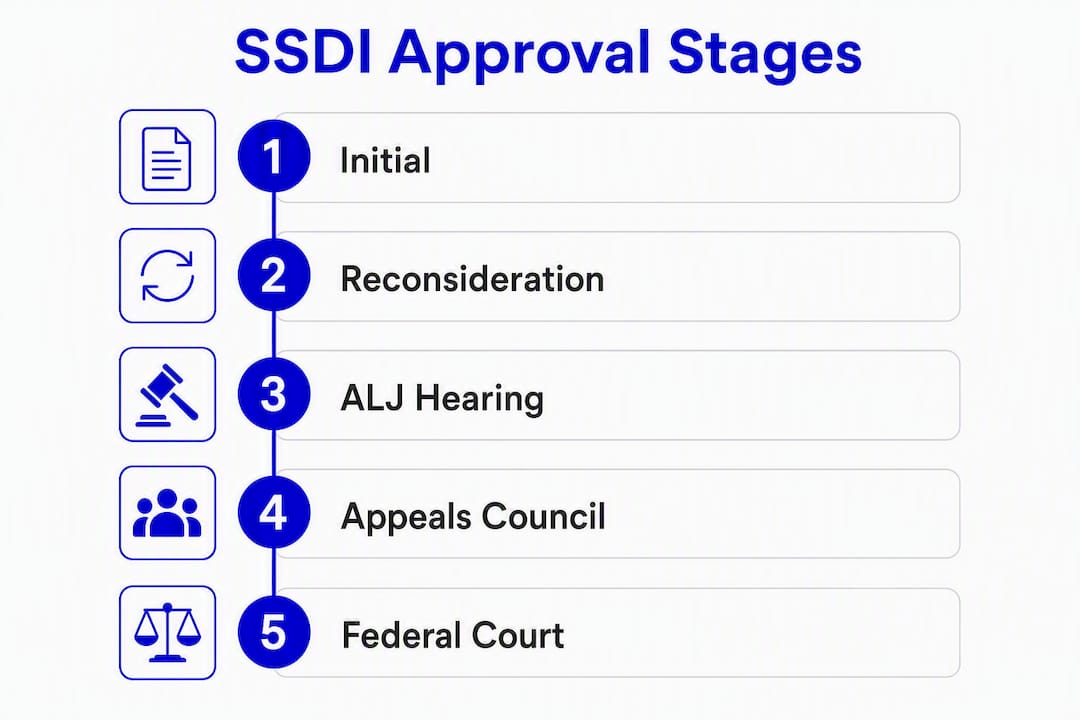
The SSA decision pipeline has five distinct stages. Attorney experience yields different returns at each one.
Initial application
An experienced attorney helps organize medical records, identify the correct onset date, and avoid procedural errors that delay processing. The role of an attorney in onset date claims is particularly significant here, since a disputed onset date can reduce back pay substantially. A novice can handle this stage for a straightforward case. For complex multi-condition claims, a mid-level or senior attorney adds real value from day one.
Best time to hire: Before filing, if your medical situation is complex or you have already been denied elsewhere.
Reconsideration
Most initial denials are upheld at reconsideration. The stage has a low approval rate nationally, and many claimants treat it as a formality before requesting a hearing. An attorney's primary job here is to submit updated medical evidence and preserve the record for the hearing. Experience level matters less at this stage than at the hearing, but an attorney who understands what ALJs look for will build the record with that in mind.
Best time to hire: Immediately after an initial denial, before the 60-day reconsideration deadline.
ALJ hearing
This is where experience yields the largest return. Attorneys with deep ALJ familiarity tailor witness preparation and argument strategy to what a specific judge finds persuasive. They cross-examine vocational experts on job availability data and challenge medical expert opinions on RFC limitations. A claimant who appears without representation at this stage faces a structural disadvantage that statistics confirm.
The hearing is not a formality. An ALJ can question a vocational expert about whether any jobs exist for someone with your specific limitations. An experienced attorney knows how to frame those limitations to narrow the job base or eliminate it entirely. That skill is not learned from a textbook.
Best time to hire: No later than 30 days before the scheduled hearing date, though earlier is always better.
Appeals Council
If the ALJ denies the claim, the Appeals Council reviews the decision for legal error. This stage is largely a written argument. An attorney with federal appeals experience can identify reversible errors in the ALJ's decision and frame them in the legal language the Appeals Council responds to. A novice may miss those errors entirely.
Best time to hire: Immediately after an ALJ denial, before the 60-day filing deadline.
Federal court
Only attorneys may represent claimants in federal district court. Non-attorney representatives cannot take cases to federal court, which is a hard limit. Federal court requires a different skill set: drafting a complaint, briefing the administrative record, and arguing that the ALJ's decision was not supported by substantial evidence. Senior specialists with federal court experience are the appropriate choice at this stage.
Best time to hire: Before the 65-day deadline to file a civil action after an Appeals Council denial.
When should you hire an SSDI attorney, and what will it cost?
Timing and cost are the two practical questions most claimants ask first.
Timing guidance
The clearest answer: hire before your ALJ hearing if you have received any denial. For complex medical cases, hiring before the initial application reduces the risk of procedural errors that delay the process. For cases that have already reached the Appeals Council or federal court, the attorney's experience level becomes the most important variable in the outcome.
How the contingency fee model works
SSDI attorneys work on contingency. You pay nothing upfront. If the attorney wins your case, the SSA withholds the fee directly from your back pay and pays the attorney. If you do not receive back pay, the attorney receives no fee. The contingency model and fee cap mechanics are explained in detail for claimants who want to understand exactly how the math works.
The SSA caps the fee at 25% of back-due benefits, with a maximum of $9,200 as of 2026. The cap applies to the standard contingency agreement approved by the SSA.
| Back Pay Amount | 25% of Back Pay | Fee Paid (SSA Cap Applies) |
|---|---|---|
| $36,800 | $9,200 | $9,200 (cap reached) |
| — | — | $9,200 (cap applies) |
The fee cap protects claimants with large back pay awards. Once your back pay exceeds approximately $36,800, the attorney's fee is fixed at $9,200 regardless of how much you recover. Claimants with long wait times often benefit most from this structure.
Out-of-pocket costs do exist in some cases. Attorneys may charge for medical record retrieval, copying, or expert witness fees. These costs are typically small and are disclosed upfront. Ask any prospective attorney to itemize potential out-of-pocket expenses before you sign a fee agreement.
How do you evaluate an SSDI attorney's experience and fit?
A free consultation is your primary evaluation tool. Use it with specific questions.
Questions to ask
- How many SSDI or SSI cases have you handled in the past three years?
- What percentage of your practice is devoted to disability claims?
- How many ALJ hearings did you personally conduct in the past 12 months?
- What is your hearing-level approval rate, and can you point me to documentation?
- Will you attend my hearing, or will a different attorney or non-attorney representative appear?
- Have you appeared before the ALJ assigned to my case?
- What out-of-pocket costs should I expect beyond the contingency fee?
Red flags
- Any request for upfront payment before the SSA approves a fee agreement.
- Guaranteed outcome promises. No attorney can guarantee an SSDI approval.
- Vague or evasive answers about hearing volume or approval rates.
- Inability to confirm who will appear at your hearing.
- A general practice attorney who cannot name a specific percentage of disability work in their caseload.
Sample consultation script (60–90 seconds)
"I'm calling about SSDI representation. I've [received a denial / not yet filed / have a hearing scheduled]. Before I decide, I'd like to know: what percentage of your practice is SSDI, how many ALJ hearings did you handle last year, and will you personally attend my hearing? I'd also like to understand your hearing-level approval rate and any costs beyond the contingency fee."
That script covers the four variables that most reliably predict attorney quality: specialization depth, hearing volume, personal attendance, and outcome transparency. The track record evaluation tips at Ssdilawyer expand on each of these with additional follow-up questions.
Non-attorney representatives
Non-attorney representatives can handle initial claims and hearings effectively in many straightforward cases. They are a reasonable alternative when the medical record is clear, the disabling condition is well-documented, and the case is unlikely to require federal court review. Their hard limit: they cannot represent you in federal district court. If your case has any realistic chance of reaching that stage, an attorney is the only option.
Pro Tip: Ask any non-attorney representative whether they are accredited by the SSA and whether they carry errors and omissions insurance. Those two facts tell you more about their professionalism than years of claimed experience.
How this article's recommendations were developed
The approval rate figures cited here come from published analyses of SSA hearing-level data and industry summaries that aggregate outcomes across multiple reports. The GAO has published findings on representation and disability outcomes that provide a government-level baseline for the hearing-stage approval gap. State-level and judge-level variance is real: ALJ approval rates differ significantly by hearing office and by individual judge. The national figures cited here are averages.
Local ALJ data matters. The national hearing-level approval rate for represented claimants is a useful benchmark, but your specific ALJ's approval rate may be higher or lower. Ssdilawyer recommends checking your hearing office's data through the SSA's published statistics before your hearing date.
The experience tier definitions in this article are based on practice-based criteria used by disability law resources and consumer guidance, including Nolo and DisabilityFiled, rather than any formal SSA classification. The SSA does not certify or rank attorneys by experience level.
Ssdilawyer's matching criteria prioritize hearing volume, local ALJ familiarity, and contingency fee transparency. Claimants who submit an inquiry receive a referral to counsel that meets those criteria for their specific case and hearing office.
Pro Tip: Before your consultation, pull your local hearing office's ALJ approval rate data from the SSA's published statistics. Knowing your judge's baseline approval rate gives you a reference point when an attorney quotes their own hearing win rate.
Key Takeaways
Experienced SSDI attorneys raise hearing-level approval odds significantly, and the fee is capped under SSA rules, making representation a low-risk decision for most claimants with a denial or complex medical record.
| Point | Details |
|---|---|
| Hearing stage matters most | Represented claimants are approved at substantially higher rates compared to unrepresented claimants at the ALJ hearing level. |
| Fee cap protects claimants | The SSA caps attorney fees at 25% of back pay, with a maximum fee limit set by SSA guidelines. |
| Hire before the hearing | The best time to retain counsel is before your ALJ hearing, ideally immediately after any denial. |
| Evaluate with specific questions | Ask about hearing volume, specialization percentage, personal attendance, and approval rate transparency. |
| Ssdilawyer matches by experience | Ssdilawyer connects claimants with attorneys vetted for hearing volume, local ALJ knowledge, and contingency fee transparency. |
What the data actually tells you about attorney experience
The 62% versus 34% hearing-level approval gap is real, but it is an average. It does not mean every attorney produces that result. The gap between a novice handling their tenth hearing and a senior specialist who has appeared before your specific ALJ dozens of times is not captured in that statistic. What the data confirms is that representation matters. What it cannot tell you is whether the attorney you are considering is operating at the level that produces those results.
The practical implication: the evaluation questions in this article are not optional. Asking an attorney about their hearing volume and local ALJ familiarity is the only way to move from the average to an informed estimate of what your specific representation will produce. An attorney who cannot or will not answer those questions directly is telling you something important about their practice.
The contingency fee structure removes the financial barrier to getting experienced help. With no upfront cost and a fee capped at $9,200, the risk of hiring a qualified attorney is low. The risk of appearing at an ALJ hearing without one is documented.
Ssdilawyer connects you with experienced SSDI attorneys at no upfront cost
Ssdilawyer matches claimants with disability attorneys who meet specific criteria: documented hearing volume, familiarity with local ALJs, and a contingency fee arrangement that complies with the SSA's $9,200 cap. The matching service is free to claimants. You pay nothing unless your attorney wins your case and the SSA awards back pay.
After you submit an inquiry at ssdilawyer.co, the intake process identifies your stage in the SSA pipeline, your hearing office, and the complexity of your medical record. That information is used to match you with counsel suited to your specific situation, not a generic referral. Attorneys in the network work on contingency and are vetted for the experience metrics this article describes.
If you have received a denial or have a hearing scheduled, the time to act is now. Submit your inquiry at ssdilawyer.co and get matched with an experienced SSDI attorney who works on contingency, with no upfront cost to you.
This article provides general information about SSDI representation and attorney experience. It is not legal advice. Consult a qualified disability attorney or the SSA directly to confirm rules and eligibility for your specific situation.
Useful sources and further reading
The following primary and authoritative sources were used in this article. Claimants are encouraged to consult local hearing office data for ALJ-specific approval trends, which can differ substantially from national averages.
- GAO Report GAO-18-37: Social Security Disability — Representation Outcomes
- SSA: Non-Attorney Representatives
- SSA: Disability Benefits Overview
- Ssdilawyer: SSDI Lawyer Approval Rate — How to Check in 2026
- Ssdilawyer: Why Disability Lawyers Work on Contingency
- Ssdilawyer: Disability Attorney Track Record Evaluation Tips 2026