
For a first-time SSDI application or a single-denial reconsideration, a local SSDI-focused attorney or small SSDI boutique firm is the practical choice. For multi-denial cases, complex impairments, onset-date disputes, or any path toward federal court, a licensed attorney at a national or specialized SSDI practice is the appropriate level of representation. The difference is not firm size. It is whether your representative can follow your case all the way to federal litigation if needed.
Before your first consultation, raise three questions:
- Does a licensed attorney handle the ALJ hearing, or does a paralegal or non-attorney representative appear in your place?
- What percentage of the firm's practice is devoted to SSDI specifically, not disability broadly?
- Is the fee agreement in writing, and does it confirm the SSA contingency fee cap of 25% of past-due benefits, with a maximum of $9,200?
Ssdilawyer connects claimants with vetted SSDI attorneys who have been screened on all three points. Submit a case inquiry at Ssdilawyer to get a matched consultation without upfront cost.
Table of Contents
- How do the main SSDI representative types compare?
- What do fees actually cost, and what should you verify?
- Which firm type fits your claim stage?
- What can a licensed attorney do that a non-attorney representative cannot?
- What questions should you ask during an intake call?
- What is the typical SSDI timeline at each stage?
- How does Ssdilawyer match claimants to vetted SSDI attorneys?
- Key Takeaways
- Three selection mistakes that hurt SSDI claims
- Connect with a vetted SSDI attorney through Ssdilawyer
- Useful sources
How do the main SSDI representative types compare?
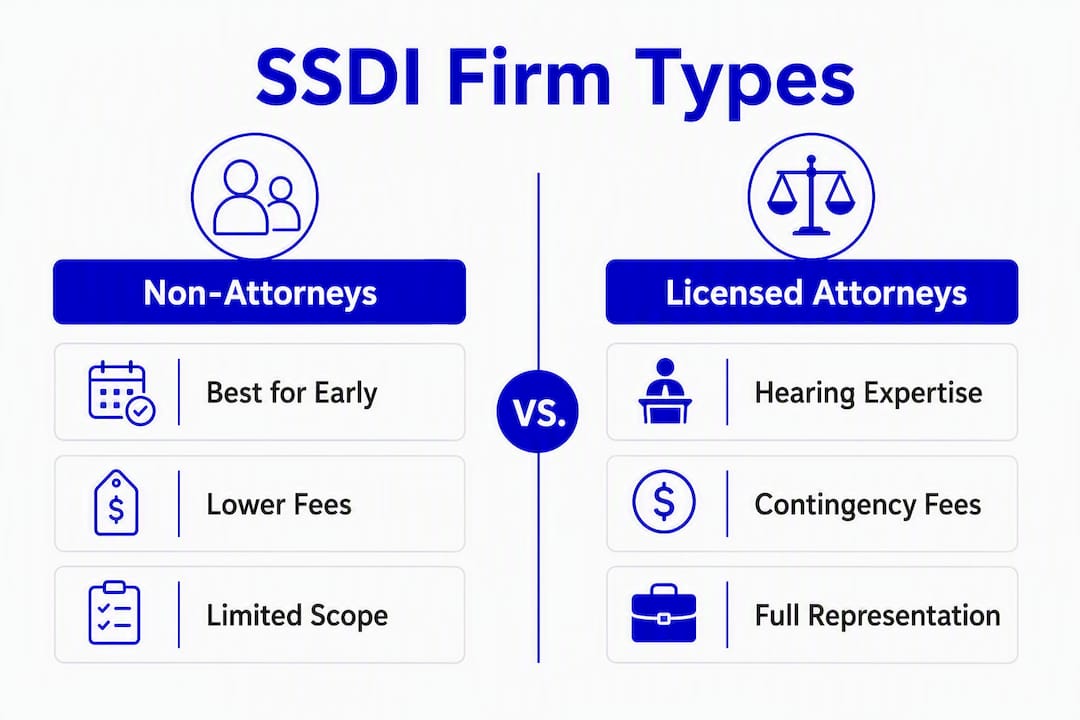
The six representative types differ on four dimensions that actually affect outcomes: who can appear at which stage, what resources they bring, how accessible they are, and what they cost. Local and national firms each carry real trade-offs: in-person access and familiarity with local ALJ tendencies on one side, centralized appellate resources and proprietary hearing-office data on the other.

One point that trips up many claimants: disability law is not one practice area. SSDI/SSI, ERISA long-term disability, VA claims, and workers' compensation each operate under different evidence rules, deadlines, and appeal structures. A firm that handles all four rarely maintains deep competence in any one of them. Match the firm's primary specialty to your program.
| Representative Type | Best for (stage/complexity) | Fee model | Availability | Hearing track record | Scope of representation | Communication |
|---|---|---|---|---|---|---|
| Local SSDI attorney | Initial application, first denial, single impairment | Contingency, SSA cap | In-person, limited geography | Familiar with local ALJ tendencies | ALJ hearings, Appeals Council; federal court if licensed | Direct attorney access; responsive |
| National SSDI firm | Multi-denial, complex impairments, appellate work | Contingency, SSA cap | Phone/video, nationwide | Proprietary ALJ data across offices | Full scope including federal court | Structured; may use case managers |
| SSDI boutique firm | Any stage; high specialization value | Contingency, SSA cap | Regional or national | Deep SSDI-only hearing experience | ALJ hearings, Appeals Council, federal court | High; SSDI is their only focus |
| Solo practitioner | Simple claims, rural areas, clients who want one point of contact | Contingency, SSA cap | Local, limited capacity | Varies widely; verify directly | ALJ hearings; federal court depends on individual | Highly personal; capacity limits apply |
| Non-attorney representative | Initial application, straightforward cases only | Contingency, SSA cap | Varies | SSA-certified; no attorney-client privilege | ALJ hearings and SSA administrative proceedings only; no federal court | Varies |
| Legal aid / nonprofit | Low-income claimants, initial or reconsideration stage | Free or reduced fee | Geographic service area | Varies by organization | ALJ hearings; federal court rare | Case-load dependent; may have waitlists |
Pro Tip: Ask any firm whether the person listed as your representative is the same person who will appear at your ALJ hearing. At some national firms, intake is handled by attorneys but hearings are delegated to non-attorney staff. Get the answer in writing.
What do fees actually cost, and what should you verify?
The Social Security Administration sets a single contingency fee rule that applies to both licensed attorneys and SSA-certified non-attorney representatives: a set percentage of past-due benefits, capped at a federally established maximum, payable only if the claim succeeds. No win, no fee. That cap is not a suggestion; it is a federal ceiling, and the SSA withholds the fee directly from your back pay before releasing the remainder to you.
The cap covers SSA administrative proceedings. Federal court work is a separate matter. If your case escalates to U.S. District Court, some firms charge an additional fee under the Equal Access to Justice Act or a separate retainer. Ask about this before you sign anything.
Practical items to verify in the fee agreement:
- Confirm the contingency percentage matches the SSA cap (25%, no higher).
- Clarify who pays for medical records, consultative exam costs, and expert fees. Some firms absorb these; others bill them as case expenses separate from the contingency fee.
- Ask whether the same fee agreement covers Appeals Council review or only the initial hearing.
- Get the name of the attorney who will represent you at the hearing, in writing.
Pro Tip: During intake, ask: "Does your fee agreement cover representation through the Appeals Council, and are medical record costs included or billed separately?" Any firm that cannot answer both questions directly is worth reconsidering. You can also find SSDI attorneys who charge no upfront fees through vetted matching services.
Which firm type fits your claim stage?
The right representative type shifts as a claim moves through the SSA process. Early stages reward responsiveness and accurate filing. Later stages reward cross-examination skill and appellate experience.
Initial application
A local SSDI attorney or small SSDI boutique firm handles this stage well. The priority is accurate documentation, correct onset-date framing, and meeting SSA deadlines. Errors here create problems that persist through every subsequent stage. A solo practitioner with strong SSDI experience is also a reasonable choice if capacity is not an issue.
After initial denial or reconsideration denial
Most initial SSDI applications are denied. After a reconsideration denial, hiring an attorney before the ALJ hearing is strongly associated with higher approval rates. If you started without representation, this is the point to retain a licensed attorney. A local firm with documented ALJ hearing experience or a national SSDI firm with office-specific data are both appropriate here.
Before an ALJ hearing
This is where firm type matters most. The hearing is adversarial. The ALJ may call a vocational expert or medical expert whose testimony can sink a claim if not challenged effectively. A licensed attorney with hearing experience at your specific ALJ office is the right choice. National and boutique SSDI firms often maintain data on individual ALJ approval tendencies, which shapes hearing strategy directly.

Cases involving multiple impairments, onset-date disputes, or parallel VA or long-term disability claims add complexity that favors a firm with dedicated appellate resources. For onset-date disputes specifically, attorney strategy at this stage directly affects the benefit calculation.
Appeals Council and federal court
If the ALJ denies the claim, the Appeals Council reviews the decision for legal error. If that review fails, the next step is U.S. District Court. Only a licensed attorney can represent you in federal court. A non-attorney representative's authority ends at the SSA administrative level. A national SSDI firm or SSDI boutique with federal appellate experience is the appropriate choice at this stage.
One-sentence scenarios:
- Single impairment, first application, rural location: local solo SSDI practitioner or small firm.
- Two prior denials, complex medical record, upcoming ALJ hearing: national or boutique SSDI firm with office-specific ALJ data.
- ALJ denial, strong legal error argument: licensed attorney at a firm with federal appeals experience.
What can a licensed attorney do that a non-attorney representative cannot?
The practical differences matter most when a case becomes contested or reaches federal court.
Only licensed attorneys can represent claimants in federal court. Both attorneys and SSA-certified non-attorney representatives may appear at SSA administrative proceedings and ALJ hearings, but the authority stops there for non-attorney reps. If a case requires federal litigation, a claimant who started with a non-attorney representative must retain a licensed attorney mid-appeal. That transition disrupts continuity, can delay remedies, and requires a new attorney to get up to speed on an existing record.
Beyond court access, the differences include:
- Attorney-client privilege — Communications with a licensed attorney are protected. Non-attorney representatives are SSA-certified and background-checked, but they do not provide this protection.
For a full breakdown of these distinctions, disability lawyer vs. non-attorney rep covers the authority differences in detail.
To verify credentials: look up the attorney's state bar standing by name on the relevant state bar's public directory. Ask for the attorney's SSA representative ID. Ask what percentage of their practice is SSDI. Ask how many ALJ hearings they have handled in the past 12 months at your specific hearing office.
What questions should you ask during an intake call?
The intake call is a screening opportunity. Use it.
- What percentage of your practice is devoted to SSDI claims specifically?
- Who will appear at my ALJ hearing: a licensed attorney or a non-attorney representative?
- How many ALJ hearings have you handled in the past year at my specific hearing office?
- What are your recent hearing outcomes for cases similar to mine?
- Does your fee agreement cover representation through the Appeals Council, or only the initial hearing?
- Who handles medical records requests and consultative exam scheduling?
- How often will I receive case updates, and who is my primary contact?
- If my case reaches federal court, does your firm handle that, or do I need separate counsel?
Track record verification is a separate step. Evaluating an attorney's hearing record means asking about outcomes at your specific ALJ office, not just national averages. Checking an SSDI lawyer's approval rate by hearing office gives you a concrete benchmark.
Red flags to watch for:
- Any request for upfront fees before a decision.
- Vague or evasive answers about who handles the hearing.
- Inability to name recent ALJ hearing experience at your office.
- A fee agreement that does not specify the contingency percentage in writing.
- A firm that handles SSDI, ERISA, VA, and workers' comp with equal emphasis and no clear primary specialty.
Trust signals that matter:
- Written fee agreement that cites the SSA cap.
- Signed retainer naming the attorney of record.
- Verifiable state bar standing.
- SSA representative ID on file.
- Documented ALJ hearing experience at your specific office.
What is the typical SSDI timeline at each stage?
The SSDI process moves in defined stages, each with its own wait and decision logic.
Initial application. The SSA typically issues an initial decision within three to five months, though processing times vary by state Disability Determination Services office. Most initial applications are denied.
Reconsideration. A claimant has 60 days from the initial denial to request reconsideration. The SSA reviews the same record with a different examiner. Most reconsiderations are also denied. The window to request an ALJ hearing after a reconsideration denial is also 60 days.
ALJ hearing. Wait times for an ALJ hearing have historically ranged from several months to over a year, depending on the hearing office backlog. The hearing itself is the most consequential stage. Evidence submitted before the hearing closes the record; late submissions require ALJ approval.
Appeals Council. After an ALJ denial, the Appeals Council reviews for legal error, not factual re-weighing. Review can take several months to over a year. The Council may deny review, issue a decision, or remand to the ALJ.
Federal court. If the Appeals Council denies review or issues an unfavorable decision, the claimant has 60 days to file in U.S. District Court. This stage requires a licensed attorney.
Pro Tip: Ask your representative at each stage: "What is the current wait time at my hearing office, and what evidence deadlines should I be tracking?" A representative who cannot answer this question for your specific office is not managing your case actively.
For a detailed breakdown of how attorney representation affects approval at each stage, why hiring an SSDI attorney improves approval odds covers the evidence.
How does Ssdilawyer match claimants to vetted SSDI attorneys?
Finding a qualified SSDI attorney independently means screening for specialty, hearing experience, and fee compliance on your own. Matching services filter for those criteria before making an introduction.
Ssdilawyer's matching process works as follows:
- Vetting — Attorneys in the network are screened for SSDI-specific practice percentage, documented ALJ hearing experience, state bar standing, and contingency fee compliance with the SSA cap.
The vetting criteria address the selection risks this article covers: specialty mismatch, non-attorney representation at the hearing stage, and fee agreement gaps. Matching services reduce the time spent on cold searches and lower the risk of hiring a generalist firm that handles SSDI as a secondary practice.
To submit a case inquiry and get matched with a vetted SSDI attorney, visit Ssdilawyer. Additional resources on SSDI legal representation benefits are available on the Ssdilawyer blog.
Key Takeaways
Matching your representative type to your claim stage and case complexity is the single most consequential decision in the SSDI process.
| Point | Details |
|---|---|
| Stage determines firm type | Early claims favor local or boutique SSDI attorneys; ALJ hearings and federal appeals require licensed attorneys with documented hearing experience. |
| SSA fee cap is fixed | The contingency fee is capped at 25% of past-due benefits, up to $9,200, and applies only if your claim is successful. |
| Non-attorney reps have hard limits | SSA-certified non-attorney representatives cannot appear in federal court; switching mid-appeal disrupts case continuity. |
| Ask the right intake questions | Confirm who handles the hearing, what percentage of practice is SSDI, and whether the fee agreement covers the Appeals Council. |
| Ssdilawyer reduces selection risk | Ssdilawyer matches claimants to vetted SSDI attorneys screened for hearing experience, specialty, and fee compliance before introduction. |
Three selection mistakes that hurt SSDI claims
The most common error is not choosing the wrong firm. It is choosing a firm whose specialty does not match the program. A firm that primarily handles ERISA long-term disability claims operates under entirely different evidence rules than one focused on SSDI. The intake process may feel similar. The hearing preparation is not. Ask directly: what percentage of your current caseload is SSDI claims filed with the Social Security Administration?
The second mistake is equating firm size with relevant experience. A large national firm with hundreds of attorneys may assign your case to a non-attorney representative for the ALJ hearing. A solo practitioner with 15 years of SSDI hearings at your specific office may outperform that firm on the one day that matters. Size is a proxy. Hearing experience at your ALJ office is the actual variable.
The third mistake is failing to verify ALJ hearing experience before signing a retainer. Many claimants ask about "experience" and accept a general answer about years in practice or number of cases filed. The question that matters is specific: how many ALJ hearings has this attorney handled at my hearing office in the past 12 months, and what were the outcomes? A firm that cannot answer that question has not been tracking the data that shapes hearing strategy. Finding a disability lawyer with a verified local track record requires asking that specific question, not a general one.
Connect with a vetted SSDI attorney through Ssdilawyer
Comparing SSDI firm types is useful. Acting on that comparison is what moves a claim forward.
Ssdilawyer connects claimants with SSDI attorneys who have been screened for hearing experience, program specialty, and contingency fee compliance before any introduction is made. There is no upfront cost. The contingency model means the attorney's fee comes from your back pay only if the claim succeeds. Matches are stage-appropriate: whether you are filing an initial application, preparing for an ALJ hearing, or facing an Appeals Council review, the attorney you are connected with has documented experience at that stage.
Submit a case inquiry at Ssdilawyer to get matched with a qualified SSDI attorney. Response times vary by location and caseload, but the intake form takes under five minutes to complete.
This article is general information, not legal advice. Confirm current SSA rules and your specific eligibility with the Social Security Administration or a licensed disability attorney.
Useful sources
- Social Security Administration: Disability Benefits — Primary source for SSA fee cap rules, representative authority, and the official definition of disability under SSDI.
- Social Security Administration: Adult Listings (Blue Book) — The SSA's official medical criteria used to evaluate SSDI claims at the listing level.
- Types of Disability Law Firms: Your 2026 Selection Guide (Ssdilawyer blog) — Taxonomy of firm specialties, program differences, and when to use each type.
- Disability Attorney Track Record Evaluation Tips (Ssdilawyer blog) — Checklist for evaluating ALJ hearing records and attorney outcomes by office.