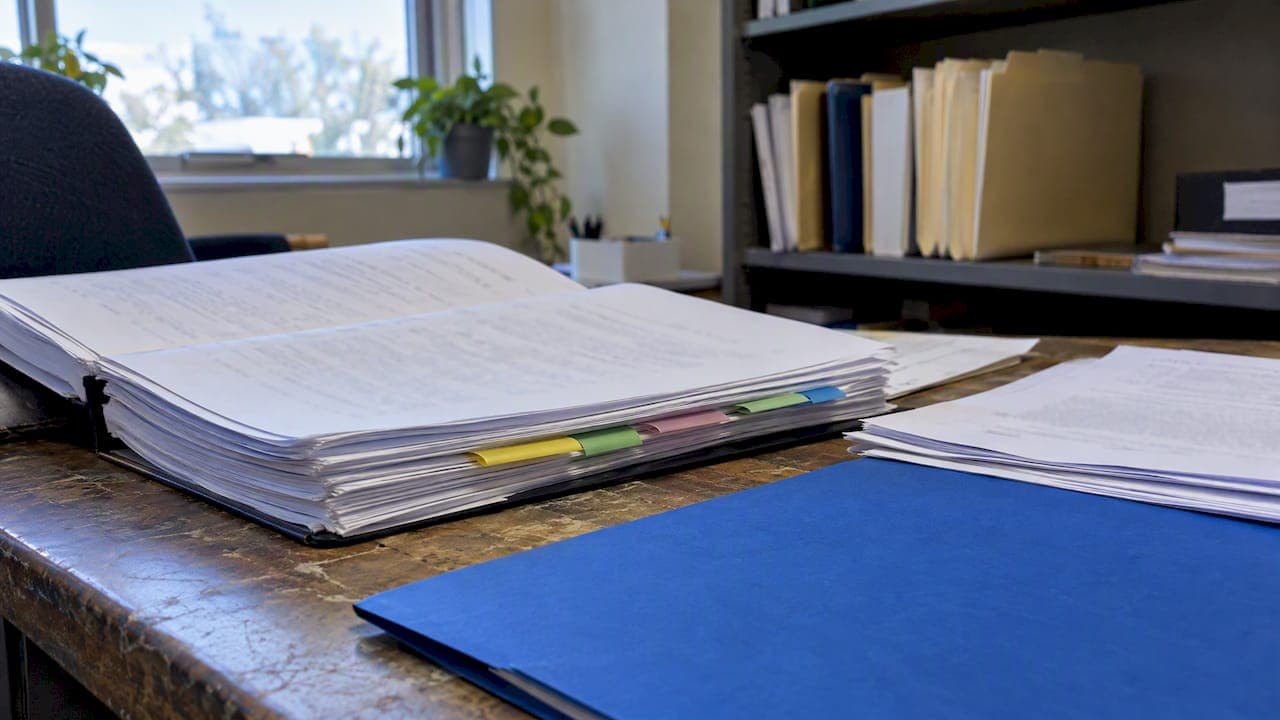
Send a concise, exhibit-cited prehearing brief organized by the SSA five-step evaluation and submit it at least five business days before your hearing, earlier if possible. Gather your key exhibits now and label them clearly. A checklist and a short fill-in template follow so you can build a judge-ready document without missing a required step.
TL;DR:
- Address SSA steps, cite pages proving listing criteria, explain why residual functional capacity rules out past and other work, and briefly contextualize adverse records.
- Send statements and evidence to every party at least five business days before the hearing; late material may be rejected unless a regulatory exception applies.
- Use ARS with OTRRQST for OTR requests; if ARS is unavailable, fax the hearing office cover sheet, since mailed briefs risk missing the deadline.
- Practitioners commonly file two to four weeks early; call the hearing office afterward and retain dated proof of fax or ARS receipt.
- Keep the exhibit index under one page, listing each citation and its page number so the judge can locate evidence quickly.
Table of Contents
- What a prehearing brief does and why the judge reads it first
- Checklist: what to include, organized by SSA's five-step test
- Deadlines, format, and how to submit your brief
- How to organize evidence so the judge can verify it fast
- Sample brief structure and a short fill-in template
- Practitioner notes on common brief mistakes
- Get matched with an attorney who can prepare your brief
- FAQ
- Sources
What a prehearing brief does and why the judge reads it first
A prehearing brief is a short-written document that points the administrative law judge (ALJ) to the exact evidence that supports a favorable decision. It works as a roadmap: before the hearing, a judge who reviews a thin or disorganized file has to hunt for support. A tight brief removes that burden and focuses the judge's initial read on the strongest facts.
The brief also doubles as a vehicle for an On-the-Record (OTR) request, asking the judge to issue a fully favorable decision without holding a hearing at all, under SSA's OTR guidance. Even when a judge declines an OTR request, a well-organized brief still shapes how the hearing review goes. A claimant preparing alongside an attorney often benefits from how counsel structures this case strategy well before the hearing date.

Checklist: what to include, organized by SSA's five-step test
Build your brief around the same sequential evaluation the judge must apply. Address each step the judge is legally required to consider, and point to the record instead of summarizing it from memory.
- Step one and two: state that you are not performing substantial gainful activity and cite the medical exhibits establishing a severe impairment (lab results, imaging, treatment notes).
- Step three: if you meet or equal a listing, name the listing and cite the specific exhibit pages showing each required criterion.
- Step four (RFC and past work): summarize your residual functional capacity using the treating physician's opinion and function reports, then explain why that RFC rules out your past relevant work.
- Step five (other work): address why your RFC, age, education, and work history rule out other work in the national economy, citing vocational evidence where available.
- Unfavorable evidence: name the specific exhibit, give one or two sentences of factual context, and point to stronger evidence elsewhere in the file rather than writing a long rebuttal.
Reference exhibit numbers directly, such as "2F at 14" or "5F, dated March 3, 2025," so the judge can flip straight to the page. A line like "the record supports a finding of disabled as of [onset date] under Step 5" states your requested outcome without extra padding; guidance on onset date evidence can help when onset timing is contested.
Pro Tip: Write one sentence per exhibit citation. If a point needs a paragraph to explain, it probably belongs in testimony, not the brief.
Deadlines, format, and how to submit your brief
Written statements and evidence intended for the judge must reach every party no later than five business days before the scheduled hearing, under HALLEX I-2-6-76. That same floor governs evidence generally under HALLEX I-2-6-58, which allows an ALJ to decline evidence submitted later unless a regulatory exception applies under 20 CFR 404.935(b) or 416.1435(b).
- Submit electronically through Appointed Representative Services (ARS) when registered, selecting the OTRRQST document type for an OTR request.
- Use fax with the hearing office's bar-coded cover sheet when ARS access is not available.
- Mail works but carries the longest delivery risk against the five-day floor.
The five-business-day deadline is a floor, not a target: legal-aid guidance recommends getting missing records and statements to the hearing office well before that cutoff, and practitioners commonly submit briefs two to four weeks ahead according to Oregon Law Help. After submission, call the hearing office to confirm receipt and keep a dated copy of your fax confirmation or ARS submission record.
How to organize evidence so the judge can verify it fast
A judge working through a thick file rewards a brief that makes verification effortless. Number your exhibits consistently with the agency's own exhibit list, group medical records by provider, and place consultative exams and function reports in their own labeled sections.
- Attach a short exhibit index at the top of the brief listing each citation and its page number.
- Write factual statements that point directly to a date and page, such as "treatment notes from 4F, page 22, dated June 2025."
- Address unfavorable records with brief factual context rather than extended argument.
- When requesting an OTR, attach a proposed checksheet matching the format described in POMS procedures for oral decisions.
Pro Tip: Keep your exhibit index to one page. If the judge can find every citation in under a minute, the brief has done its job.
An ALJ who announces a fully favorable oral decision on the record adds a checksheet to the file and later incorporates it into a written decision, a process described in POMS HA 01280.019. A brief that anticipates this format, with a ready-made checksheet, gives the judge less to draft before issuing that decision. Readers building out a fuller case development file will find this exhibit discipline carries over to every stage of the appeal.
Sample brief structure and a short fill-in template
A prehearing brief differs from a brief of law or a post-hearing brief: it is shorter, submitted before the hearing, and aimed at shaping the judge's initial file review rather than responding to testimony already given. Keep the structure tight.
- Caption: claimant name, Social Security number, and hearing date.
- Statement of the case: two to three sentences on alleged onset date and claimed impairments.
- Argument by step: one short section for each applicable sequential-evaluation step, citing exhibits.
- Requested relief: a single sentence, such as "claimant respectfully requests a fully favorable decision, or in the alternative, an On-the-Record decision under the attached checksheet."
- Exhibit index and signature block.
Keep each point to one or two sentences, and keep the full exhibit list under one page. Before sending, confirm the brief is signed, copies went to every party as required under HALLEX I-2-6-76, and you have a receipt confirming the hearing office got it. A representative experienced with ALJ hearings can adapt this template to a specific hearing office's local preferences, which sometimes affect formatting or preferred submission method.
Practitioner notes on common brief mistakes
The most frequent error is burying the requested outcome in a long narrative instead of stating it plainly near the top. The second is citing a condition without pointing to the exhibit that proves it, which forces the judge to search the file instead of verifying the claim. Both fixes take minutes, not hours, and both change how fast a judge can act on a brief.
— Gerard
Get matched with an attorney who can prepare your brief
Claimants can work with experienced SSDI attorneys who build case strategy, organize exhibits, and file compliant prehearing briefs before the five-business-day deadline. The matching process is built for claimants who need legal support quickly, not for readers piecing together a brief alone under a looming hearing date.
An attorney matched through our intake can also handle legal representation tasks beyond the brief itself, including requesting the hearing file and confirming submission with the hearing office. If your hearing date is already set, request a case review at Ssdilawyer now so representation and filing details can be confirmed with time to meet SSA's submission window.
This article is general information, not a substitute for advice from a qualified financial advisor. Consult a qualified financial professional about your own circumstances before acting on anything here.

FAQ
What do you say to win a disability hearing?
State your requested outcome plainly, then support it with exhibit-cited medical evidence organized by the sequential evaluation steps. Judges respond to specific citations, such as exhibit number and page, rather than general descriptions of your condition.
Can you get approved for SSDI without a hearing?
Yes, through an On-the-Record (OTR) request, where a judge reviews the file and issues a fully favorable decision without holding a hearing, as described in SSA's OTR guidance. An OTR request typically includes a brief and a proposed checksheet submitted through ARS using the OTRRQST document type.
What are the most common reasons for an SSDI claim being denied?
Common reasons include insufficient medical documentation of a severe impairment, evidence that does not clearly support the claimed limitations, and gaps between alleged symptoms and the treatment record. A well-organized brief that addresses each sequential evaluation step and cites supporting exhibits directly targets these gaps.
What are the odds of winning an SSDI hearing?
Approval rates vary widely by judge, hearing office, and case specifics, and a single flat percentage does not reflect any individual claimant's chances, as explained in our breakdown of ALJ approval rates. Strong case preparation, including an exhibit-cited prehearing brief, is one of the more reliable levers a claimant and representative control directly.
Sources
- OHO Recommending a Favorable Decision for Your Client | SSA
- POMS: HA 01280.019 - Oral Decisions on the Record (Bench Decisions)
- How to get ready for your Social Security disability hearing | Oregon Law Help