
An SSDI pre-hearing conference (PHC) is a procedural meeting authorized under 20 CFR 404.961 and 416.1461, conducted by an ALJ or authorized designee, to organize the administrative record and resolve logistical issues before your disability hearing. It is not a merits review. The ALJ will not signal how your case will go.
Three things to know immediately:
- Who runs it: An ALJ or an authorized hearing office designee conducts the PHC. Only an ALJ can issue binding orders that affect case merits.
- What it covers: Representation status, evidence gaps, hearing logistics, and required SSA forms such as Form HA-4631 and Form HA-4632.
- What it triggers: Evidence submission deadlines, hearing format selection, and written orders documenting any agreements reached.
The governing SSA rules are POMS HA 01210.075 and HALLEX HA 01210.045. Both are the primary references for how PHCs are conducted and what they may address.
Table of Contents
- Who conducts the PHC and who should attend?
- What topics does the ALJ cover at a PHC?
- When is a PHC scheduled and what notice will you receive?
- How to prepare for your SSDI pre-hearing conference
- What unrepresented claimants should know about a PHC
- What happens after a PHC: common outcomes and next steps
- Dos and don'ts for the PHC and your hearing
- Recent procedural changes affecting PHCs and hearing formats
- Key Takeaways
- Why PHC preparation is the step most claimants underestimate
- Ssdilawyer connects you with SSDI attorneys before the PHC
- Useful sources
Who conducts the PHC and who should attend?
The ALJ assigned to your case has authority to conduct the PHC directly. Under POMS HA 01210.075, the ALJ may also designate a qualified hearing office staff member to run the conference. If a designee conducts the PHC and any agreement affecting the merits of the case is needed, the ALJ must later review and act on it. Only the ALJ can issue binding orders on substantive issues.
Typical attendees:
- The claimant (you)
- Your attorney or non-attorney representative, if you have one
- Hearing office staff
- An interpreter, if one has been requested
Attendance is generally expected. If you cannot attend, contact the hearing office as soon as possible and explain why in writing. The SSA hearing process rules require written notification when a scheduled appearance cannot be kept. You may also request to waive the PHC if you and your representative agree it is not needed for your case.
Pro Tip: If you have an attorney, confirm with them before the PHC whether they will attend on your behalf or whether your presence is also required. Some hearing offices conduct PHCs by phone, which makes attendance easier to arrange.

What topics does the ALJ cover at a PHC?
The PHC is procedural only. POMS HA 01210.075 explicitly prohibits discussing the merits or likely outcome of the claim. Do not expect the ALJ to preview a decision or comment on the strength of your evidence.
Standard topics covered at a PHC include:
- Right to representation: Whether you have an attorney or representative, and whether you need time to obtain one.
- Hearing logistics: Format (phone, video, in-person), scheduling, and location.
- Status of medical evidence: Which records are in the file, which are missing, and what steps are needed to obtain them.
- Required forms: The ALJ or designee will typically ask about Form HA-4631 (Claimant's Recent Medical Treatment) and Form HA-4632 (Claimant's Medications). Both forms document current treatment and medications and must be current.
- Work and school activity: Any new work attempts or educational activity since the alleged onset date.
- Documentation steps: How agreements reached at the PHC will be recorded, typically via an SSA-5002 Report of Contact.
A common example: the ALJ's staff reviews the file and identifies that records from a treating specialist are missing. The PHC becomes the mechanism to set a deadline for submitting those records before the hearing. That kind of gap, identified and resolved early, can change a hearing outcome.
When is a PHC scheduled and what notice will you receive?
Under CFR §498.206, the ALJ has authority to schedule a PHC at their discretion or at the request of a party. A PHC is not automatic in every case. It is used when procedural issues need to be resolved before the hearing can proceed efficiently.
The SSA Handbook §2010 requires written notice of the PHC date, time, place, and purpose at least seven business days in advance, unless you waive that requirement. The PHC typically occurs weeks before the scheduled hearing date, though exact timing varies by hearing office workload and case complexity.
Key scheduling points:
- You may request a different PHC date if the scheduled time conflicts with a medical appointment or other obligation. Contact the hearing office promptly.
- You may request a PHC if you believe unresolved procedural issues need attention before your hearing.
- Receiving a PHC notice is not a signal about the merits of your case. ALJs schedule them to clear administrative bottlenecks.
- If you want to waive the PHC, notify the hearing office in writing. Your representative can do this on your behalf.
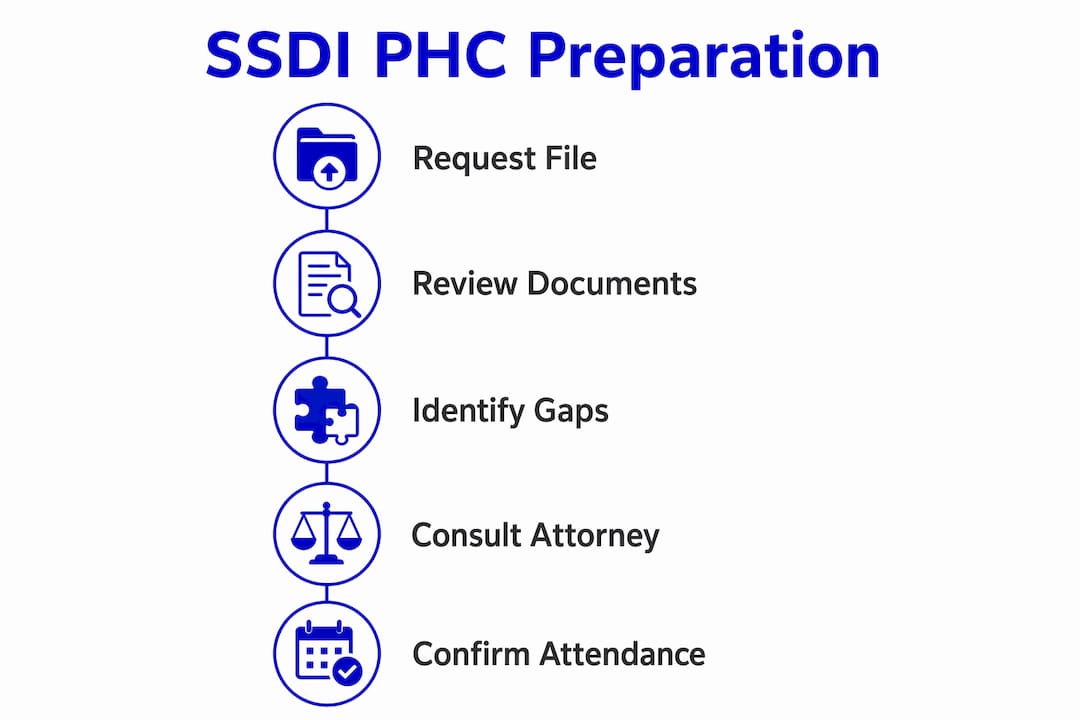
How to prepare for your SSDI pre-hearing conference
Preparation before the PHC is where cases are won or lost. Waiting until the PHC to assemble evidence is a tactical mistake. The PHC is a procedural checkpoint, not the moment to start gathering records.
Step-by-step preparation checklist:
- Request your hearing file. Contact the hearing office and ask for a copy of your complete file. Review it for missing records, outdated medical reports, or incorrect information.
- Update your medical records. Identify treating physicians, specialists, and hospitals with records not yet in the file. Contact those providers and request records promptly.
- Complete Form HA-4631 and Form HA-4632. Form HA-4631 documents recent medical treatment; Form HA-4632 lists current medications. Both should reflect your current status at the time of the PHC.
- Gather lay witness statements. Written statements from family members, caregivers, or others who observe your daily limitations can support your testimony.
- Compile updated work and school reports. Any work attempts, vocational rehabilitation, or school activity since your alleged onset date should be documented.
- Prepare questions for the PHC. Ask about the hearing format, exhibit exchange deadlines, witness logistics, and any outstanding evidence requests.
- Confirm representation. If you have an attorney, confirm they have your complete updated records. If you do not, the PHC is the point at which the ALJ will address your right to representation.
Legal aid guides recommend requesting your hearing file months before the hearing and submitting missing evidence at least one month before the hearing date when possible.
Pro Tip: Do a brief run-through with your attorney before the PHC. Confirm which records are still outstanding, agree on what questions to raise, and clarify who will speak on your behalf during the conference.
What unrepresented claimants should know about a PHC
If you do not have an attorney, the PHC takes on additional importance. The ALJ or designee will address your right to representation directly. You are not required to have an attorney, but the PHC is the right moment to ask for time to find one if you want counsel.
Practical steps for unrepresented claimants:
- Ask the ALJ or designee to explain any procedural step you do not understand. Request clarification in writing if needed.
- Document any agreements or deadlines the ALJ states during the PHC. Write them down during the call.
- Submit any missing records as soon as possible after the PHC. Do not wait for a follow-up notice.
- Ask the hearing office what forms you still need to complete and confirm the submission deadline.
- If you want an attorney but have not found one, tell the ALJ at the PHC and request additional time. The ALJ has discretion to allow a short extension.
Free and low-cost legal help is available through legal aid organizations in most states. You can also learn more about winning an SSDI appeal without a lawyer if representation is not an option. That said, SSDI legal representation at the hearing stage consistently improves case outcomes.
What happens after a PHC: common outcomes and next steps
The PHC produces a record. Under POMS HA 01210.075, the hearing office completes an SSA-5002 Report of Contact to document what was discussed and agreed. The PHC recording becomes part of the official case record.
Common PHC outcomes:
- Evidence deadlines set. The ALJ specifies when outstanding records must be submitted.
- Hearing format confirmed. The assigned format (phone, video, in-person) is confirmed or adjusted.
- Orders issued. If the ALJ agreed to take action, a written order is issued. Get a copy.
- Issues narrowed. In some cases, the ALJ may clarify or narrow the specific issues to be addressed at the hearing.
- Hearing rescheduled. If significant evidence is still missing, the hearing may be postponed.
After the PHC, do these things:
- Submit all agreed evidence by the stated deadline.
- Confirm the hearing format and date in writing with the hearing office.
- Follow up if you do not receive written confirmation of any orders within a reasonable time.
- Review the SSA-5002 if you can obtain a copy, and flag any discrepancies to your representative.
Dos and don'ts for the PHC and your hearing
| Do | Don't |
|---|---|
| Confirm all agreements on the record during the PHC | Ask the ALJ to predict the outcome of your case |
| Ask for deadlines and orders in writing | Accept legal advice from non-authorized hearing office staff |
| Bring updated Form HA-4631 and Form HA-4632 | Discuss the merits of your claim during the PHC |
| Clarify the hearing format and exhibit exchange process | Submit last-minute evidence without prior notice to the hearing office |
| Request time to obtain representation if you need it | Assume verbal agreements are binding without written confirmation |
Sample questions to ask at the PHC:
- "What is the deadline for submitting outstanding medical records?"
- "Which hearing format has been assigned, and how do I object if needed?"
- "Are there any exhibits in the file I have not yet seen?"
- "What witnesses, if any, will the ALJ call at the hearing?"
- "Is there anything else the hearing office needs from me before the hearing date?"
Recent procedural changes affecting PHCs and hearing formats
A significant rule change established four standard hearing formats as equal options: in-person, telephone, agency video, and online video. When your hearing request is processed, the SSA sends a Notice of Ways to Attend that specifies your assigned format and includes forms to object or agree to specific methods.
Check that notice immediately. If the assigned format would prevent meaningful participation, file your objection in writing and promptly. Waiting until the PHC to raise a format objection puts you at a procedural disadvantage.
The PHC is often the last structured opportunity to resolve format disputes before the hearing date is locked. If you want an in-person hearing and have been assigned a phone or video format, raise it at the PHC and document the request.
ALJ approval rates at the hearing stage vary, with outcomes driven primarily by complete medical records and credible testimony. The PHC is the mechanism that helps ensure your records are complete before you sit down with the judge. For more on how approval rates vary and what they mean for your case, see Ssdilawyer's guide to SSDI lawyer approval rates.
Key Takeaways
An SSDI pre-hearing conference is a procedural record event that sets evidence deadlines, confirms hearing logistics, and protects your right to representation before the ALJ hearing.
| Point | Details |
|---|---|
| PHC is procedural only | The ALJ cannot discuss merits or predict outcomes; use the PHC to resolve logistics and evidence gaps. |
| Seven-day notice required | SSA must provide written notice at least 7 business days before the PHC unless you waive it. |
| Submit evidence early | Request your hearing file months out and submit missing records at least one month before the hearing. |
| Get agreements in writing | PHC outcomes are documented via SSA-5002; confirm any orders or deadlines in writing after the conference. |
| Ssdilawyer matches you with counsel | Ssdilawyer connects claimants with experienced SSDI attorneys who can prepare you for the PHC and the hearing. |
Why PHC preparation is the step most claimants underestimate
Most claimants treat the PHC as a formality. That is a mistake. The PHC is where the administrative record gets shaped before the hearing, and the decisions made there, about which records to submit, which format to use, and which deadlines to accept, directly affect what the ALJ sees on hearing day.
The cases that go poorly at the hearing stage often have a common thread: evidence that was available but never submitted, or a format that made testimony harder to deliver. Both of those problems surface at the PHC and can be fixed there. By the time the hearing starts, it is too late to correct them cleanly.
Claimants who arrive at the PHC with their file reviewed, their forms completed, and their questions prepared are in a fundamentally different position than those who treat it as a scheduling call. The PHC is not the hearing, but it determines the conditions under which the hearing happens.
Ssdilawyer connects you with SSDI attorneys before the PHC
The PHC is a procedural event with real consequences for your hearing. Having an experienced disability attorney before that conference, not after, is the difference between arriving prepared and scrambling to catch up.
Ssdilawyer matches claimants with disability attorneys who handle SSDI hearings and PHC preparation. The matching service is free to use. After you submit a case inquiry, Ssdilawyer connects you with an attorney experienced in your type of claim who can review your file, complete required forms, and represent you at the PHC and hearing. No upfront cost to get matched. To get started, visit Ssdilawyer.co and submit a free case inquiry today.
Useful sources
The following official and legal-aid references cover the rules and procedures discussed in this article:
- SSA POMS HA 01210.075: The primary SSA policy rule governing PHC purpose, conduct, topics, recording requirements, and documentation procedures. Start here.
- HALLEX I-2-1-5: Hearing office procedural guidance on when to schedule a PHC and related hearing procedures.
- CFR §498.206: The federal regulation establishing ALJ authority to schedule PHCs and issue orders based on PHC agreements.
- SSA Handbook §2010: Covers notice requirements, recording procedures, and the administrative steps that follow a PHC.
- SSA Hearing Process Overview: The SSA's official explanation of the full hearing process, including the Notice of Ways to Attend and format options.
- Oregon Law Help: Preparing for Your SSDI Hearing: Practical legal-aid guidance on requesting your file, submitting evidence, and hearing preparation steps.
- DisabilityFiled: SSDI ALJ Hearing Guide: A practical overview of the ALJ hearing stage, including approval rate context and preparation strategy.
This article is general information about the SSDI pre-hearing conference process, not legal advice. Rules and procedures can change. Confirm current requirements with the SSA directly or consult a qualified disability attorney for guidance on your specific case.